
Piazza Navona is famous for two things: its long oval shape, which follows the track of the Stadium of Domitian, built in 86 AD, and its Baroque art, above all Bernini’s Fountain of the Four Rivers and Borromini’s church of Sant’Agnese in Agone. It is a free public square in Rome’s historic center, open day and night.
Cover photo: Meshari Alawfi, CC BY 4.0, via Wikimedia Commons
What is Piazza Navona? It is the long Baroque square in the heart of Rome, a few minutes’ walk from the Pantheon. It began as an ancient stadium, became a market and a stage for festivals, and in the 17th century turned into the showcase of Pope Innocent X and his family, the Pamphilj, with works by the two great rivals of Roman Baroque, Gian Lorenzo Bernini and Francesco Borromini. We are a local tour operator in Rome, and Piazza Navona is on many of our golf cart and Fiat 500 routes. This guide covers its history, its three fountains and the famous legend about them, the church and the palace on the square, the stadium underneath, the Christmas market, and practical tips for your visit.
Why is Piazza Navona famous?
- Its shape. The square keeps the shape and size of the track of an ancient stadium, built by Emperor Domitian in 86 AD. The buildings around it stand on the remains of the stadium, which is why the square is long and narrow, with one rounded end.
- Its Baroque art. In the 1640s and 1650s Pope Innocent X Pamphilj (pope from 1644 to 1655) rebuilt the square around his family palace. Bernini designed the Fountain of the Four Rivers, and Borromini completed the church of Sant’Agnese in Agone, so you see the work of the two rivals side by side.
- Its three fountains. The Fountain of the Four Rivers stands in the middle, the Fountain of the Moor at the south end and the Fountain of Neptune at the north end.
- Its life. For centuries the square was the stage of popular festivals, races and jousts, according to Turismo Roma, the City of Rome’s tourism website. Today it is a favorite meeting place for Romans and visitors, and every December it hosts Rome’s traditional Christmas market.

What was Piazza Navona before it became a square?
In ancient times this area was part of the Campus Martius, the flat land inside the bend of the Tiber. Here Emperor Domitian built a stadium for the Certamen Capitolinum, games in honor of Jupiter modeled on the Greek Olympic Games, with running, wrestling, boxing and the pentathlon. It opened in 86 AD. You can read more in our guide to the Stadium of Domitian.
The name comes from the Latin agones, “games”, as Turismo Roma explains: over the centuries the area “in agone” became “Navona”. When the stadium fell into ruin, houses rose on its stands, and the open space in the middle kept the shape of the track. In 1477 the city market moved here from the foot of the Capitoline Hill, and in the 1570s Pope Gregory XIII had the architect Giacomo della Porta build two fountains at the ends of the square.
The great change came with Innocent X. During his ten years as pope, his family palace, the church of Sant’Agnese and the Fountain of the Four Rivers turned the square into a Baroque stage.
Have you read about sea battles in Piazza Navona? The ancient stadium was built for athletics, not for mock naval battles (the naumachia). The water came much later: from the 17th to the mid-19th century, on Saturdays and Sundays in August, the square, which then had a concave floor, was partly flooded to cool off the Romans and entertain them.
| When | What happened |
|---|---|
| 86 AD | Domitian’s stadium opens, for athletic games |
| Middle Ages | Houses rise on the ruins of the stands; the open space keeps the shape of the track |
| 1477 | The city market moves here from the Capitoline Hill |
| 1570s | Giacomo della Porta builds the fountains at the two ends, for Pope Gregory XIII |
| 1648–1651 | Bernini builds the Fountain of the Four Rivers for Innocent X |
| 1652–1657 | The church of Sant’Agnese in Agone is built, completed by Borromini |
| 17th to mid-19th century | On August weekends the square is partly flooded |
| 1870s | Statues are finally added to the Fountain of Neptune |
| 1936 | Remains of the stadium come to light at the north end |
| 2021 and 2024 | The Fountain of the Four Rivers is restored |

What is the Fountain of the Four Rivers?
The Fountain of the Four Rivers (Fontana dei Quattro Fiumi) is the large fountain in the middle of the square, in front of Sant’Agnese. Innocent X wanted it to crown the square where his family palace was rising, and it replaced a simple 16th-century trough. In 1647 the pope gave Borromini the job of bringing more water from the Acqua Vergine aqueduct, the same aqueduct that feeds the Trevi Fountain, and decided to move an obelisk here: a Roman copy made in Domitian’s time, which lay broken in the Circus of Maxentius on the Appian Way. After a competition, the commission went to Bernini, who had presented a silver model of his design, according to the Sovrintendenza Capitolina, the City of Rome’s office for its monuments.
Bernini and a large team of artists built the fountain between 1648 and 1651, and it was unveiled on 12 June 1651. A travertine cliff, hollowed by a grotto with four openings, carries the granite obelisk. On top of the obelisk sits a bronze dove with an olive branch, the emblem of the Pamphilj family, which also appears on the two papal coats of arms on the cliff.
At the corners sit four marble giants, one for each continent known at the time, each with an animal or plant from its land. Bernini designed them and four sculptors carved them:
- The Danube (Europe), by Antonio Raggi, with a horse.
- The Ganges (Asia), by Claude Poussin, with a long oar and a dragon.
- The Nile (Africa), by Giacomo Antonio Fancelli, with a veiled head, because no one knew where the river’s source was, and a lion and a palm tree.
- The Río de la Plata (America), by Francesco Baratta, with one arm raised, perhaps to shield himself from the sun, and an armadillo.
The fountain was restored in 2021 and again in 2024. During the last restoration, part of the Danube’s left index finger, missing since the 1980s, was rebuilt with the help of old photographs. For Rome’s other famous fountains, see our guide to the fountains of Rome.

Is the story about Bernini and Borromini true?
It is a legend, and a good one. Bernini and Borromini were rivals for most of their careers, and Roman guides love this story about the fountain:
- The Nile covers its head so as not to see Borromini’s church of Sant’Agnese, right in front of it.
- The Río de la Plata raises its hand as if the church’s façade might fall on him.
- St Agnes, in the statue on the façade, puts her hand on her chest, as if to promise that the church will stand.
Turismo Roma tells the legend and also explains why it cannot be true: the fountain was finished in 1651, before Borromini took over the church in 1653. The real reason for the Nile’s veil is simpler: in the 17th century, no one knew where the river began.

What are the Fountain of the Moor and the Fountain of Neptune?
The two fountains at the ends of the square are older than the Four Rivers. Giacomo della Porta built them for Pope Gregory XIII in the 1570s, after the restoration of the Acqua Vergine aqueduct brought water back to this part of Rome.
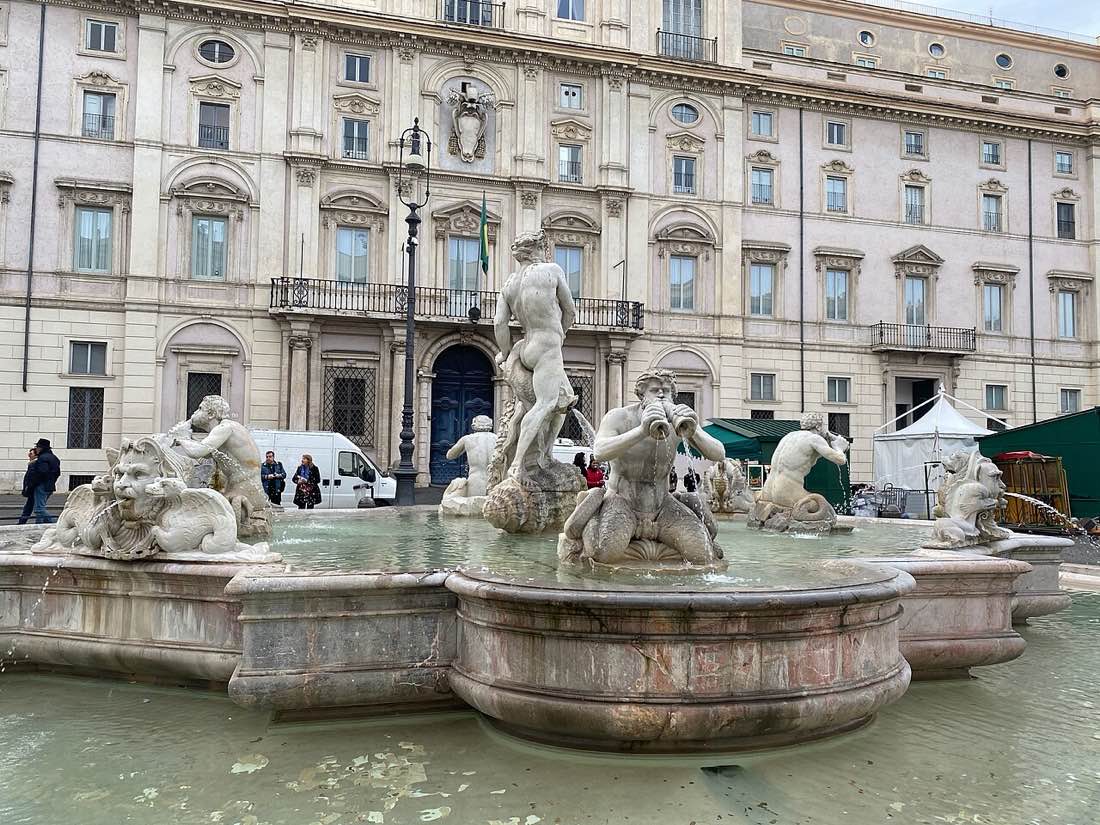
The Fountain of the Moor (Fontana del Moro) stands at the south end, in front of Palazzo Pamphilj. Della Porta’s basin of pink-veined portasanta marble dates from 1575, and its tritons, dragons and masks are copies made by Luigi Amici in 1874. Innocent X asked Bernini to renew the fountain, and in 1655 a new statue was placed in the middle: the Moor, carved by Giannantonio Mari to Bernini’s design, holding a dolphin by the tail. Turismo Roma adds a curious detail: Bernini’s first idea, a group with dolphins and a shell known as “the snail”, did not please Olimpia Maidalchini, the pope’s sister-in-law, and ended up in the gardens of Villa Pamphilj, where it still is.
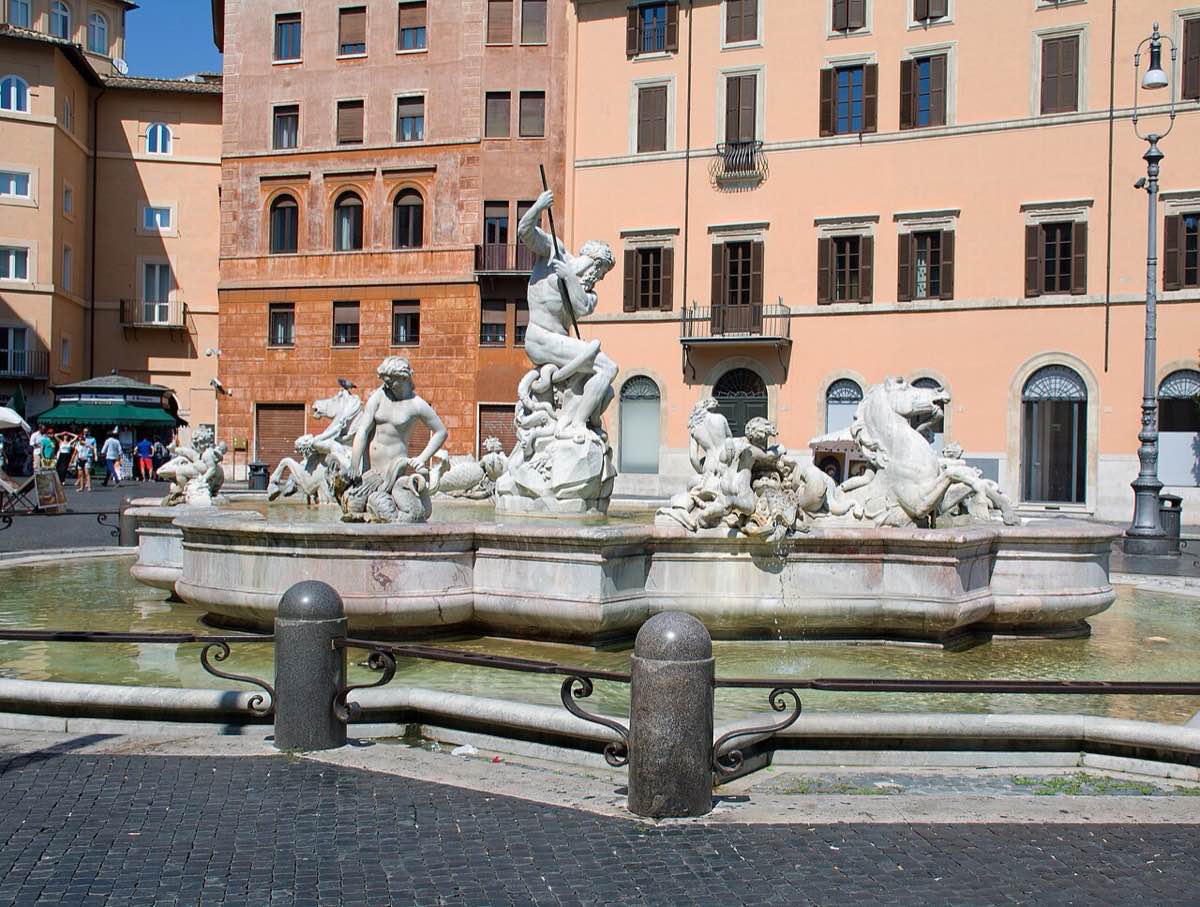
The Fountain of Neptune (Fontana del Nettuno), at the north end, was once called the Fontana dei Calderari, after a nearby alley full of pot makers’ workshops. Bernini removed its steps and railing and gave it a larger basin, but for about 300 years it had no statues at all. Only in the 1870s, after a competition held by the City of Rome, did it receive its sculptures: Neptune fighting an octopus, by Antonio Della Bitta, and the nereids, sea horses, cupids and dolphins by Gregorio Zappalà.
| Fountain | Where | When | Who |
|---|---|---|---|
| Fountain of the Moor | South end, in front of Palazzo Pamphilj | Basin 1575; the Moor 1655 | Giacomo della Porta; Giannantonio Mari to Bernini’s design |
| Fountain of the Four Rivers | Center, in front of Sant’Agnese | 1648–1651 | Gian Lorenzo Bernini and his team |
| Fountain of Neptune | North end | Basin 1570s; statues 1870s | Giacomo della Porta; Antonio Della Bitta and Gregorio Zappalà |

What is inside Sant’Agnese in Agone?
The church on the west side of the square is dedicated to St Agnes, a young Roman martyr. According to the legend, she was exposed naked here, in the ancient stadium, because she was a Christian, and her hair grew miraculously to cover her.
The church you see today was begun in 1652 by Girolamo and Carlo Rainaldi for Innocent X. A year later Borromini took over (1653–1657) and changed the design, with the concave façade and the tall dome. The twin bell towers follow his plans. Inside, the church has a Greek cross plan, with gold and marble, a dome frescoed by Ciro Ferri and pendentives painted by Baciccia. Innocent X is buried here with other members of his family, in a crypt to the left of the main altar. Below the church, in an old medieval oratory, a marble relief by Alessandro Algardi shows the miracle of St Agnes’s hair.
- Hours: Tuesday to Friday 9:00–13:00 and 15:00–19:00; Saturday and Sunday 9:00–13:00 and 15:00–20:00; closed on Mondays, according to the church’s website.
- Crypt: the church’s website has a page to book a guided visit of the crypt.

What is Palazzo Pamphilj, and can you go inside?
Palazzo Pamphilj is the long palace next to Sant’Agnese, on the west side of the square. Innocent X had it built to join the family’s older houses into one great palace, to a design by Girolamo Rainaldi, while the square and the church took shape around it. Here lived Olimpia Maidalchini, the pope’s sister-in-law and adviser, a favorite target of Pasquino’s satires: the talking statue just behind the palace called her “Olim pia”, Latin for “once pious”.
Since 1960 the palace has been the Embassy of Brazil, which is why you see the Brazilian flag on the façade. Inside are rooms frescoed by 17th-century painters such as Pietro da Cortona, Agostino Tassi and Giacinto Brandi, and a gallery designed by Borromini, with scenes from the life of Aeneas painted by Pietro da Cortona. According to Turismo Roma, the embassy offers free guided visits on Mondays and Wednesdays, for individual visitors only, and you must book in advance through the embassy’s booking page.
What is under Piazza Navona?
Under the square lie the remains of the Stadium of Domitian, opened in 86 AD. It was the only masonry stadium in ancient Rome, with room for about 30,000 spectators, and its track was more than 260 m long. That is why the square is long and narrow, with a rounded north end. The ruins lie about 4.5 m below today’s street level.
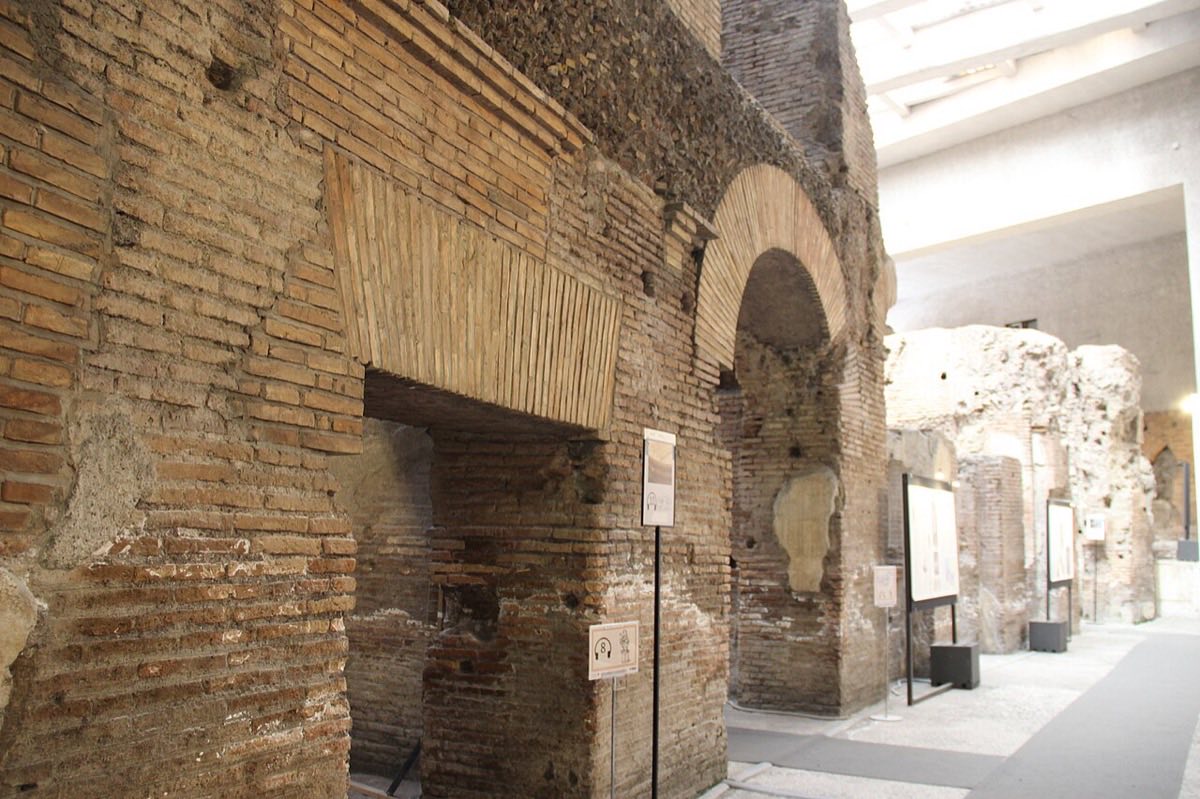
At the north end, the remains came to light in 1936, when old houses were demolished, and were incorporated into the modern building on Piazza di Tor Sanguigna, where you can see part of the ancient structure from the street. The underground archaeological site, at Via di Tor Sanguigna 3, is normally open as a museum, but on 1 November 2026 Turismo Roma listed it as closed for restoration. For its history and the latest news, see our guide to the Stadium of Domitian.
When is the Christmas market in Piazza Navona?
Every winter Piazza Navona hosts the Festa della Befana, Rome’s traditional Christmas market, named after the Befana, the kind witch who brings sweets to Italian children on the night before Epiphany. According to the City of Rome’s official notice for the market stalls, the market runs from 1 December to 6 January every year, until January 2028. For the 2026–27 season, that means 1 December 2026 to 6 January 2027. The City had not yet published a program or opening hours for this season when we checked.
Expect stalls with crafts, nativity figures, wooden toys and sweets around the fountains. The season traditionally ends on 6 January with the Befana’s arrival in the square, although in 2026 the City canceled the firefighters’ Befana descent because of a weather alert. For Christmas lights, nativity scenes and other events, read our guide to Christmas in Rome.

How do you visit Piazza Navona?
Piazza Navona is free and always open. It is a public square, so there are no tickets, no hours and no booking. Only the church, the embassy and the stadium site have their own rules, as explained above.
- When to go: early in the morning, when the square is almost empty and the light is soft, or in the evening, when the fountains are lit. Midday and weekend afternoons are the busiest times (our experience).
- How long to stay: half an hour is enough to walk the square and look at the three fountains; add time if you visit Sant’Agnese.
- Underfoot: the square is paved with sampietrini, Rome’s traditional cobblestones. Wear comfortable shoes, and read why they are called sampietrini.
- Cafés: the cafés and restaurants on the square charge for the view; a street or two away, prices are usually lower (our experience).
- Crowds: as in every busy place in Rome, keep an eye on your bags.
There is no metro station near Piazza Navona. Many buses stop along Corso del Rinascimento and Corso Vittorio Emanuele II, the two big streets east and south of the square, but lines change often, so check your route in a journey planner. The easiest way is on foot:
The free Nemo audio guide app explains Piazza Navona and the Fountain of the Four Rivers on its Rome itineraries.
| From | On foot (our estimate) |
|---|---|
| Pantheon | about 5 minutes |
| Campo de’ Fiori | about 7 minutes |
| Castel Sant’Angelo | about 12 minutes |
| Trevi Fountain | about 15 minutes |
| St Peter’s Square | about 20–25 minutes |
| Colosseum | about 30 minutes |

What else can you see near Piazza Navona?
- Pasquino, Rome’s most famous talking statue, at the corner of Palazzo Braschi, just off the south end of the square. Romans have hung anonymous satirical verses on it for centuries; read about it in our guide to the talking statues of Rome.
- Palazzo Braschi, the palace at the south end, now home to the Museo di Roma, the City’s museum of Rome’s history and art.
- Caravaggio’s paintings in two churches a few minutes away: the three paintings of St Matthew in San Luigi dei Francesi and the Madonna of Loreto (or of the Pilgrims) in Sant’Agostino. See our guide to where to see Caravaggio in Rome.
- The Pantheon, about 5 minutes away on foot: our guide to the Pantheon explains tickets and hours.
- Our Lady of the Sacred Heart, the church on the east side of the square, once called San Giacomo degli Spagnoli and built for the Jubilee of 1450.
See Piazza Navona with us
Piazza Navona is free and easy to visit on your own. Our tours help if you want to see it together with the other sights of central Rome, without long walks. On the rides the sights are seen from the outside, and our drivers are drivers, not licensed tour guides.
- Private golf cart tour: the 3-hour version includes Piazza Navona, the Pantheon and the Trevi Fountain, together with the Colosseum, the Circus Maximus and quieter corners such as the Orange Garden. It costs €450 for 1–3 people, then €150 per person, with a Trevi Fountain ticket and a stop for gelato or coffee. Start times: 9:30, 10:00, 14:30, 18:00 or 18:30. The 2-hour version (November to mid-April) covers fewer stops and costs €350 for 1–3 people, then €115 per person.
- Shared golf cart tour: a fixed route from our office at Via del Colosseo 11A, at 9:30 or 14:30. The 2-hour tour passes Piazza Navona and the Pantheon and ends at the Trevi Fountain, for €59 per person; the 3-hour tour, for €99 per person, adds more sights and ends back at the office. The carts take up to 7 people, shared with other travelers.
- 90-minute golf cart tour with audio guide: a shared ride on a fixed route past the Colosseum, Piazza del Popolo, Piazza Navona, the Pantheon and the Trevi Fountain, with an audio guide in 12 languages in the free Nemo app (bring your own headphones). €35 per person, with seven departures a day between 9:00 and 19:00 from Via del Colosseo 11A, where the tour also ends.
- Dolce Vita Fiat 500 tour: 3 hours in a restored original Fiat 500 converted to electric, on a private route planned around your interests; a typical route includes Piazza Navona, the Pantheon and the Spanish Steps. A Trevi Fountain ticket and a short food stop are included. From €590 for 1–3 people, €1,180 for 4, then €240 per person from 5.
- At night: on the golf cart tour by night you choose the places, such as Piazza Navona, from €450 for 1–3 people at 20:00. Rome by night in a vintage Fiat 500 can include Piazza Navona too, from €590 for 1–3 people at 20:00. Both cost more at later start times.
- Golf cart tour + catacombs: 4 hours from 9:30, every day except Monday. The driver passes Piazza Navona, where you see some remains of the Stadium of Domitian from the outside, then drives to the Appian Way and the San Sebastiano Catacombs; add the optional catacombs ticket (€12 per person) for a guided visit of about 40 minutes. €590 for 1–3 people, then €200 per person, up to 15 travelers. On weekends our driver changes the route, and the catacombs close for their annual break from 7 to 27 December 2026. The same tour in a vintage Fiat 500 costs €790 for 1–3 people, €1,580 for 4, then €295 per person. Both are non-refundable once we confirm them. More on the catacombs in our catacombs guide.
Good to know on all these tours:
- Groups: the golf cart tours and the Dolce Vita tours take up to 21 guests guaranteed (on the 2-hour private golf cart tour, the maximum depends on the start time), with larger groups on request. The catacomb tours take up to 15 travelers, and the 90-minute tour up to 7 per booking.
- Pickup: private tours pick you up in the historic center; if you stay further out, we meet at our office, Via del Colosseo 11A. Shared tours start only from the office.
- Children: golf carts take children of any age, except the 90-minute tour (from age 4). Child seats are available on private golf cart tours only. A folded stroller fits on board our private and shared golf carts (just tell us when you book), but not on the 90-minute tour. Fiat 500 tours take children aged 3 and over, with no child seats: the cars are restored originals, and some have no seat belts, because they were built before seat belts were required.
- Weather: the golf carts have rain covers and run in the rain. In rain or wet weather, the Fiat 500 tours run in golf carts; if none is available, we offer another date or time.
- Cancellation: full refund if you cancel at least 72 hours before the tour, 50% if you cancel at least 48 hours before; later cancellations and no-shows are not refunded. The two catacomb tours are non-refundable once we confirm them.
| Tour | Piazza Navona | Length | Price |
|---|---|---|---|
| On your own | As long as you like | Your choice | Free |
| Private golf cart tour (ours) | Included in the 3-hour version | 2 hours (November to mid-April), 3 or 5 hours | from €350 for 1–3 people |
| Shared golf cart tour (ours) | On the fixed route | 2 or 3 hours | €59 per person |
| 90-minute golf cart tour with audio guide (ours) | On the fixed route | 90 minutes | €35 per person |
| Dolce Vita Fiat 500 tour (ours) | On the typical route | 3 hours | from €590 for 1–3 people |
| Golf cart tour by night (ours) | If you choose it | 2 hours | from €450 for 1–3 people |
| Golf cart tour + catacombs (ours) | Passed on the way, with stadium remains seen from the outside | 4 hours | €590 for 1–3 people |
See all our golf cart tours in Rome, our vintage Fiat 500 tours in Rome and our night tours.
Explore it with us
 Private Golf Cart Tour of Rome3 hours with pickup in the center, including Piazza Navona, the Pantheon and the Trevi Fountain · from €450 for 1–3 peopleBook now
 Dolce Vita Tour in a Vintage Fiat 5003 hours on a private route, usually with Piazza Navona, plus a Trevi ticket and a food stop · from €590 for 1–3 peopleBook now
 Golf Cart Tour + San Sebastiano Catacombs4 hours from 9:30, not on Mondays: Piazza Navona, the Appian Way and the catacombs · €590 for 1–3 peopleBook now
FAQ
Why is Piazza Navona famous?
For its shape and its art. The square follows the track of the Stadium of Domitian, built in 86 AD, which explains its long oval form. In the 17th century Pope Innocent X turned it into a Baroque showcase, with Bernini’s Fountain of the Four Rivers and Borromini’s church of Sant’Agnese in Agone facing each other.
When was Piazza Navona built?
In stages. The stadium underneath opened in 86 AD, and houses later rose on its ruins, keeping the shape of the track. The square as you see it today took shape mostly between 1644 and 1657, starting under Pope Innocent X, while the statues of the Fountain of Neptune were added only in the 1870s.
Is Piazza Navona free, and is it open at night?
Yes to both. It is a public square with no tickets and no opening hours, so you can visit it at any time. Early morning is the quietest time, and in the evening the fountains are lit. Only Sant’Agnese, Palazzo Pamphilj and the stadium site have their own hours and rules.
Did Bernini make the Nile cover its face so as not to see Borromini’s church?
No, it is a legend. The fountain was finished in 1651, before Borromini took over Sant’Agnese in 1653. The Nile’s head is veiled because in the 17th century no one knew where the river’s source was. The story survives because Bernini and Borromini really were rivals.
When is the Christmas market in Piazza Navona?
The Festa della Befana runs from 1 December to 6 January every year, according to the City of Rome’s official notice for the market stalls, so the 2026–27 edition runs from 1 December 2026 to 6 January 2027. When we checked, the City had not yet published opening hours for this season.
Can you visit the Stadium of Domitian under Piazza Navona?
Not at the moment: on 1 November 2026 Turismo Roma listed the underground site, at Via di Tor Sanguigna 3, as closed for restoration. You can still see part of the ancient structure from the street on Piazza di Tor Sanguigna, at the north end of the square. Check our Stadium of Domitian guide for updates.

Comment (0)