
A Hidden Treasure: Exploring Rome’s Jewish Quarter
Rione XI – Sant’Angelo hosts Rome’s Jewish Quarter, one of the capital’s hidden treasures. This small neighborhood is rich in archaeological, cultural, and religious heritage. Moreover, its culinary specialties have had a strong influence on traditional Roman cuisine.
Historically, Rome’s Jewish Quarter ranks among the oldest in the world, with only Venice’s (established in 1516) predating it. It began in 1555 by order of Pope Paul IV. At that time, authorities required residents to live within the quarter. Residents also had to carry a distinctive sign marking them as part of the Jewish community. Authorities prohibited residents from trading and from owning real estate.
Transformation Over Time
Throughout its history, authorities dissolved the area several times, usually for brief periods, before imposing new confinements. This cycle continued until 1870, when the breach of Porta Pia and the end of papal rule brought about its final closure.
Then, in 1904, community members celebrated the inauguration of the Tempio Maggiore, the Great Synagogue, with great pomp. This event firmly established the synagogue as a cultural landmark for the entire Jewish community. Today, the synagogue, along with the Jewish Museum inside, stands as one of the area’s main attractions.
Remembering the Past: The Persecution of the Jewish Community
During World War II, Nazi-Fascist forces persecuted the Jewish community in the Jewish Quarter, culminating on October 16, 1943, in the largest roundup of Jews in Roman history. Today, brass plaques called Memorie d’inciampo (“stumbling stones”) honor those deported to Nazi death camps. Artisans engraved each plaque with the name of someone who never returned. These small memorials remind us of a past that we must not forget.
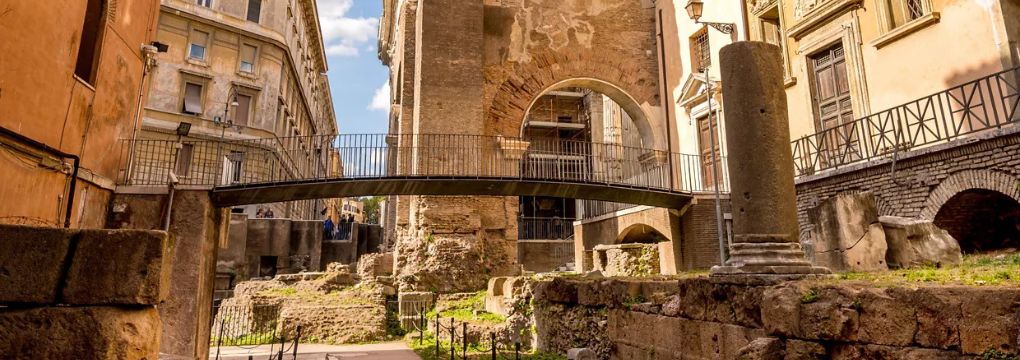
Monuments and Sites of Interest
The area features several notable monuments. These include the Portico d’Ottavia and the Church of Sant’Angelo in Pescheria, which builders constructed within the ancient fish market on the remains of the Portico d’Ottavia. Visitors can also see Lorenzo Manilio’s house and the Church of San Gregorio in Divina Pietà. The community dedicated this church to Pope Gregory the Great, who granted Jews freedom of worship as early as the 16th century. Other highlights include the Pons Judaeorum (Bridge of the Jews) and the Ponte dei Quattro Capi, which connects the Jewish Ghetto to Tiber Island. The area also features the Church of Santa Maria in Campitelli, where people prayed during World War II. Lastly, visitors can admire the beautiful Turtle Fountain, which many attribute to Bernini.
For a leisurely stroll, visitors can explore the picturesque streets and squares. Streets like Via della Reginella, Via di Sant’Ambrogio, and Via del Tempio provide beautiful scenery. Meanwhile, Piazza delle Cinque Scole and Piazza dei Cenci also offer perfect spots for photography.
A Taste of Jewish-Roman Cuisine
Finally, one of the main reasons people visit the ghetto today is to sample the delicacies of Jewish-Roman and kosher cuisine. Popular dishes include carciofi alla giudia (Jewish-style artichokes), ricotta and sour cherry tart, filetti di baccalà (fried salt cod), and tortino di aliciotti e indivia (anchovy and endive pie). Many local establishments serve these rich traditional Jewish-Roman dishes, along with treats from renowned pastry shops, including Rome’s only Austrian bakery. Additionally, they offer fusion recipes that blend traditional Jewish cuisine with international flavors.

Comment (0)