
Caravaggio in Rome: A Guide to His Life and Where to See His Masterpieces
If you love art, drama, or just a good story, Caravaggio is a name you can’t miss when visiting Rome. His paintings feel alive, shocking, and theatrical — much like the life he lived. Let’s dive into his story and then take a walk through the Eternal City to see where his most famous works still hang today.
A Life Full of Light and Shadows
Michelangelo Merisi, better known as Caravaggio, was born in Milan on September 29, 1571, the feast day of Saint Michael. His family had ties to the small town of Caravaggio in Lombardy, which is where his nickname comes from.
As a teenager, he trained in the workshop of Simone Peterzano, a painter influenced by Titian. By the early 1590s, he had arrived in Rome. At the time, the city was buzzing with new projects such as the rebuilding of ancient basilicas and the completion of Saint Peter’s. Nevertheless, Caravaggio often preferred taverns and backstreets over elegant salons.
Rise Under Cardinal del Monte
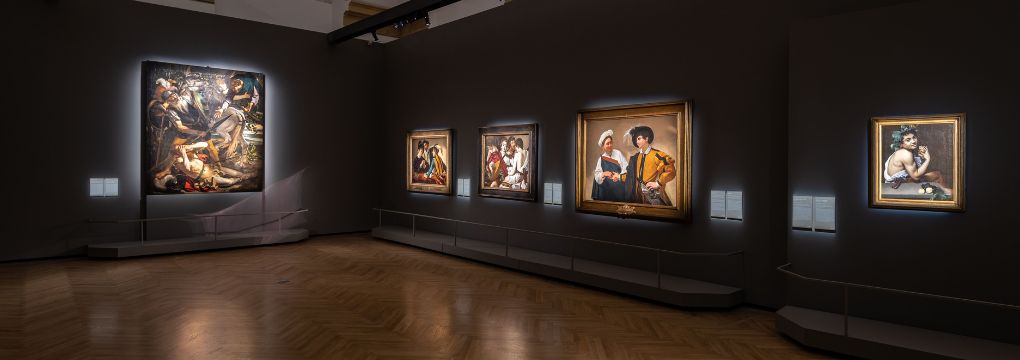
While working for Cavalier d’Arpino, he mostly painted flowers and fruit. However, fate intervened when Cardinal Francesco del Monte noticed his talent and invited him to live in Palazzo Madama. Thanks to this support, Caravaggio began experimenting with naturalism and dramatic light. For instance, The Fortune Teller and Boy with a Basket of Fruit already revealed his unique eye for realism.
Breakthrough Commissions
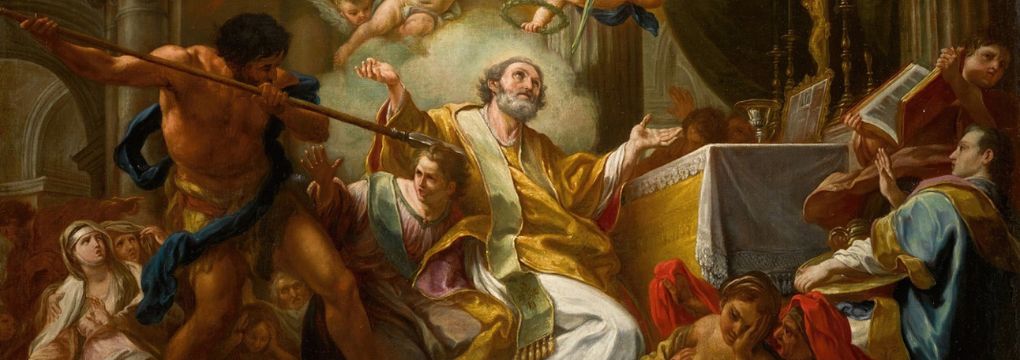
By 1600, Caravaggio received his first major commission: decorating the Contarelli Chapel in San Luigi dei Francesi. He painted The Martyrdom of Saint Matthew, The Calling of Saint Matthew, and later Saint Matthew and the Angel. These paintings shocked audiences because they showed saints as ordinary men, with dirty feet and wrinkled skin. On the other hand, they also dazzled viewers with theatrical shafts of light, setting a new standard in European painting.
Success and Scandal
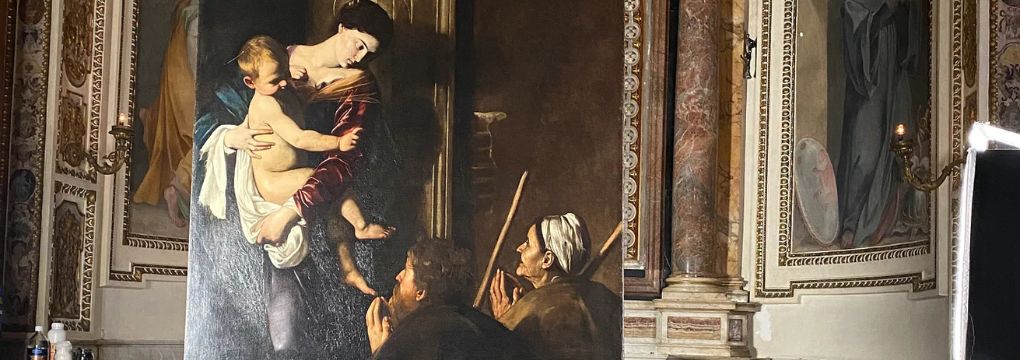
Soon after, Monsignor Cerasi commissioned works for Santa Maria del Popolo, and the Mattei family requested pieces like Saint John the Baptist and Supper at Emmaus. For the church of Sant’Agostino, Caravaggio painted The Madonna of the Pilgrims, which scandalized many because of the peasants’ calloused feet.
Nevertheless, his growing fame could not stop his turbulent lifestyle. In 1606, a quarrel escalated into a duel that left one man dead. As a result, Caravaggio was forced to flee Rome.
Exile and Final Years
Over the next four years, he wandered from Naples to Malta and Sicily. During this time, he created masterpieces such as The Seven Works of Mercy, The Beheading of Saint John the Baptist (his only signed work), and The Raising of Lazarus. Finally, in 1610, he attempted to return to Rome to secure a pardon. Tragically, he died of fever on the beach at Porto Ercole, only 38 years old.
Why Caravaggio Still Matters
Caravaggio was not interested in polished ideals; instead, he painted life as it really was. His saints look like ordinary people — workers, beggars, or courtesans — and his dramatic use of light inspired generations of artists after him.
Therefore, if you are in Rome, walking through the churches and galleries that house his works is one of the best ways to experience the city. You will see both its sacred beauty and its raw humanity, just as Caravaggio saw it.
Where to See Caravaggio in Rome Today
Fortunately, Rome remains the best city in the world to admire Caravaggio’s genius. Below is a practical guide to all the major places where you can find his masterpieces.
🖼️Galleria Borghese – Piazzale Scipione Borghese, 5
Home to six Caravaggio paintings, this gallery showcases his early and late career side by side. Don’t miss:
- Young Sick Bacchus and Boy with a Basket of Fruit — intimate, early works (one thought to be a self-portrait).
- Madonna of the Palafrenieri — rejected for indecency but now a highlight.
- Saint Jerome — depicted as a scholar.
- David with the Head of Goliath — a haunting self-portrait in Goliath’s severed head.
- Saint John the Baptist — a dark, introspective late work.
🖼️Casino Ludovisi – Via Lombardia, 46
This Renaissance villa holds Caravaggio’s only mural: Jupiter, Neptune and Pluto (c. 1597). Painted in an alchemical lab, it shows gods in bold foreshortening — a rare ceiling experiment by the artist.
🖼️Palazzo Barberini – Via delle Quattro Fontane, 13
Part of the National Gallery of Ancient Art, it houses:
- Narcissus — the mythological youth entranced by his own reflection.
- Judith Beheading Holofernes — shocking, raw, and unforgettable.
- Saint Francis in Meditation — painted during Caravaggio’s troubled years on the run.
🖼️Galleria Doria Pamphilj – Via del Corso, 305
A private collection where you’ll find:
- Penitent Magdalene — criticized at the time for being “too real.”
- Rest on the Flight into Egypt — one of Caravaggio’s rare landscapes, mixing peace with drama.
🖼️Capitoline Museums – Piazza del Campidoglio, 1
Here you’ll see:
- The Fortune Teller — a gypsy slyly stealing a ring as she tells a young man’s fortune.
- Saint John the Baptist — sensual and provocative, painted for the Mattei family.
⛪ Church of San Luigi dei Francesi – Piazza di San Luigi de’ Francesi
This is one of the absolute must-sees: the Contarelli Chapel cycle with three masterpieces of Saint Matthew.
- The Martyrdom of Saint Matthew — violent, chaotic, illuminated by divine light.
- The Calling of Saint Matthew — Christ’s hand and a shaft of light summon the tax collector.
- Saint Matthew and the Angel — the final altarpiece, showing the saint inspired by divine guidance.
⛪ Church of Sant’Agostino – Piazza Sant’Agostino, 80
Here hangs The Madonna of the Pilgrims — scandalous at the time for showing peasants with filthy, calloused feet kneeling before the Virgin.
⛪ Church of Santa Maria del Popolo – Piazza del Popolo, 12
Inside the Cerasi Chapel, you’ll find:
- The Conversion of Saint Paul — with Paul sprawled on the ground beneath a horse.
- The Crucifixion of Saint Peter — an old man hoisted upside-down by workers.
🖼️ Vatican Pinacoteca – Musei Vaticani, Viale Vaticano
The Entombment of Christ (c. 1600–04) is one of Caravaggio’s grandest works, full of grief and humanity. It was once looted to Paris, but thankfully returned in 1816.
🖼️ Galleria Corsini – Via della Lungara, 10
Here you’ll find another Saint John the Baptist — stripped of traditional symbols, shown instead as a youthful, almost pagan figure.

Comment (0)