
The Arch of Constantine: Rome’s Biggest Triumph Arch
Walk near the Colosseum and you can’t miss a massive stone monument standing just a few steps away. You’re looking at the Arch of Constantine, the largest surviving honorary triumphal arch from ancient Rome. Size is only part of the story, though. The arch works like ancient “public relations”: it sells a political message, shows off a curated mix of imperial art, and even demonstrates one of Rome’s earliest famous habits of reusing older monuments to build something new.
You’ll find it right along the traditional route of Roman triumphal processions, on the stretch between the Circus Maximus and the Arch of Titus. Emperors once paraded here after major victories, surrounded by crowds and celebration. That location wasn’t an accident. Rome placed the arch where people would see it repeatedly—right in the city’s “celebration corridor.”
What it celebrates: one victory, one turning point
Roman builders raised the Arch of Constantine to celebrate Emperor Constantine’s victory over Maxentius on October 28, 312 AD, after the Battle of the Milvian Bridge (Ponte Milvio).
A few years later, the monument received its official dedication in classic Roman style. The inscription on the central vault explains that the Senate dedicated the arch to Constantine in memory of that triumph. It also marked the decennalia, the celebration at the start of the tenth year of his reign, on July 25, 315 AD.
So the arch does two jobs at once: it remembers a victory and publicly confirms Constantine as the legitimate ruler.
A “new” arch made from older emperors
This is where the arch gets especially fascinating.
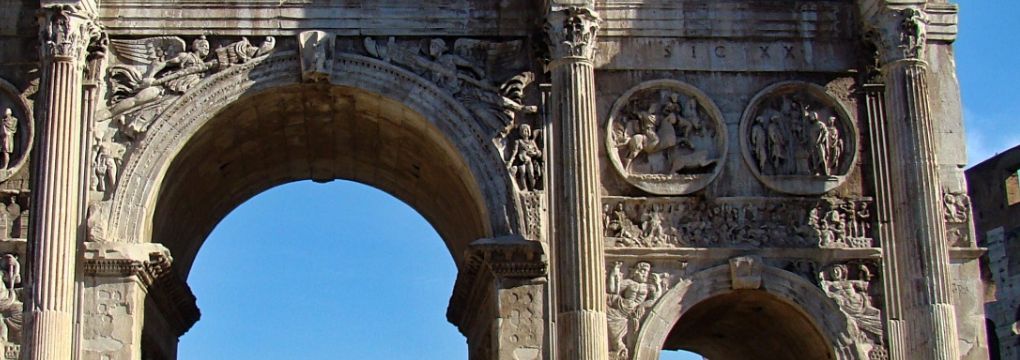
Constantine’s team planned a unified decorative program for the monument, but they built it mostly by reusing marble reliefs and architectural pieces taken from older imperial monuments. Picture a grand architectural collage made from the golden ages of earlier emperors. Across the arch, you can spot reused elements from the periods of:
- Trajan
- Hadrian
- Marcus Aurelius
- and, in the lower sections, Constantine himself
Artists arranged these pieces in symmetrical patterns on the main fronts and sides, almost like someone curated the “greatest hits” of imperial Rome.
This reuse later became common for centuries—especially through the Middle Ages—so many people view the arch as an early example of systematic recycling. At the same time, it preserves something rare: a single monument that blends over two centuries of official Roman art.
The detail that changes everything: the recarved faces
Look closely and you’ll notice one of the arch’s boldest tricks.
Sculptors recarved the emperors’ faces in older reliefs to match Constantine’s likeness. They even gave him a nimbus (a halo-like symbol) to underline his imperial majesty.
It feels daring—and a little unsettling. Politically, though, it works perfectly. Constantine steps into the visual space of Rome’s greatest rulers, as if the past itself leads straight to him.
What you actually see on the arch
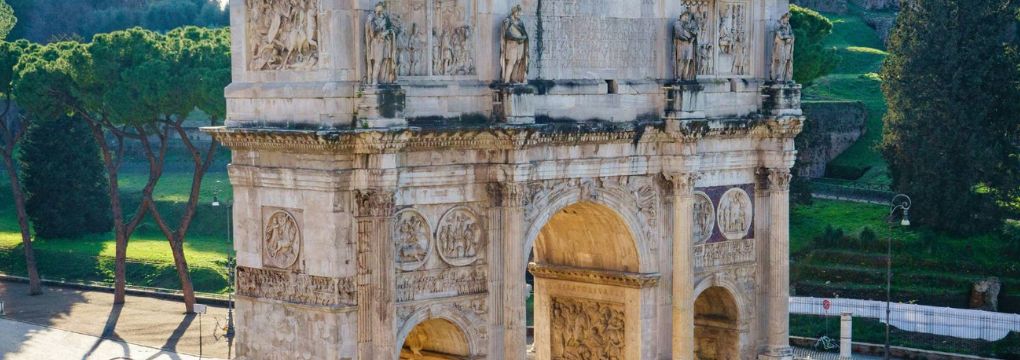
The Arch of Constantine rises to about 25 meters and features three arches:
- The central arch is the widest and carries rich relief decoration on every side.
- Above the smaller side arches, reliefs show Constantine’s campaign against Maxentius.
- Higher up, Hadrianic tondos (round reliefs) depict hunting and sacrificial scenes.
Then your eyes move to the attic (the top section), which turns the monument into an open-air museum:
- Eight Dacian statues (from Trajan’s Forum) stand out above, flanking the long inscription.
- Large panels from the time of Marcus Aurelius show episodes connected to the Germanic war.
- Allegorical figures decorate the bases of the Corinthian columns.
Scan from bottom to top and you travel through layers of Roman imperial storytelling—stitched together to serve one central message.
The “single thread” behind all those images
Even with art from different eras, the arch follows a clear theme: Constantine as the restorer of the empire.
The reused images act like visual proof. By surrounding himself with the language of celebrated rulers and classic triumph scenes, Constantine presents himself as:
- the rightful winner over Maxentius
- the new arbiter of Rome’s destiny
- the strong leader who will restore stability to the empire
To deliver that message, he picked a monument type deeply rooted in Roman tradition: the triumphal arch. The structure tells his victory story, and the borrowed masterpieces of earlier emperors help legitimize his power.
Later life: fortress walls, restorations, and missing pieces
Time didn’t end the arch’s story—later Romans kept reshaping it.
In the mid-12th century, the Frangipane incorporated the monument into their fortress, turning ancient architecture into medieval defense. From the late 15th century onward, restorations followed through the 16th century, and workers returned again in 1733, adding extensive repairs where parts had gone missing.
So today you see a mix: ancient Rome, Renaissance restoration, and centuries of preservation choices layered together.
Nearby: the ghost of the Meta Sudans
Near the arch once stood the Meta Sudans, a monumental fountain built in the Flavian age. Its name describes it beautifully:
- “meta” refers to its conical shape, like the turning markers in a Roman circus
- “sudans” points to water that seemed to “sweat” and gush from it
The fountain stayed in use until roughly the 5th century AD, when changes in the area began to obstruct the water outflow canals. In the 1930s, fascist-era urban projects demolished the remaining ruins to create Via dei Trionfi.
The arch still stands today—but the fountain that once helped frame the scene has vanished.
Why the Arch of Constantine still hits different
Many ancient monuments impress us because they survived. This one impresses because it thinks ahead.
Yes, it celebrates a victory. More importantly, it delivers a carefully crafted statement:
- “I am Constantine. I won. I belong to Rome’s greatest legacy. And the empire’s future is mine.”
He didn’t whisper that message. He carved it into stone, placed it on the triumph route, filled it with powerful imagery, and ensured Rome would read it for centuries.
Next time you pass it, take the photo—but give it an extra minute. The details reveal one of the smartest political monuments the ancient world ever produced.
Go beyond the photo
If this monument catches your attention, there’s a much richer way to experience it.
With us, you can pair a guided visit of the Colosseum and Roman Forum with a Private Golf Cart Tour or Dolce Vita Tour around the city, combining deeper historical insight with a more relaxed and panoramic way of seeing Rome. It’s a great way to connect the Arch of Constantine to the wider story of ancient Rome while also enjoying the city in style.


Comment (0)