
Walk through Rome, and you’ll see them—if you know where to look.
At a street corner, on the wall of an old building, or set into the edge of a palace, you might spot a small sacred image. Most often it’s the Virgin Mary. Sometimes it’s so simple that people pass by without even noticing it.
Romans have a name for them: Madonnelle.
It’s an affectionate name, and it says a lot. These small shrines are not just religious decorations—they are part of the everyday life of the city, a reflection of a deep, popular, street-level devotion that has shaped Rome for centuries.
A Tradition That Begins in Ancient Rome
Even though the Madonnelle are clearly Christian, their roots go much further back.
In ancient Rome, small shrines were placed at crossroads and intersections. These were dedicated to the Lares Compitales, protective deities—possibly of Etruscan origin—who were believed to guard places where two or more streets met.
The idea was simple but powerful: every crossing needed protection.
Over time, as Christianity spread, these ancient figures were replaced by images of the Virgin Mary. But the purpose remained the same. The crossroads were still watched over—only now, by a different kind of presence.
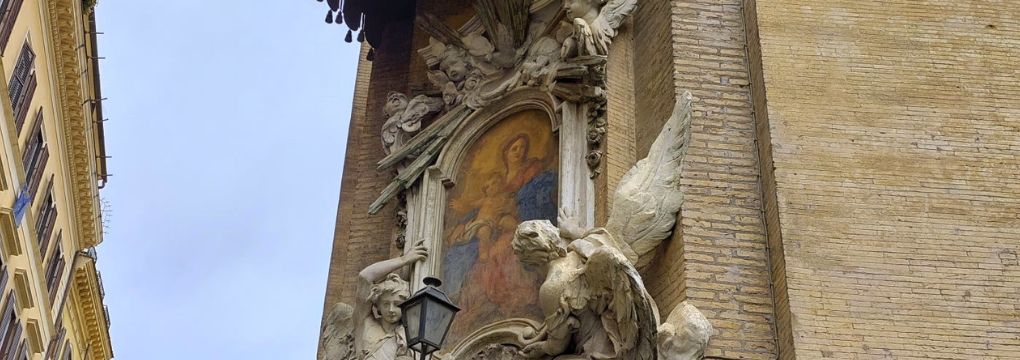
Hundreds Remain, But There Were Once Thousands
Today, around 500 Madonnelle can still be found in Rome. But in the past, there were thousands.
They were often surrounded by ex voto offerings—small objects left by the faithful in gratitude for prayers answered or protection received. Each one was a sign of a personal story, a moment of faith, a silent “thank you.”
Until the early 20th century, the people of each neighborhood—the rioni—took care of these shrines themselves. They made sure candles and oil lamps were always lit. And those lights were not only symbolic.
They had a very practical function: illuminating the streets. Without them, many of Rome’s narrow alleys and winding lanes would have been completely dark at night. In this way, the Madonnelle didn’t just offer spiritual comfort—they literally helped people find their way.
Small Shrines, Real Works of Art
Madonnelle are incredibly varied. They can be:
- Mosaics
- Frescoes
- Oil paintings
- Sculptures in marble or terracotta
The oldest ones that survive today mostly date from between the 17th and 19th centuries, often in Baroque or Neoclassical styles.
Many are surprisingly elaborate. You might see decorative baldachins, flowing drapery, fringes, bows, scrolls, columns, and even small cherubs (putti) surrounding the image.
And yet, despite their beauty, most of them were created by anonymous craftsmen.
Time has damaged many of them, but each one remains a small work of art—with its own story to tell. Some stories speak of miracles, others of sacrilege, and many of graces believed to have been granted.
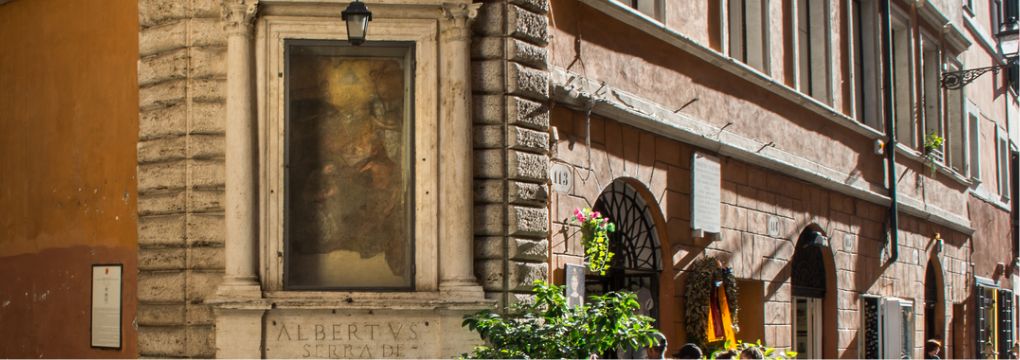
The Oldest Madonnella: Imago Pontis
Among all of them, one stands out.
The “Imago Pontis”—meaning “Image of the Bridge”—is the oldest known Madonnella in Rome. It stands on Via dei Coronari, and it is so well known that it gave its name to that stretch of the street.
It dates back to 1523 and was commissioned by Alberto Serra da Monferrato.
The project involved major artists:
- The architectural design was by Antonio da Sangallo the Younger
- The painting was created by Perin del Vaga, who depicted the Coronation of the Virgin
The quality of the work was so high that Giorgio Vasari himself mentioned it in his famous Lives of the Artists.
When a Shrine Becomes Too Important for the Street
Some Madonnelle became so important that they were eventually moved indoors, into churches or chapels.
- One example is the Madonna of Strada Cupa.
Originally painted on a wall at the foot of the Janiculum Hill, it became associated with so many miracles that it was eventually transferred to the Basilica of Santa Maria in Trastevere.
It’s a reminder that these weren’t just images—they were believed to be active presences in people’s lives.
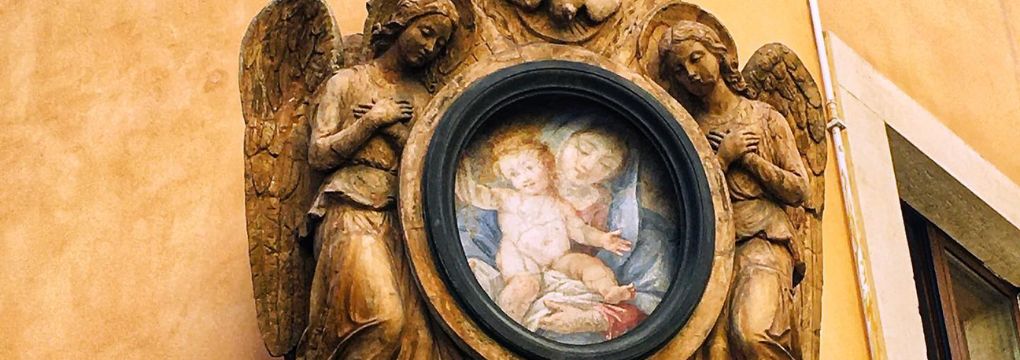
The Most Famous Event: The “Moving Eyes” of 1796
The most extraordinary story connected to the Madonnelle happened in 1796, on the eve of the Napoleonic invasion. On July 9, something unusual was reported. And it didn’t stop that day—it continued throughout the entire month of July.
Across different parts of Rome, people began to claim that several Madonnelle were moving their eyes.
The phenomenon started with the Madonna dell’Archetto in the Trevi district. This image was already known and venerated for earlier miracles, and in the mid-19th century it would later be moved into a small chapel. But in 1796, it became the center of something much larger. The reports spread. More and more images across the city were said to show the same movement. The reaction was so strong that the Pope appointed a special commission to investigate.
Out of 26 Madonnelle examined, five were officially declared miraculous.
They are:
- Madonna dell’Archetto
- Madonna della Divina Provvidenza (Via delle Botteghe Oscure)
- Madonna della Pietà (Vicolo delle Bollette)
- Madonna del Rosario (Via dell’Arco della Ciambella – now preserved as a copy)
- Madonna Addolorata, later moved to Piazza del Gesù at the end of the 19th century
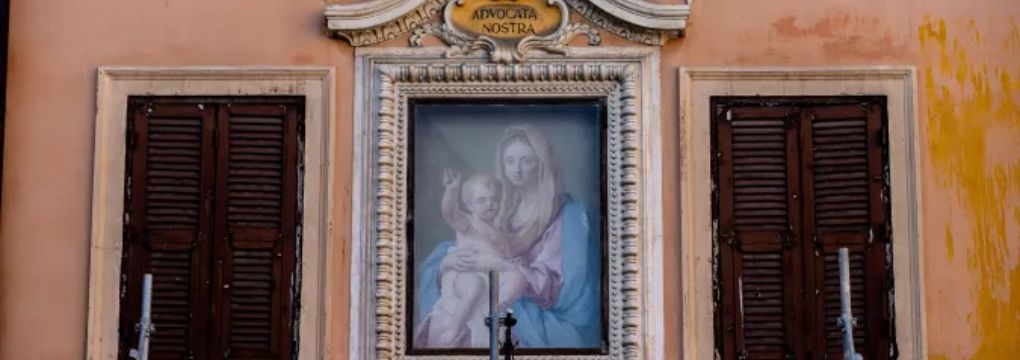
A City You Can Still Read on Its Walls
Today, many Madonnelle are worn, damaged, or simply overlooked. But they are still there.
Each one is a fragment of Rome’s history—of its art, its faith, its fears, and its hopes. They tell stories of miracles and devotion, of anonymous artists and local communities, of ancient traditions that never really disappeared, only changed form.
So next time you walk through Rome, don’t just look ahead. Look at the corners. Look at the walls.
Because hidden in plain sight, the Madonnelle are still watching over the city—just as they always have.
Spot Rome’s hidden Madonnelle along the way on our Dolce Vita Tour or Private Golf Cart Tour, a stylish and comfortable way to explore the city’s most charming corners.


Comment (0)