
The Circus Maximus was ancient Rome’s chariot-racing track, about 600 m long, in the valley between the Palatine and Aventine hills. Today it is a long grassy park, free and always open. The excavated ruins at its east end, with the medieval Torre della Moletta, cost €7 and open Tuesday to Sunday from 9:30.
Cover photo: Victor R. Ruiz, CC BY-SA 2.0, via Wikimedia Commons
Many visitors expect a stadium and find a field. That is the Circus Maximus today: a long, sunken meadow that still follows the shape of the track where Romans watched chariot races for more than a thousand years. We are a local tour operator in Rome, and several of our golf cart and Fiat 500 tours drive past it. This guide explains what the Circus Maximus was, what you can still see, the hours and tickets of the ruins and of the Circo Maximo Experience, the best viewpoints and how to get there.
What was the Circus Maximus?
The Circus Maximus was the largest building for public entertainment in the ancient world and one of the largest ever built, according to the Sovrintendenza Capitolina, the City of Rome’s heritage office. It filled the Valle Murcia, the wide valley between the Palatine and the Aventine hills.
- The kings: the valley was first used for chariot races at the time of the Tarquin kings, in the 6th century BC. Legend places the Rape of the Sabine Women here, one of the first episodes in the story of Rome.
- Julius Caesar built the first real circus in masonry.
- Trajan, in the 2nd century AD, rebuilt it almost entirely after several fires. Most of the structures you see today date from his time.
- The obelisks: in 357 AD Emperor Constantius II raised a huge Egyptian obelisk in the Circus; it now stands at the Lateran. An older obelisk, brought from Egypt by Augustus, has stood in Piazza del Popolo since the 16th century.
The races went on until the first decades of the 6th century AD, long after the fall of the Western Roman Empire.
How big was the Circus Maximus, and how many people did it hold?
The Circus measured about 600 m in length and 140 m in width. Spectators sat by rank: in the galleries that led to the stands, senators had the ground floor and ordinary people the upper floor.
Ancient writers give different figures for the crowd. Dionysius of Halicarnassus, writing under Augustus, counted about 150,000 seats, while Pliny the Elder, a few decades later, wrote of 250,000. There is no official modern figure, so treat these numbers as ancient estimates.
What were the chariot races like?
Chariot races were, with gladiator games, the Romans’ favorite contests. The four-horse chariots (quadrigae) belonged to rival stables known by their colors, the Greens, the Blues, the Reds and the Whites. The crowd split along the same colors and cheered its drivers with chants and slogans, and the best drivers became stars.
The chariots started from gates at the straight west end, toward the Tiber, and raced around a long central barrier decorated with monuments and lap counters, usually for seven laps. Crashes were part of the show. The valley also hosted triumphal parades, religious processions and public executions.
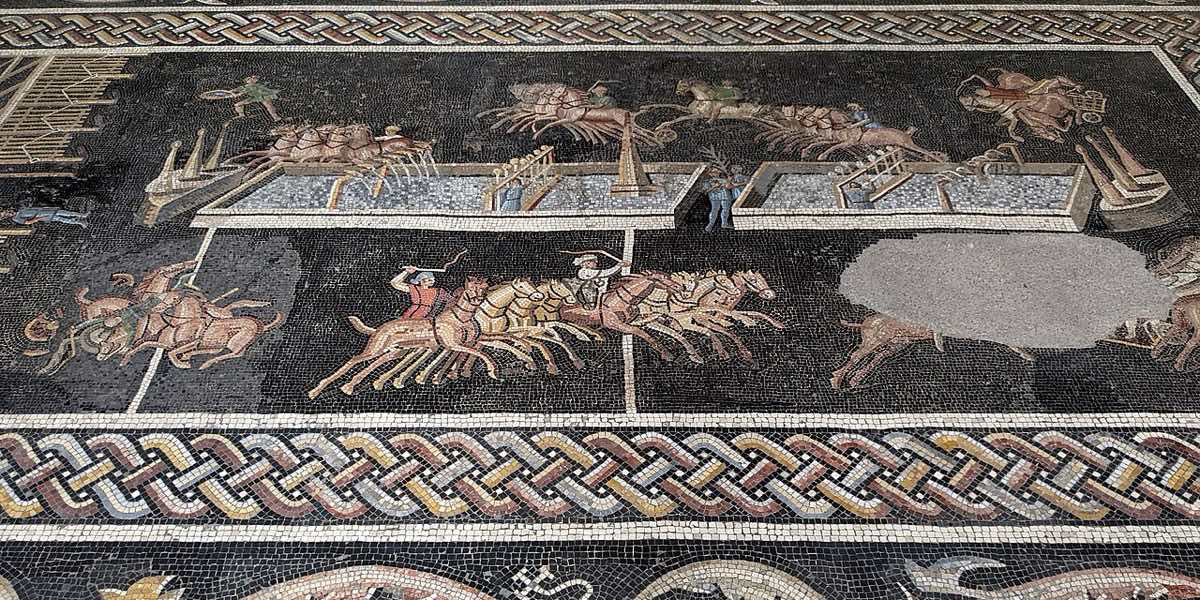
This Roman mosaic is in the Lugdunum museum in Lyon, France, not in Rome, but it shows a race much like those in the Circus Maximus: the central barrier, the chariots and a crash.
What happened to the Circus Maximus?
After the last races, the valley slowly changed use:
- Middle Ages: it became farmland. In the 12th century the Frangipane family owned a tower at its east end, the Torre della Moletta, which still stands.
- 19th century: gasworks, warehouses, workshops and houses filled the area.
- Early 1900s: work began on an archaeological promenade.
- 1930s: excavations uncovered much of the curved east end and the remains of the Arch of Titus. The area was then given to the National Fascist Party for its events and hosted large exhibitions from 1937 to 1940.
- After the Second World War: it went back to being a green space, and the ancient structures were largely abandoned.
- 2016: new excavations and restoration were completed, and the archaeological area opened to visitors.
What is left of the Circus Maximus today?
There are two parts: the park and the archaeological area.
The park. The long meadow follows the shape of the track, with grassy slopes where the stands once rose. It is an open public park where people walk, jog and sit on the grass, with the brick ruins of the imperial palaces on the Palatine Hill above one side.
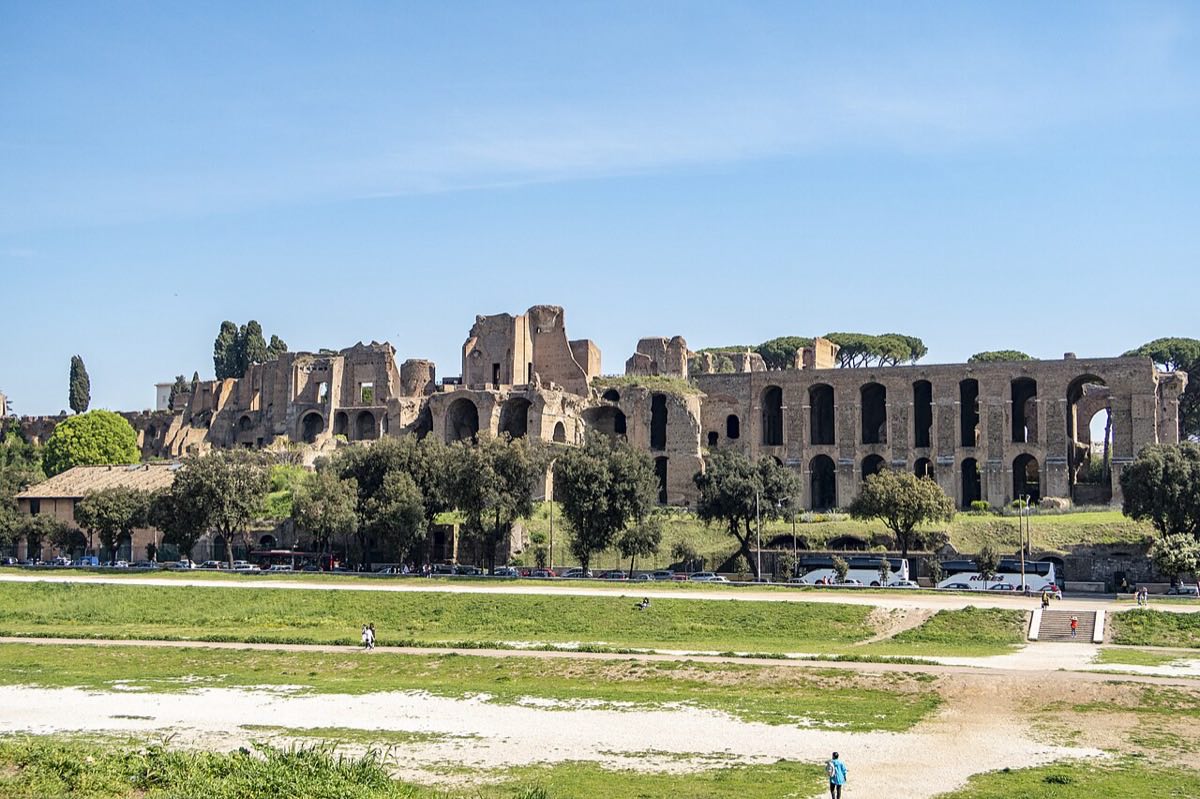
The archaeological area, at the curved east end near Piazza di Porta Capena, holds most of the ancient remains. According to the Sovrintendenza, you can:
- walk for about 100 m through each of the galleries that led to the stands, and see the remains of ancient latrines;
- follow the ancient paved street outside, with a large travertine drinking trough, and enter rooms that served as shops (tabernae): inns, food shops, storerooms, laundries, brothels and the offices of money changers, who handled the betting on the races;
- see the bases of the Arch of Titus, one of the largest triumphal arches in Rome, built to celebrate his victory in Judea, at the center of the curve. Its front columns were at least 10 m tall. It is a different monument from the Arch of Titus that still stands in the Roman Forum;
- climb the inner staircase of the Torre della Moletta, a 12th-century tower, to its top floor, a viewpoint over the whole valley.
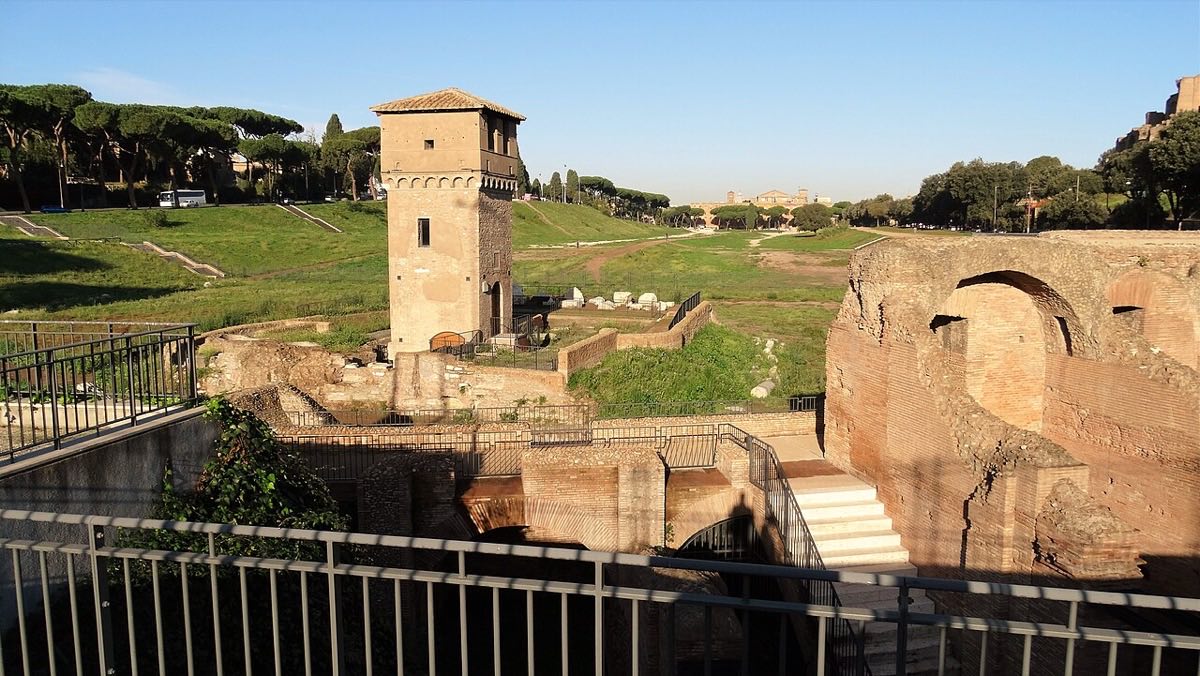
In our experience, about an hour is enough for the archaeological area.
Is the Circus Maximus free? Opening hours and tickets
The park is free and always open. The archaeological area and the Circo Maximo Experience have their own hours and tickets:
| Visit | Hours | Ticket |
|---|---|---|
| The park (the old track) | Always open | Free |
| Archaeological area and Torre della Moletta | Tuesday to Sunday 9:30–16:00, last entry 15:00, until 27 March 2027; then 9:30–19:00, last entry 18:00 | €7, reduced €4 |
| Circo Maximo Experience (augmented and virtual reality visit) | Tuesday to Sunday 10:00–16:00, last entry 14:50, from October to May; evening hours in summer | €12, reduced €10 |
- Closed on Mondays, 25 December and 1 May (both the archaeological area and the Experience).
- Book ahead: entry to the archaeological area is limited, so the Sovrintendenza strongly recommends buying tickets online or on the City’s phone line 060608 (every day 9:00–19:00).
- Free entry: residents of Rome and its metropolitan area, with proof of residence, and MIC card holders enter the archaeological area free.
- First Sunday of the month: on Sunday 1 November 2026, entry was free for everyone in the City of Rome’s museums and in several archaeological areas, including the Circus Maximus, “on the occasion of the first Sunday of the month”, according to the City museums’ notice. Check the notices before you plan around it.
- Accessibility: Turismo Roma describes the archaeological area as partially accessible to visitors with disabilities.
What is the Circo Maximo Experience?
The Circo Maximo Experience is a guided walk through the archaeological area with a headset that overlays reconstructions on what you see. You watch the valley change through the centuries, walk among Roman shops, see the Arch of Titus at its original height and watch a chariot race. It is a project of the Sovrintendenza Capitolina, and it is running now: on 1 November 2026 the official ticket site was selling visits from 3 November to 31 December 2026.
- The route: about 40 minutes on foot with eight stops, from the valley in early times to the imperial Circus, the stands, the Arch of Titus, the shops, the Middle Ages and “A Day at the Circus”, plus a panoramic view.
- Equipment: see-through headsets and stereo earphones are included. You leave an original ID card or passport as a deposit for the headset.
- Languages: English and several other languages, with simplified subtitles in Italian or English for deaf visitors.
- Hours: from 1 October to 31 December and from 2 January to 31 May, 10:00–16:00, with a group every 15 minutes and last entry at 14:50; on 24 and 31 December 10:00–14:00, last entry 12:35. From June to September it runs in the evening (for example 17:00–21:00 in June and July).
- Tickets: €12, or €10 reduced, for example for visitors under 26, teachers, groups of 10 or more, and Roma Pass or MIC card holders. Children under 6 enter free. A family ticket for two adults with children under 18 costs €22, booked only by phone on 060608 or at the City’s tourist infopoints. You can also buy tickets at the ticket office on Viale Aventino, where the entrance is.
- Rules: arrive 15 minutes early, because late arrivals lose their slot without a refund. Children under 14 can wear the headset only with an adult who signs a release form.
- Rain: the visit does not run in the rain. Refunds or date changes are possible only when a visit is cancelled for weather or technical reasons, and booking fees are never refunded.
If you find it hard to picture ancient Rome from ruins, this is the easiest way to see the Circus as it was. On a rainy day, or on a Monday, plan something else.
Where is the best view of the Circus Maximus?
- From the Palatine Hill. The southern edge of the Palatine, where the emperors built their palaces, looks straight down on the track; the cover photo of this guide was taken from there. The Palatine is part of the Colosseum Archaeological Park: according to the Park’s ticket page, all its tickets include the Roman Forum and the Palatine, and the Forum Pass SUPER covers them without the Colosseum. The Palatine entrance is at Via di San Gregorio 30. Our Colosseum tickets guide explains the options.
- From the Torre della Moletta, inside the archaeological area, with the ticket.
- From the Aventine side. The City’s Rose Garden, at Via di Valle Murcia 6, lies on the Aventine slope facing the Circus and the Palatine, but it opens only during the spring and autumn blooms. In autumn 2026 it is open from 25 October to 8 November, 8:30–17:30, with free entry, according to Roma Capitale. Read our guide to the Rose Garden.
- From the street: walking along Via del Circo Massimo, below the Palatine, you get the classic view of the palace ruins above the track.
Further up the Aventine are two more famous views, though not over the Circus: the Orange Garden, with its terrace over the Tiber, and the Aventine Keyhole, which frames St Peter’s dome.
How do you get to the Circus Maximus?
The easiest way is Metro B to Circo Massimo station, at the east end of the park, next to the archaeological area and the Experience entrance on Viale Aventino. The bus stop nearby is called Aventino (Circo Massimo).
| From | On foot (our estimate) |
|---|---|
| Circo Massimo metro station (line B) | 2–3 minutes to the archaeological area |
| Colosseum | about 10–15 minutes |
| Mouth of Truth (Bocca della Verità), at the west end | about 15 minutes along the park to the archaeological area |
| Aventine Keyhole | about 15 minutes, downhill |
On concert nights the station can close early: in June 2026, for example, Circo Massimo station closed from 22:00 on two concert nights, with Piramide and Colosseo as the alternatives, according to Roma Mobilità, the City’s mobility agency.
From the Circus Maximus, the Arch of Constantine and the Colosseum are a short walk away along Via di San Gregorio, at the foot of the Palatine.
Are there concerts and events at the Circus Maximus?
Yes. The open field hosts big summer and autumn concerts. The Sovrintendenza even sells the reduced €4 ticket for the archaeological area to holders of a ticket for a concert at the Circus Maximus, in the month of the concert. The Circus has also hosted huge public celebrations, such as the party after Italy won the 2006 football World Cup.
If you plan to visit on a concert day, check the metro and traffic notices on Roma Mobilità before you go.
See the Circus Maximus with us
The Circus Maximus is easy to visit on your own, and the park is free. If you want to see it as part of a ride through Rome, it is on the route of several of our tours. On the rides the sights are seen from the outside, and our drivers are drivers, not licensed tour guides: to walk inside the ruins or try the Experience, plan it before or after the tour.
- Private golf cart tour: the 3-hour version includes the Colosseum, the Circus Maximus, Piazza Venezia, Piazza Navona, the Pantheon, the Trevi Fountain and the Spanish Steps, plus the Orange Garden and the Aventine Keyhole. It costs €450 for 1–3 people, then €150 per person, with the Trevi Fountain ticket and a stop for gelato or coffee. Pickup in the historic center at 9:30, 10:00, 14:30, 18:00 or 18:30. A 2-hour version, from November to mid-April, covers fewer stops.
- Shared golf cart tour: a fixed route from our office at Via del Colosseo 11A, at 9:30 or 14:30. It goes from the Colosseum to the Circus Maximus, the Orange Garden and the Mouth of Truth, then on to Piazza Navona, the Pantheon and the Trevi Fountain. €59 per person for 2 hours or €99 for 3 hours, in carts of up to 7 people shared with other travelers.
- Vintage Fiat 500 tour: 3 hours in restored original Fiat 500s converted to electric, or a Fiat 850 Spiaggina for larger groups. The typical route includes the Colosseum, the Circus Maximus, the Orange Garden and the Mouth of Truth, with a Trevi Fountain ticket and a short food stop. From €590 for 1–3 people, €1,180 for 4, then €240 per person.
- Golf cart tour + San Sebastiano Catacombs: 4 hours from 9:30, on the days the catacombs are open: Tuesday to Sunday, but not from 7 to 27 December 2026, on 1 January or on Easter Sunday. The driver goes past Piazza Navona, Piazza Venezia and the Circus Maximus to the Quo Vadis Church on the Appian Way and the catacombs, where you can join a guided visit of about 40 minutes with the optional catacombs ticket (€12 per person). €590 for 1–3 people, then €200 per person, up to 15 travelers; this booking is non-refundable. On Saturdays and Sundays the first stretch of the Appian Way is a limited traffic zone, so on weekends our driver changes the route. Read our guides to the Appian Way and the catacombs of Rome.
Good to know on these tours:
- Groups: the private golf cart tour and the Fiat 500 tour take up to 21 guests guaranteed (on the 2-hour private tour, the maximum depends on the start time), with larger groups on request. The shared tour takes up to 21 per booking, and the catacombs tour up to 15.
- Pickup: private tours pick you up in the historic center; if you stay further out, we meet at our office, Via del Colosseo 11A. The shared tour starts only from the office.
- Children: golf carts take children of any age, and child seats are available on private golf cart tours only. A folded stroller fits on board; just tell us when you book. Fiat 500 tours take children aged 3 and over, with no child seats, and some of the cars have no seat belts, because they were built before seat belts were required.
- Wheelchairs: on a private golf cart tour, wheelchair users move onto a seat of the golf cart, and the folded wheelchair travels on board in place of the two back seats. Contact us before booking if the traveler cannot move from the wheelchair to a seat. The shared tour is not suitable for wheelchair users, and the catacombs, with about 70 uneven steps, are not suitable for visitors with reduced mobility.
- Weather: the golf carts have rain covers and run in the rain. In rain or wet weather, the Fiat 500 tour runs in golf carts; if none is available, we offer another date or time.
- Cancellation: full refund if you cancel at least 72 hours before the tour, 50% if you cancel at least 48 hours before; later cancellations and no-shows are not refunded. The catacombs tour is different: it is non-refundable once we confirm it.
| Way to see it | Inside the ruins? | Time | Price |
|---|---|---|---|
| The park, on your own | No: you walk the old track | As long as you like | Free |
| Archaeological area, on your own | Yes | About 1 hour | €7 |
| Circo Maximo Experience | Yes, with a headset | 40 minutes | €12 |
| From the Palatine Hill | View from above | Part of a Forum and Palatine visit | A Colosseum Archaeological Park ticket |
| Shared golf cart tour (ours) | No, seen from the outside | 2 or 3 hours | €59 per person |
| Private golf cart tour (ours) | No, seen from the outside | 3 hours | from €450 for 1–3 people |
| Vintage Fiat 500 tour (ours) | No, seen from the outside | 3 hours | from €590 for 1–3 people |
If the Circus Maximus is your main interest, the archaeological area and the Experience give you more than any ride. Our tours are the better choice when you want to see it together with the Colosseum, the Aventine and the historic center in a few hours, without long walks. See all our golf cart tours in Rome and vintage Fiat 500 tours in Rome.
Explore it with us
 Private Golf Cart Tour of Rome3 hours with pickup in the center, past the Colosseum and the Circus Maximus · from €450 for 1–3 peopleBook now
 Shared Golf Cart Tour of Rome2 or 3 hours from Via del Colosseo 11A, on a fixed route with the Circus Maximus · €59 per personBook now
 Vintage Fiat 500 Tour of Rome3 hours in a restored Fiat 500, with the Circus Maximus on the typical route · from €590 for 1–3 peopleBook now
FAQ
Is the Circus Maximus free to visit?
Yes, the park on the old track is free and always open. The excavated archaeological area at the east end, with the Torre della Moletta, costs €7 (€4 reduced) and opens Tuesday to Sunday from 9:30. The Circo Maximo Experience, the augmented and virtual reality visit, costs €12.
What does the Circus Maximus look like today?
It is a long, sunken meadow that follows the shape of the ancient track, with grassy slopes where the stands once rose and the ruins of the imperial palaces on the Palatine above it. Most of the ancient remains are in the archaeological area at the curved east end: galleries, shops, the bases of the Arch of Titus and a medieval tower.
How many people did the Circus Maximus hold?
Ancient writers give different figures: about 150,000 spectators according to Dionysius of Halicarnassus, who wrote under Augustus, and 250,000 according to Pliny the Elder, a few decades later. The building was about 600 m long and 140 m wide, the largest venue for public entertainment in the ancient world.
What events were held at the Circus Maximus?
Mainly chariot races, the Romans’ favorite contests together with gladiator games, run by four teams known as the Greens, Blues, Reds and Whites. The valley also hosted triumphal parades, religious processions and public executions. Today it hosts big concerts and public celebrations.
What happened to the Circus Maximus?
The races ended in the first decades of the 6th century AD, and the valley became farmland. From the 19th century it was covered by gasworks, warehouses and houses, until excavations began in the 20th century. The latest excavations and restoration were completed in 2016.
How much is the Circo Maximo Experience, and when is it open?
A ticket costs €12, or €10 reduced, and children under 6 enter free. From October to May it runs Tuesday to Sunday from 10:00 to 16:00, with last entry at 14:50, and in summer it runs in the evening. It is closed on Mondays and does not run in the rain.


Comment (0)