
The Spanish Steps are a free baroque staircase that climbs from Piazza di Spagna to the church of Trinità dei Monti, built in 1723–1726. You can walk up and down and take photos at any time, but sitting on the Steps, also to eat or drink, is banned, with a €250 fine.
Cover photo: Falk2, CC BY-SA 4.0, via Wikimedia Commons
For three centuries the Spanish Steps have been one of Rome’s favorite meeting places, and almost every visitor passes through Piazza di Spagna at least once. Many still expect to eat a gelato on the steps, as Audrey Hepburn did in Roman Holiday, and are surprised to learn that sitting there is now banned. We are a local tour operator in Rome, and several of our golf cart and Fiat 500 tours pass the Steps. This guide explains who built them and why they are called “Spanish”, how many steps there are, the rules you need to know, the church at the top, what is nearby and the best time for photos.
What are the Spanish Steps, and why are they called “Spanish”?
In Italian they are the Scalinata di Trinità dei Monti, the staircase of Trinità dei Monti. They link Piazza di Spagna at the bottom with the French church of Trinità dei Monti at the top, on the slope of the Pincian Hill.
The name comes from the square. Piazza di Spagna is named after the Spanish Embassy to the Holy See, which has stood on the square since the 17th century. So the Steps are “Spanish” in name, but the church at the top belonged to the kings of France, the money for the project came from a Frenchman, and France argued with the Popes over it for decades.
| Fact | Details |
|---|---|
| Italian name | Scalinata di Trinità dei Monti |
| Built | 1723–1726, inaugurated for the Jubilee of 1725 |
| Architect | Francesco De Sanctis, a Roman architect |
| Number of steps | 135 (the usual count) |
| Material | Travertine stone |
| Entry | Free |
| At the bottom | Piazza di Spagna and the Barcaccia fountain |
| At the top | Trinità dei Monti church and the Sallustiano obelisk |
| Nearest metro | Spagna, line A |
Who built the Spanish Steps, and who paid for them?
The Roman architect Francesco De Sanctis (1693–1740) designed the Steps, and they were built between 1723 and 1726. The city’s tourist board says the French cardinal Pierre Guérin de Tencin commissioned the work, and Pope Benedict XIII inaugurated the staircase for the Jubilee of 1725.
The idea is much older. According to the City of Rome’s heritage office, a staircase was first proposed in 1559, and the real push came in 1660 from the bequest of a Frenchman, Étienne (Stefano) Gueffier, who left money for the project. Then the Papal State and the French crown argued for decades over who owned the land and who would decide the design. Work started only under Pope Innocent XIII, and the pillars at the bottom still carry both the eagles of his family, the Conti, and the lilies of France.
| Year | What happened |
|---|---|
| 1559 | The first documented idea of a staircase below the church |
| About 1579 | The Apostolic Chamber buys the land; Pope Gregory XIII wants a staircase like the one at the Aracoeli |
| 1660 | Étienne Gueffier’s bequest leads to the first designs, including one attributed to Bernini’s workshop, with curving walls and pincer-shaped ramps |
| 1717 | Pope Clement XI holds a design competition |
| 1723 | Work starts under Pope Innocent XIII |
| 1725 | Benedict XIII inaugurates the Steps for the Jubilee |
| 1726 | The Steps are completed |
| 1995 | A complete restoration |
| 2015–2016 | Restoration paid for by the jeweler Bulgari (€1.5 million, for its 130th anniversary), unveiled on 22 September 2016 |
Bulgari’s link to the Steps is local: its first shop opened on Via Sistina, near the top of the Steps, in 1884, and its shop today is on Via dei Condotti, at the bottom.
How many steps are the Spanish Steps?
The figure usually given is 135 steps. The City of Rome’s tourist board describes the staircase as 11 flights of 12 steps each, with balustrades and landings where you can stop and enjoy the view, so you may also see other numbers. The flights split, curve and join again as they climb, which is why the Steps look different from every angle.
With a suitcase or a stroller, the Steps are hard work, and there is a specific rule: you may not drag suitcases, strollers or similar items up or down the steps of historic staircases, and the regulation names the Spanish Steps as its example. Carry them, or go around by street: Via Sistina and Viale della Trinità dei Monti both reach the top.
Can you sit on the Spanish Steps?
No. Since July 2019, Rome’s Urban Police Regulation bans sitting “also while eating or drinking” on monuments of historic and artistic value, including fountains and monumental stairways, and the City of Rome sets the fine at €250. When the rule came in, local police officers were posted on the Steps to enforce it. Lying down and climbing on monuments are banned too.
| On the Spanish Steps | Allowed? | Rule (Urban Police Regulation) |
|---|---|---|
| Walking up and down, stopping for photos | Yes | No restriction |
| Sitting or lying on the steps, also to eat or drink | No: €250 fine | Article 4 |
| Dragging a suitcase or stroller on the steps | No: carry it. €400 fine | Article 19 |
| Sitting on, climbing or stepping into the Barcaccia fountain | No | Article 8 |
In areas with many visitors, such as Piazza di Spagna, the police can also ban offenders from the area for 48 hours, and repeat offenders can receive a longer ban. The full text is on the City of Rome’s regulation page (in Italian). In practice: enjoy your gelato in the square or at a café, then walk up the Steps for the view.
What is the Barcaccia fountain?
The Barcaccia (“old boat”) is the boat-shaped fountain in the middle of Piazza di Spagna, at the foot of the Steps. Pope Urban VIII Barberini had it built between 1626 and 1629 by Pietro Bernini, the architect of the Acqua Vergine aqueduct and father of the more famous Gian Lorenzo Bernini. The City of Rome’s heritage office says a collaboration with his son is “not ruled out”.
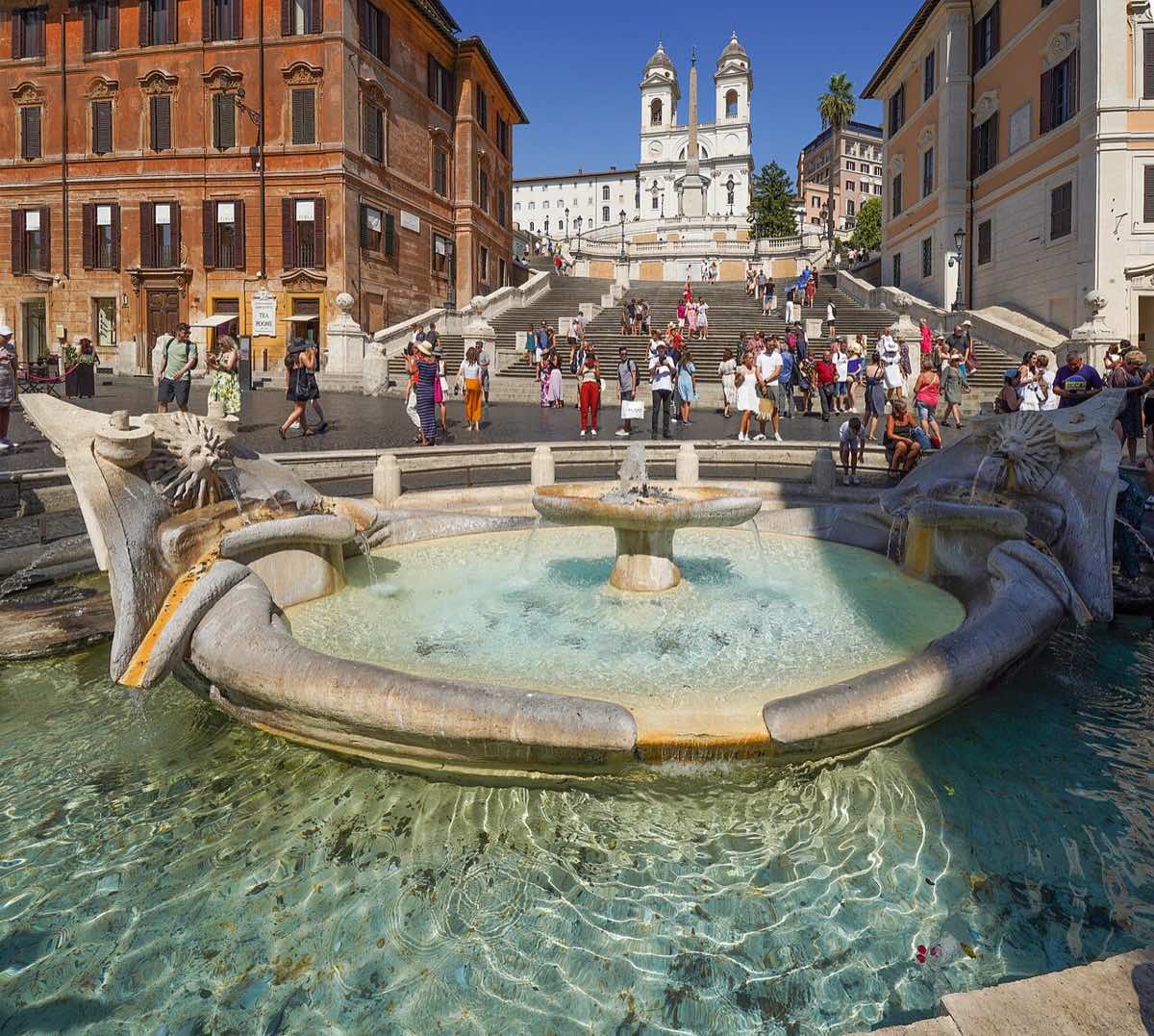
Look closely and you will see why it is special. The sides of the boat are low, as if it were sinking. Water flows from two suns at the bow and the stern and from a small central basin, and spouts from fake cannon mouths next to the Pope’s coats of arms with the Barberini bees. The tourist board links the boat theme to the great flood of 1598, when boats on the Tiber reached this spot, and the name to the boats of the old river port of Ripetta. The basin sits low, almost at street level, because the water pressure of the aqueduct here is weak.
The Barcaccia is protected by the same regulation as the other historic fountains: no sitting on its edge, no climbing and no stepping into the water. Read more in our guide to the fountains of Rome.
What is at the top of the Spanish Steps?
At the top of the Steps stands Trinità dei Monti, the church with two bell towers that you see in every photo. It was consecrated in 1594 and is known as “the Roman church of the Kings of France”. Inside are 17 chapels, including the Deposition by Daniele da Volterra, painted from sketches by Michelangelo. Entry to the church is free.
| Trinità dei Monti church | Hours |
|---|---|
| Monday, Tuesday, Thursday, Friday, Saturday | 10:15–19:45 |
| Wednesday | 12:00–19:45 |
| Sunday | 9:00–19:30 |
Visits stop during services. The convent next door, with its cloister, two anamorphic frescoes (paintings that change as you move), the so-called astrolabe and a refectory painted by Andrea Pozzo, can be seen only on a guided tour: in English every Monday at 10:00 (other days in French and Italian), €15, €6 for under 18s and students, free under 8. You must book by email before the day of the visit, on the official Trinità dei Monti website. Dress modestly.
In front of the church stands the Sallustiano obelisk, a Roman obelisk of red granite from the 2nd or 3rd century AD. Its hieroglyphs were copied from the obelisk in Piazza del Popolo. It first stood in the ancient Gardens of Sallust and was raised here in 1787.
Where was the Roman Holiday scene filmed?
In Roman Holiday (1953), after her haircut, Princess Ann (Audrey Hepburn) wanders to the Spanish Steps. She buys a gelato at the bottom, walks up the center and eats it with the towers of Trinità dei Monti above her, until Joe (Gregory Peck) “bumps into” her. You can stand on the same spot today, but not sit there with a gelato. All the film’s locations are in our Roman Holiday guide.
When are the azaleas and the Christmas tree on the Steps?
- Azaleas, spring: from about mid-April to mid-May, the Steps are covered with white and lilac azaleas, a tradition since the 1950s. There are about 450 plants, grown and cared for by the City of Rome’s gardeners. The exact dates change every year.
- Christmas tree, December: in recent years a Christmas tree has stood on the Steps. In 2025–26 it was a 12-meter, eco-friendly tree with firefly-like lights. The 2026 tree had not been announced when we checked. For Christmas markets, nativity scenes and lights around the city, read our guide to Christmas in Rome.
What can you see near the Spanish Steps?
- Keats-Shelley House, Piazza di Spagna 26, right beside the Steps: the house where the English poet John Keats died in 1821, a museum since 1909, with terraces over the square. Check the opening hours on the museum’s official website before you go. We tell its story in our romantic things to do in Rome.
- Via dei Condotti, the straight street that starts at the foot of the Steps, with Via Frattina and Via Borgognona next to it: Rome’s luxury shopping area. See our guide to the shopping streets of Rome.
- Via Margutta, the artists’ street and Joe’s address in Roman Holiday, about 5 minutes on foot.
- Pincio Terrace, the viewpoint over Piazza del Popolo, about 10 minutes on foot from the top of the Steps past Villa Medici. It is one of our panoramic views of Rome.
- Trevi Fountain, about 10 minutes on foot, and the Pantheon, about 15 minutes. Read our guides to the Trevi Fountain and the Pantheon.
How do you get to the Spanish Steps?
- Metro: the Spagna station on line A opens next to the Steps. Line A runs from 5:30 to 23:30 from Sunday to Thursday, and until 1:30 on Fridays and Saturdays (last trains from the end stations).
- On foot: from the Trevi Fountain, walk about 10 minutes north; from Piazza del Popolo, about 12 minutes along Via del Babuino.
- By street to the top: Via Sistina, from Piazza Barberini, and Viale della Trinità dei Monti, from the Pincio, both reach the church square without stairs.
When is the best time to visit the Spanish Steps, and where are the best photos?
The Steps are free and open to all, so the time you choose makes a big difference:
- Early morning, before about 9:00, is the quietest time, with the fewest people in your photos.
- Late afternoon brings warm sunlight on the church facade, and the evening a lively atmosphere, but also the biggest crowds. For an evening tour of the lit-up center, read our post Rome at night: golf cart or Fiat 500?
- In spring you get the azaleas; in December, the Christmas lights on the shopping streets.
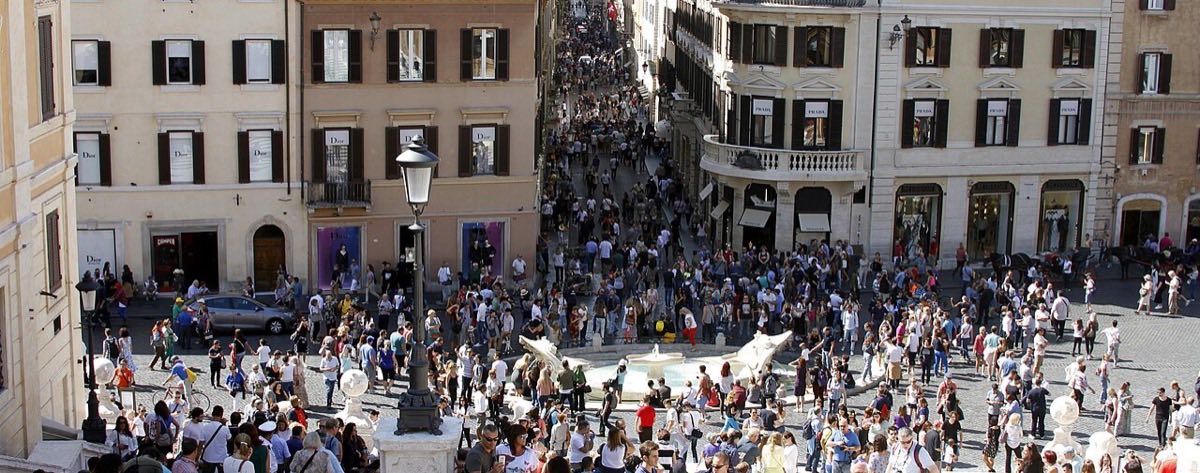
For photos, stand by the Barcaccia for the classic view of the Steps with the church above, or climb to the top for the view down over the square and the long line of Via dei Condotti.
See the Spanish Steps with us
Several of our tours pass the Spanish Steps, together with other sights of the historic center. On every tour you see the Steps from the outside: to climb them or to visit the church, walk over on your own, before or after the tour. It is free.
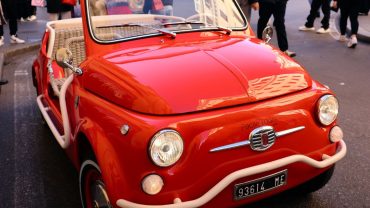
- Roman Holiday tour by vintage Fiat 500: the film tour’s route includes Trinità dei Monti and the Spanish Steps, Via Margutta, the Pantheon, the Trevi Fountain, the Colosseum, the Mouth of Truth, Castel Sant’Angelo and St. Peter’s Square. 4 hours, private, with a Trevi Fountain ticket and a snack. From €690 for 1–3 people, €1,380 for 4, then €270 per person from 5 to 21.
- Private golf cart tour: the 3-hour version includes the Colosseum, the Circus Maximus, Piazza Venezia, Piazza Navona, the Pantheon, the Trevi Fountain and the Spanish Steps, with a Trevi Fountain ticket and a stop for gelato or coffee. €450 for 1–3 people, then €150 per person. A 2-hour version, from November to mid-April, covers fewer stops, so tell us when you book if the Steps are a must.
- Vintage Fiat 500 tour: 3 hours, private, on a route your driver plans around your interests; the typical route includes the Spanish Steps. From €590 for 1–3 people, €1,180 for 4, then €240 per person.
- Shared golf cart tour: from our office at Via del Colosseo 11A, at 9:30 or 14:30. Only the 3-hour version (€99 per person) includes the Spanish Steps, the Villa Borghese Gardens and Piazza del Popolo; the 2-hour version (€59) ends at the Trevi Fountain.
- Semi-private golf cart tour: 3 hours on a fixed route whose last sight is the Spanish Steps, with pickup in the historic center and no more than 6 guests in the cart. €120 per person, up to 5 per booking.
- 90-minute golf cart tour with audio guide: it passes Trinità dei Monti at the top of the Steps, then Villa Medici and the Pincio Terrace, with an audio guide in 9 languages (bring your own headphones). €35 per person, from Via del Colosseo 11A.
| Tour | Spanish Steps | Time | Price |
|---|---|---|---|
| Roman Holiday tour (Fiat 500, private) | On the route, with Trinità dei Monti | 4 hours | from €690 for 1–3 people |
| Private golf cart tour | Included in the 3-hour version | 3 hours | from €450 for 1–3 people |
| Vintage Fiat 500 tour (private) | On the typical route | 3 hours | from €590 for 1–3 people |
| Shared golf cart tour | 3-hour version only | 3 hours | €99 per person |
| Semi-private golf cart tour | Last sight of the route | 3 hours | €120 per person |
| 90-minute tour with audio guide | Passes the top (Trinità dei Monti) | 90 minutes | €35 per person |
Good to know on these tours:
- Groups: the private golf cart tour and the Fiat 500 tours take up to 21 guests guaranteed (on the 2-hour private tour, the maximum depends on the start time), with larger groups on request. Our golf carts carry 3, 5 or 7 passengers plus the driver.
- Children: golf carts take children of any age (from 4 on the 90-minute tour), and child seats are available on private golf cart tours only. A folded stroller fits on board; just tell us when you book (strollers are not allowed on the 90-minute tour). Fiat 500 tours take children aged 3 and over, with no child seats. Our Fiat 500s are restored original Fiat 500s converted to electric; some have no seat belts, because they were built before seat belts were required.
- Wheelchairs: on a private golf cart tour, wheelchair users move onto a seat of the golf cart, and the folded wheelchair travels on board in place of the two back seats. Contact us before booking if the traveler cannot move from the wheelchair to a seat. The shared, semi-private and 90-minute tours are not suitable for wheelchair users.
- Weather: the golf carts have rain covers and run in the rain. In rain or wet weather, the Fiat 500 tours run in golf carts; if none is available, we offer another date or time.
- Cancellation: full refund if you cancel at least 72 hours before the tour, 50% if you cancel at least 48 hours before; later cancellations and no-shows are not refunded.
If the Steps are all you want to see, you don’t need a tour: take the metro to Spagna and walk up. Our tours are the better choice when you want to see the Steps together with the Colosseum, the Pantheon and the Trevi Fountain in a few hours, without long walks. See all our golf cart tours in Rome and vintage Fiat 500 tours in Rome.
Explore it with us
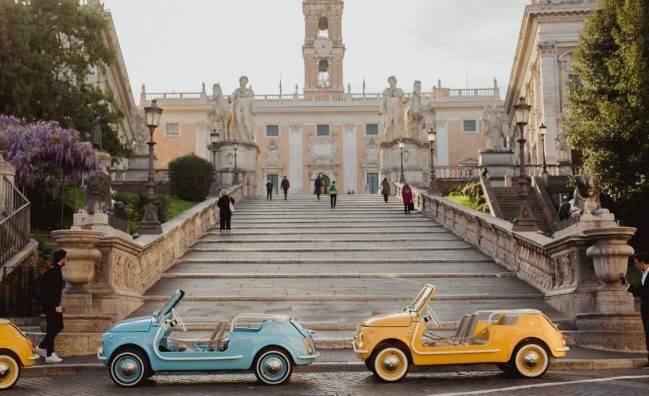 Roman Holiday Tour by Vintage Fiat 5004 hours, private, with Trinità dei Monti, the Spanish Steps and Via Margutta · from €690 for 1–3 peopleBook now
 Private Golf Cart Tour of Rome3 hours with pickup in the center, including the Trevi Fountain and the Spanish Steps · from €450 for 1–3 peopleBook now
 Shared Golf Cart Tour of Rome3 hours from Via del Colosseo 11A, with the Spanish Steps, Villa Borghese and Piazza del Popolo · €99 per personBook now
FAQ
Can you sit on the Spanish Steps?
No. Since July 2019, Rome’s Urban Police Regulation bans sitting on monuments, including monumental stairways like the Spanish Steps, also to eat or drink. The fine is €250. You can still walk up and down, stop on the landings and take photos.
How many steps are the Spanish Steps?
The usual count is 135 steps, from Piazza di Spagna up to the church of Trinità dei Monti. The City of Rome’s tourist board describes the staircase as 11 flights of 12 steps each, with landings and balustrades between them.
Do you have to pay to visit the Spanish Steps?
No. The Spanish Steps and Piazza di Spagna are public spaces, free to visit at any time. The church of Trinità dei Monti at the top is free too; only the guided tour of its convent costs €15 (€6 reduced).
Why are they called the Spanish Steps?
They take their name from Piazza di Spagna, the square at the bottom, named after the Spanish Embassy to the Holy See. The staircase itself, built in 1723–1726, was started with a French bequest and leads up to Trinità dei Monti, the church of the kings of France.
What are the opening hours of Trinità dei Monti?
The church is open Monday, Tuesday, Thursday, Friday and Saturday from 10:15 to 19:45, Wednesday from 12:00 to 19:45 and Sunday from 9:00 to 19:30, except during services. Entry is free. Guided tours of the convent must be booked by email before the day.
When is the best time to visit the Spanish Steps?
Early morning is the quietest time; the evening is lively but crowded. From about mid-April to mid-May the Steps are covered with azaleas, and in recent Decembers a Christmas tree has stood on the Steps.
Comment (0)