
Pantheon in Rome: the ancient building that still feels alive
There are places in Rome that look impressive in photos. Then there’s the Pantheon. It somehow feels even bigger, calmer, and more “real” the moment you step inside.
In the 1800s, the French writer Stendhal called it “the most beautiful surviving monument of Roman antiquity.” It’s easy to understand why. The Pantheon hasn’t just survived. It still works—like a perfectly designed space built to amaze people, century after century.
What is the Pantheon, really?
The Pantheon began its story in 27 BC, when Marcus Vipsanius Agrippa built a temple here dedicated to “all the gods.” What you see today, though, comes from Emperor Hadrian, who rebuilt it between 118 and 125 AD—making it larger, flipping its orientation, and creating a grand, open space in front of it.
In other words: the Pantheon is ancient, yes—but it’s also a masterpiece of planning, politics, and pure architectural ambition.
From forgotten temple to protected church
Like many ancient monuments, the Pantheon went through hard times. It was abandoned, then looted. But in 609 AD, it took a turn that changed everything: the Byzantine emperor Phocas donated it to Pope Boniface IV, who consecrated it as a Christian church, Santa Maria ad Martyres.
That single decision helped save it. While many other Roman buildings were stripped for materials during the Middle Ages, the Pantheon stayed in use—and stayed standing.
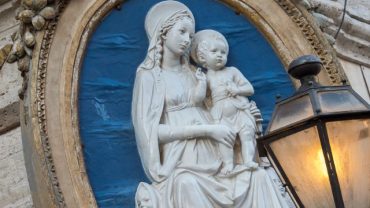
Inside, it also preserves an ancient Byzantine Icon of the Virgin and Child, linked to that same 609 dedication.
The moment you walk in, look up
The Pantheon’s design is simple to describe and impossible to forget.
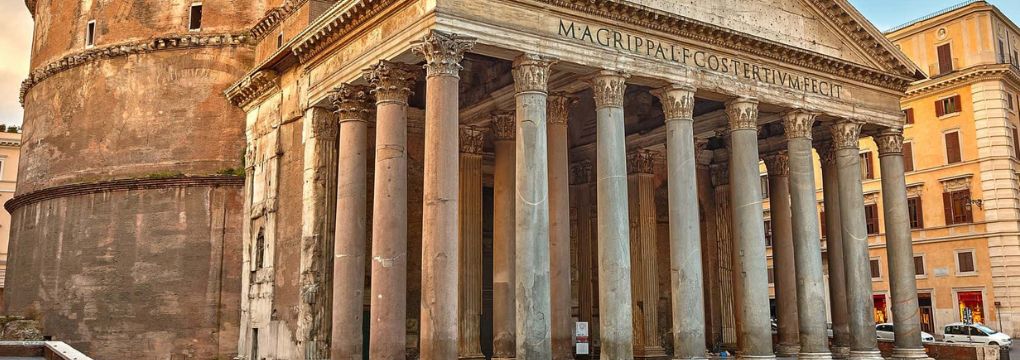
From the outside, you enter through a classic Roman portico—tall Corinthian columns, a triangular pediment, and an inscription that still honors Agrippa. Then you step into a vast circular interior—and it suddenly feels like the building opens up into the sky. The famous dome is a marvel for one reason that’s easy to remember:
- The height of the Pantheon is the same as the diameter of the dome—a little over 43 meters.
That perfect balance is part of what makes the space feel so calm and “right,” even if you don’t know anything about architecture.
The oculus: Rome’s most dramatic “window”
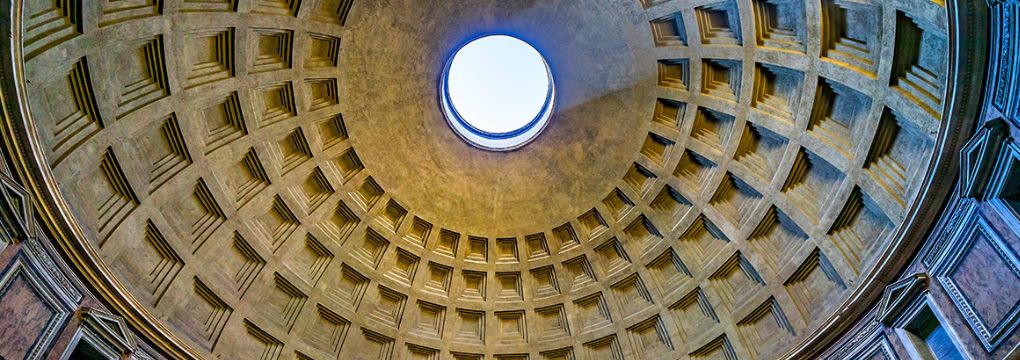
At the top of the dome is the Pantheon’s most famous feature: the oculus, an opening nearly 9 meters wide (8.92 m). There’s no glass. No cover. Just open air. That means light becomes part of the building. It moves across the walls like a spotlight, changing the mood every minute.
And yes—when it rains, rain falls inside the Pantheon. But it’s not a problem: water disappears through 22 subtle drains in the floor, which is still made with beautiful ancient stone patterns and rare marbles.
Before you leave, take a slow look at the dome itself—the details most people miss. It’s decorated with five rows of coffers—those sunken square panels that get smaller as they rise. There are 28 coffers per row, a number that was considered “perfect” in the ancient world.
The result isn’t just decoration. It makes the dome feel lighter, taller, and almost floating.
A building with a few wild chapters
The Pantheon’s history has a couple of moments that feel surprisingly human. In 1625, under Pope Urban VIII Barberini, bronze from the portico was removed and reused—helping create the baldachin in St. Peter’s Basilica and even cannons for Castel Sant’Angelo. Romans were not amused, and a famous line spread through the city:
“What the barbarians didn’t do, the Barberini did.”
Later, two bell towers were added to the front—so disliked that locals nicknamed them “donkey ears.” They were eventually removed.
And in 1870, the Pantheon became a royal tomb for Italy’s kings, and it also holds the resting place of Raphael—one more reason it feels like a living museum of Roman (and Italian) history.
A magical tradition: rose petals from the sky
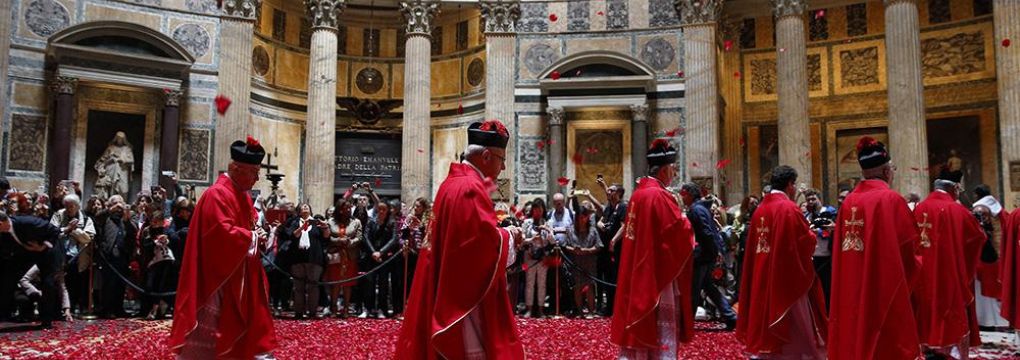
If you happen to visit on Pentecost, you might witness one of the Pantheon’s most unforgettable traditions: rose petals drifting down from the oculus like a soft, colorful rain.
It’s one of those moments that makes you realize the Pantheon isn’t just a monument—it’s still a place where things happen.
Add the Pantheon to Your Rome Experience
The Pantheon can also be enjoyed as part of one of our Sightseeing Rome tours. During our Private Golf Cart Tour or Dolce Vita Tour, you can pass by this extraordinary monument and admire its setting in the heart of the city. For those who would like to explore it from the inside, we can also arrange entry tickets on request, subject to availability.
Why you should see the Pantheon (even if you’re “not a museum person”)
Some landmarks impress you. The Pantheon does something else: it makes you quiet. It’s bright, then mysterious. Giant, yet perfectly balanced. Ancient, yet completely present.
If you want one stop in Rome that feels timeless—and takes zero effort to enjoy—put the Pantheon high on your list.


Comment (0)