
Romans eat a meatless Christmas Eve dinner of fish and fried vegetables: marinated eel, skate broth, spaghetti with clams, fried salt cod, broccoli and artichokes. Christmas Day brings pasta in broth, capon and lamb. The sweets are pangiallo, torrone, panettone and pandoro, and on New Year’s Eve Romans eat cotechino with lentils for luck.
Cover photo: Wittylama, CC BY-SA 4.0, via Wikimedia Commons
We have shown visitors around Rome since 2012, and every December our guests ask us the same question: what do Romans actually eat at Christmas? This post answers it day by day, from Christmas Eve to New Year’s Day, with the sweets you see in every bakery and the places where you can taste them. For the Christmas markets, the lights and what is open, read our guide to Christmas in Rome. For the dishes Romans eat the rest of the year, see our guide to Roman food.
What do Romans eat at Christmas, day by day?
Each day of the Roman holidays has its own menu. The table sums it up, and the sections below explain each meal.
| Day | What Romans eat | Where to try it |
|---|---|---|
| 24 December, dinner | A meatless meal: marinated eel and seafood starters, skate broth, spaghetti with clams, roast fish, fried salt cod, broccoli and artichokes | Restaurants with a Christmas Eve menu (book ahead); fish and vegetables at the Testaccio and San Cosimato markets |
| 25 December, lunch | Stracciatella or cappelletti in broth, capon with green sauce, breaded lamb chops, chicory | Restaurants open on Christmas Day (book well ahead) |
| 26 December, Santo Stefano | The leftovers of the 24th and 25th | At home, or a trattoria that opens on the holiday |
| All season | Pangiallo, panpepato, torrone, panettone and pandoro | Bakeries, pastry shops and the Piazza Navona Christmas market |
| 31 December, dinner | Cotechino with lentils | New Year’s Eve menus in restaurants |
| 1 January, lunch | Chicken broth, fresh pasta, roast lamb, the leftover lentils, pangiallo | Restaurants open on New Year’s Day (book ahead) |
What do Romans eat on Christmas Eve?
Christmas Eve dinner, the cenone della Vigilia, is traditionally meatless: Romans say they eat di magro. According to Turismo Roma, the city’s official tourism website, tradition wanted fish on the table, preferably small fish, and fish and seasonal vegetables are still the stars of the meal today. A typical Roman Christmas Eve menu looks like this:
- Starters: peeled shrimp, small octopus, marinated eel and pickled vegetables.
- First courses: a broth of arzilla (skate) and spaghetti with clams (vongole veraci).
- Main course: roast fish or peeled king prawns.
- Fried sides: broccoli or cauliflower, artichokes, strips of zucchini, cardoons (gobbi), fillets of salt cod (baccalà), potatoes, apples and ricotta.
- To finish: mandarins, oranges and clementines, walnuts and hazelnuts, then pangiallo and torrone.
The fried salt cod fillets are the dish most visitors remember. The broccoli is often broccolo romanesco, the pale green, pointed broccoli of Rome, which is on the Lazio Region’s official list of traditional food products. Eel is a Lazio product too: the same list includes the eel of Lake Bolsena, north of Rome.
What was the cottio, Rome’s Christmas fish market?
For centuries, Romans bought their Christmas fish at night. On the night between 23 and 24 December they went to the cottio, the fish market that in papal Rome was held at the Portico of Octavia, in the old Jewish Ghetto. Pope Pius VII moved it to a fish market in Via delle Coppelle, near the Pantheon, where it stayed until the unification of Italy. It then moved to Via di San Teodoro, between the Palatine Hill and the Circus Maximus, and in 1927 to the Mercati Generali, the city’s wholesale market. Over time the cottio became a society event, which drew famous travelers and ladies and gentlemen in evening dress.
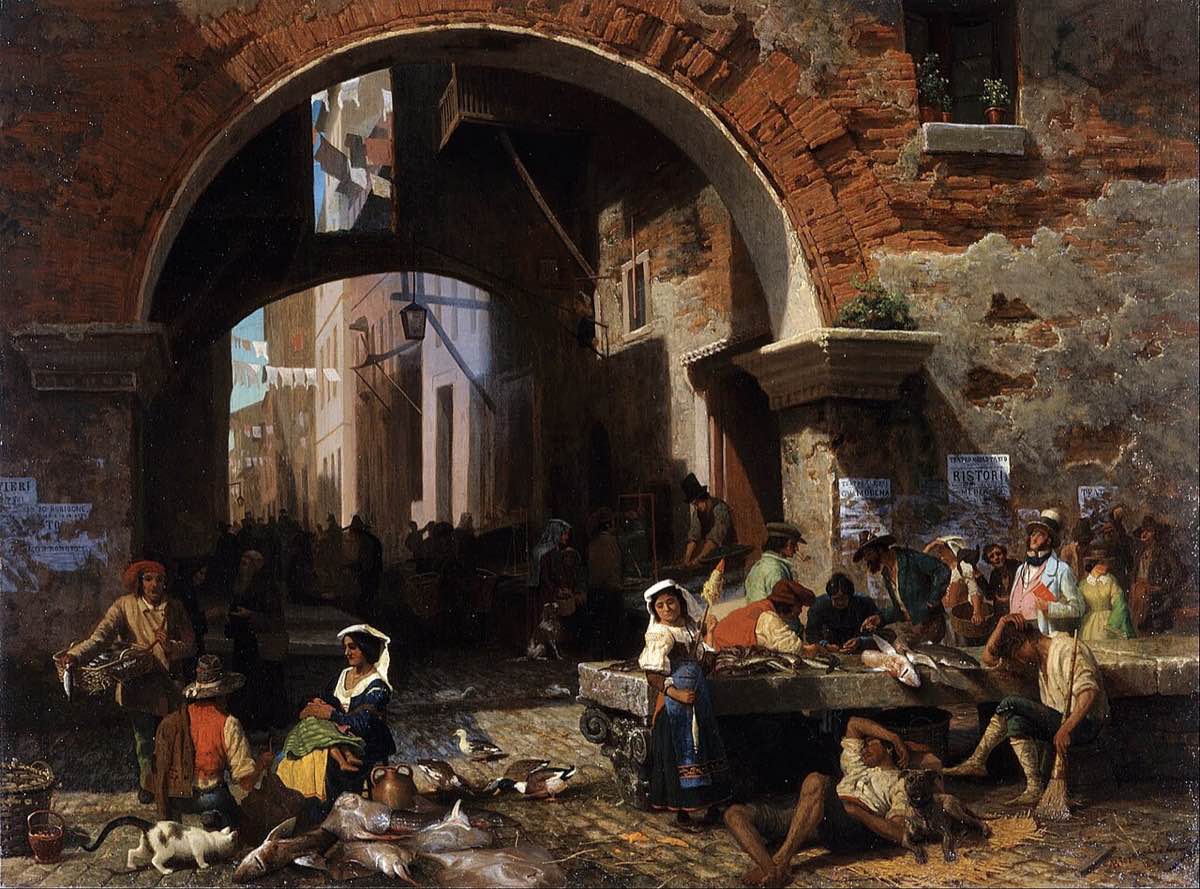
The American painter Albert Bierstadt painted the fish market at the Portico of Octavia in 1858. Today the Portico stands at the heart of the Jewish Ghetto, which our food tour crosses (see below).
What is on the table for Christmas Day lunch in Rome?
Christmas Day lunch is the family meal of the year, and the traditional Roman menu is no less rich than the night before:
- First course: stracciatella, an egg-drop soup, or cappelletti, small meat-filled pasta, in broth.
- Then: the capon cooked in that broth (cappone in brodo), served with a green sauce of parsley, anchovies, vinegar, capers, garlic, breadcrumbs and olive oil.
- Main course: breaded lamb chops, with fried vegetables, chicory sautéed in a pan, or boiled cardoons finished in butter and Parmesan.
- To finish: seasonal fruit and the Christmas sweets.
Lamb, abbacchio in Roman dialect, is the city’s festive meat: Turismo Roma calls it a must at every celebration.
What do Romans eat on Santo Stefano, 26 December?
The feast of Santo Stefano (St. Stephen) on 26 December is a public holiday in Italy, and in most homes it is the day of the leftovers. In a survey by Coldiretti, the Italian farmers’ association, and the research institute Ixè, published on 26 December 2025, 84% of Italian families said they eat the leftovers of the 24th and 25th on Santo Stefano; only 9% had finished everything. Leftover fish becomes meatballs, and leftover panettone and pandoro end up in puddings and spoon desserts.
If you plan to eat out on 26 December, book ahead, as you would on the 24th and 25th.
Which Christmas sweets do Romans eat?
Pangiallo is Rome’s own Christmas cake: a round, golden loaf packed with dried fruit, nuts, honey and candied citron, under a yellow coating. Turismo Roma traces it back to imperial Rome: according to legend, Romans made it and gave it as a gift around the winter solstice, as a wish for the return of the sun. In the early 20th century, the Roman writer Giggi Zanazzo still listed it on the Christmas table, next to vermicelli with anchovies, marinated eel, fried broccoli and torrone.
Pangiallo is on Lazio’s official list of traditional food products, and recipes vary from family to family. Some add chocolate or cocoa, pistachios, cinnamon or dried figs, and the version from Viterbo adds ground pepper. The yellow color comes from the spices, from an egg batter brushed on before baking, or from saffron.
The other sweets on a Roman Christmas table:
- Torrone: nougat of honey and nuts, which closes the Christmas Eve dinner. Turismo Roma also lists a torrone romano among the New Year sweets.
- Panpepato: a dark, round cake of walnuts, almonds, hazelnuts, raisins, honey, cocoa, candied fruit and pepper. It is a Christmas sweet of nearby Umbria, according to the Umbria Region’s sheet on traditional products, and it is on Lazio’s list too.
- Panettone and pandoro: they are not Roman, since panettone comes from Milan and pandoro from Verona, but they are in every Roman home at Christmas. Italian law protects both names. A panettone must be naturally leavened with a sourdough starter, with a round base and a cracked top crust; if it has no raisins or candied citrus peel, its name must say so. A pandoro is also naturally leavened, tall and shaped like an eight-pointed star, with no crust and an aroma of butter and vanilla.
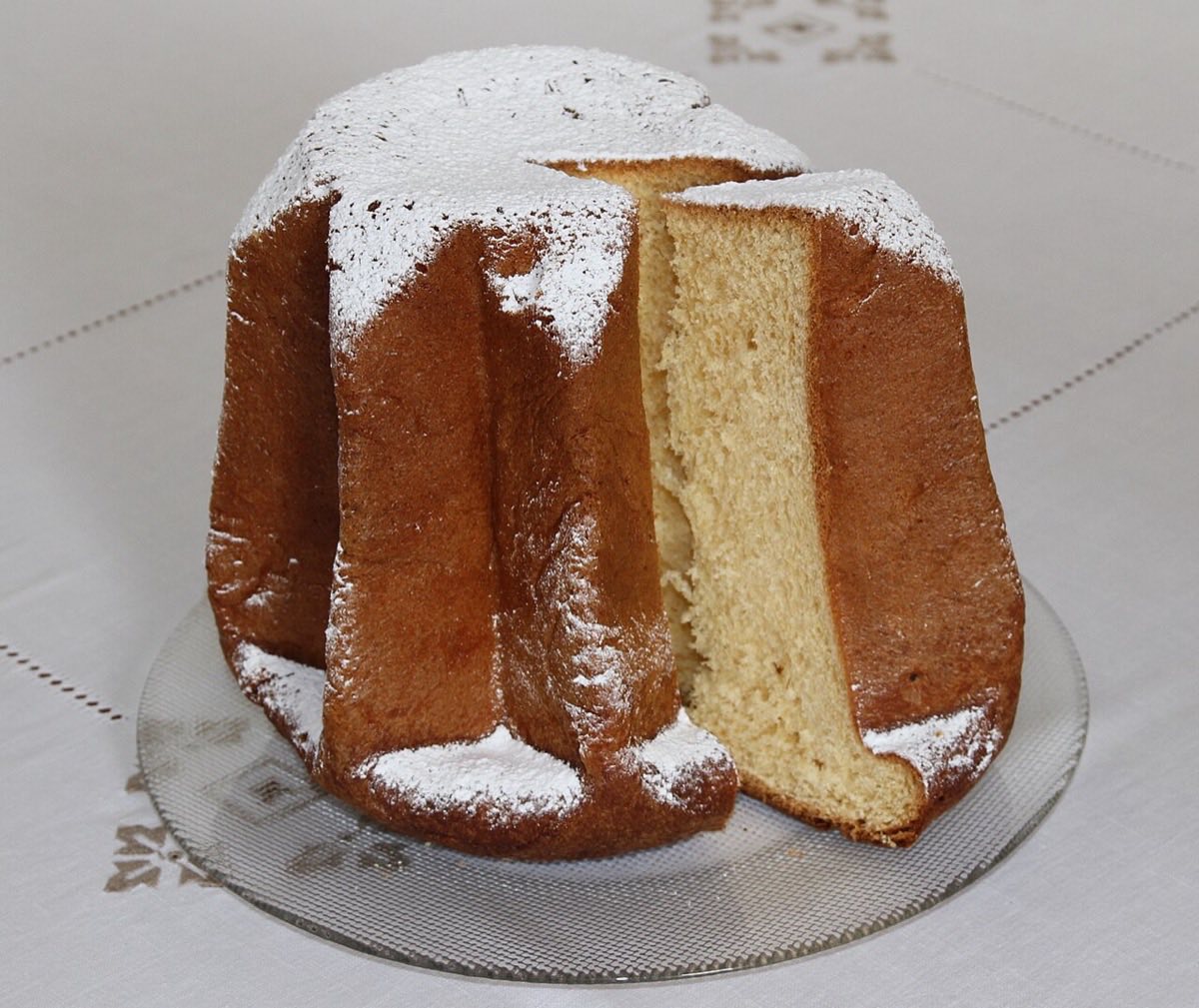
According to Turismo Roma, pangiallo has lost ground to panettone and pandoro in recent decades, but many bakeries and pastry shops in Rome still make it. It shares Lazio’s list of traditional products with another Roman classic, the maritozzo, the cream-filled bun that Romans eat for breakfast all year.
What do Romans eat on New Year’s Eve and New Year’s Day?
On the night of 31 December, Romans eat cotechino with lentils. Cotechino is a large pork sausage, boiled and served in thick slices. Turismo Roma explains the old belief: these foods keep debts away and bring money in the new year, and raisins and pork chops were musts on the table too. Lazio grows its own lentils: those of Rascino and of the island of Ventotene are both on the regional list. For the night itself, with the concert and getting home after midnight, see our guide to New Year’s Eve in Rome.
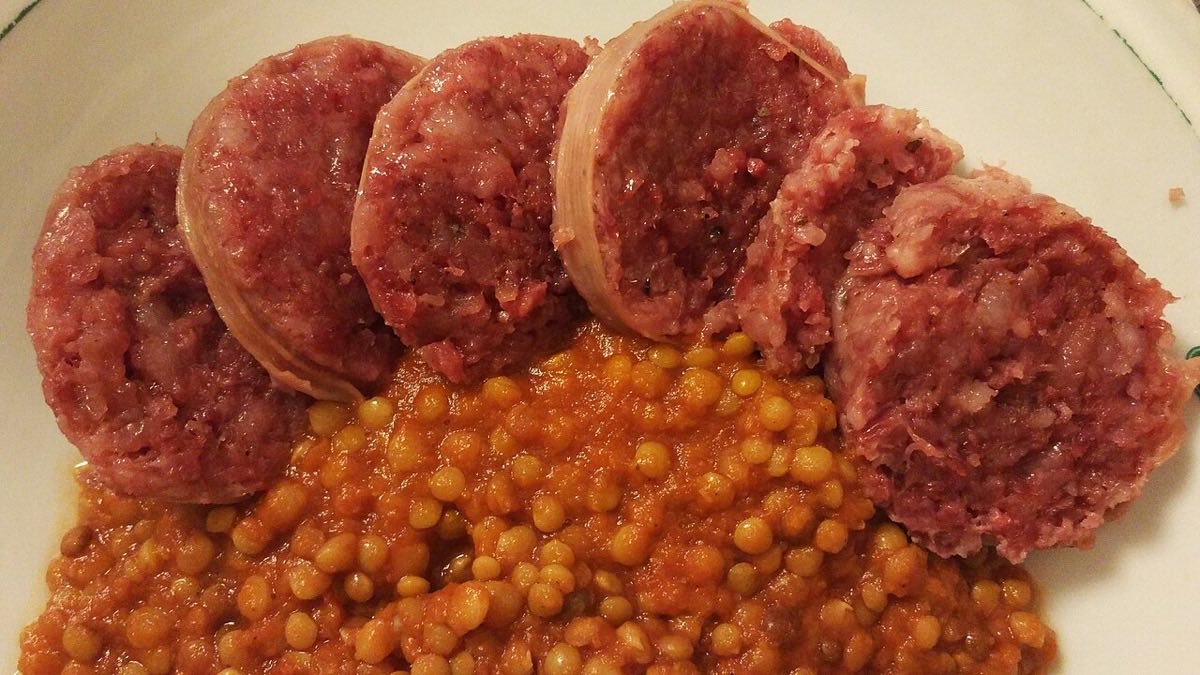
New Year’s Day lunch is another family feast. The traditional menu starts with a light chicken broth, then fresh fettuccine, baked gnocchi alla romana or lasagne, then roast lamb with potatoes, chicory or puntarelle, and, for the most superstitious, a spoonful of the night’s lentils for extra luck. For dessert: pangiallo, torrone and ciambelline al vino, crunchy wine biscuits for dipping in a glass of wine from the Castelli Romani.
Where can you taste or buy Roman Christmas food?
- Markets. The covered market of Testaccio has fishmongers, bakers, butchers and greengrocers under one roof, and opens Monday to Saturday from 7:00 to 15:30. Its website does not list holiday hours: on 24 and 31 December go in the morning, and do not count on it on 25 and 26 December or 1 January. In Trastevere, the San Cosimato market runs every morning except Sunday, with broccoli and artichokes in season and fish from the Lazio coast. Read more in our guide to the markets of Rome.
- Bakeries and pastry shops. In December, look for pangiallo in Roman bakeries (forni) and pastry shops (pasticcerie). Panettone and pandoro are everywhere, from supermarkets to artisan bakeries.
- Christmas markets. The Piazza Navona Christmas market has stalls with sweets among the toys and nativity figurines. Dates and other markets are in our guide to Christmas in Rome.
- Restaurants. Many restaurants and shops close on 25 December and on the afternoon of the 24th. For a Roman Christmas Eve dinner or Christmas Day lunch, book well ahead and ask if the menu is the traditional one.
- At home. To bring a taste of Rome home, bake the ricotta and sour cherry tart, a classic of Rome’s Jewish Ghetto, with our recipe.
Still deciding when to come? See our guide to the best time to visit Rome.
Can you take a food tour or cooking class in Rome at Christmas?
Yes. Our shared food tour and our shared pizza and pasta classes also run in December. The food tour does not run on December 25 or January 1. If you plan a cooking class on December 25 or January 1, check the calendar when you book: not every class runs on those days. For the other holiday dates, check the available dates when you book, and book early.
Our Trastevere and Jewish Ghetto food tour is a 2.5-hour shared walk in English, starting at 10:00 and 17:00 in Piazza Trilussa, in front of the poet’s statue. You taste local specialties through Trastevere, Campo de’ Fiori and the Jewish Ghetto, home of the old cottio, and finish with fresh pasta, wine and dessert. It costs €150 per person; children pay the same price, and wine is served only to adults. The tour runs rain or shine.
To cook, join our pasta making class: you make fresh pasta from scratch in traditional shapes, with seasonal sauces, then eat together, with unlimited wine for adults. It starts at 11:00, 15:00 or 18:30, lasts 3 hours and costs €79 per person from December to March (€89 from April to November). The pizza making class starts at 11:00, 15:00 or 18:30 for 3 hours: you make the dough with a pizza chef, add seasonal toppings and bake your pizza, then eat it with the group, for €79 per person. For the other start times, we send you the meeting point when you book. See all our cooking classes in Rome.
Our cooking classes are not suitable for celiacs or a gluten-free diet. On the food tour, tell us about allergies or intolerances when you book: we adapt where possible, but we cannot guarantee there is no cross-contamination. Food tours and classes are non-refundable once confirmed.
Explore it with us
 Trastevere & Ghetto Food Tour2.5-hour shared food walk with tastings, pasta and wine · €150 per personBook now
 Pasta Making Class3-hour shared class, with the meal you make and wine · from €79 per personBook now
 Pizza Making Class3-hour shared class: bake your own pizza, then eat it together · €79 per personBook now
FAQ
What do Italians eat on Christmas Eve?
Traditions change from region to region. In Rome, Christmas Eve dinner is traditionally meatless: seafood starters with marinated eel, skate broth and spaghetti with clams, roast fish, and fried salt cod, broccoli and artichokes, followed by citrus fruit, nuts, pangiallo and torrone.
What is pangiallo?
Pangiallo is Rome’s traditional Christmas cake: a round loaf of dried fruit, nuts, honey and candied citron under a yellow coating. Tradition links it to the winter solstice in ancient Rome, and it is on Lazio’s official list of traditional food products. Look for it in Roman bakeries and pastry shops in December.
What are the traditional Italian Christmas desserts?
The best known are panettone, from Milan, and pandoro, from Verona, whose names are protected by Italian law. Each region also has its own sweets: in Rome they are pangiallo and torrone, while nearby Umbria has panpepato, a dark cake of nuts, honey, cocoa and pepper.
What do Romans eat on Christmas Day?
A long family lunch: stracciatella or cappelletti in broth, then the capon cooked in that broth with a green sauce, then breaded lamb chops with fried vegetables, chicory or cardoons, and finally fruit and the Christmas sweets.
Why do Romans eat lentils on New Year’s Eve?
For luck with money. In Rome, cotechino with lentils on the night of 31 December was believed to keep debts away and bring money in the new year. The most superstitious also eat a spoonful of the leftover lentils at New Year’s Day lunch, for extra luck.
Can you take a cooking class in Rome at Christmas?
Yes. Our shared pizza and pasta classes and our food tour also run in December. The food tour does not run on December 25 or January 1. If you plan a cooking class on December 25 or January 1, check the calendar when you book: not every class runs on those days. For the other holiday dates, check the available dates when you book, and book early. Our cooking classes are not suitable for celiacs or a gluten-free diet.
Comment (0)