
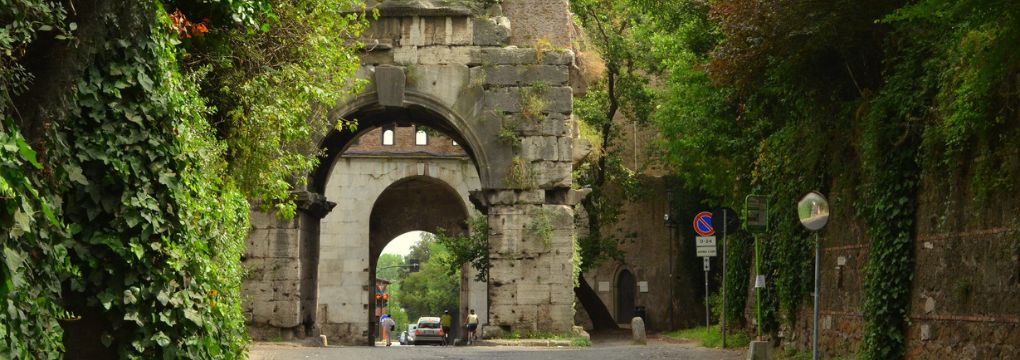
Sitting along the Via Appia, known as the “Queen of Roads” and a famous pilgrimage route, Porta San Sebastiano in Rome is named after the martyr buried nearby. Over the centuries, it’s been the scene of many key historical events, making it one of the most important gates leading into Rome.
Ancient Times: Building the Aurelian Walls to Protect Rome
Between 271 and 275 AD, the Roman Emperor Aurelian built new city walls to replace the smaller Servian Walls, which couldn’t keep up with Rome’s growth. These new walls had 381 towers and 17 gates, one of which was Porta San Sebastiano (initially called Porta Appia). It was built with two defensive towers and two arches, all connected by a walkway. The towers were raised and fortified not long after it was completed. A courtyard with a customs office was added. A parking area for carriages that couldn’t enter the city was nearby.
In 403 AD, Emperor Honorius ordered a major renovation of the city walls to ward off a potential barbarian invasion. Porta San Sebastiano in Rome was updated during this project:
The towers were rebuilt.
The façade was reduced to a single arch.
A sliding gate was added for extra protection.
Later, in 536 AD, after an earthquake, the Byzantine general Belisarius reinforced the lower part of the towers with marble. This period also saw a Christian inscription added to the inner part of the gate.
Medieval and Renaissance Eras: Porta San Sebastiano’s Role as a Key Entrance
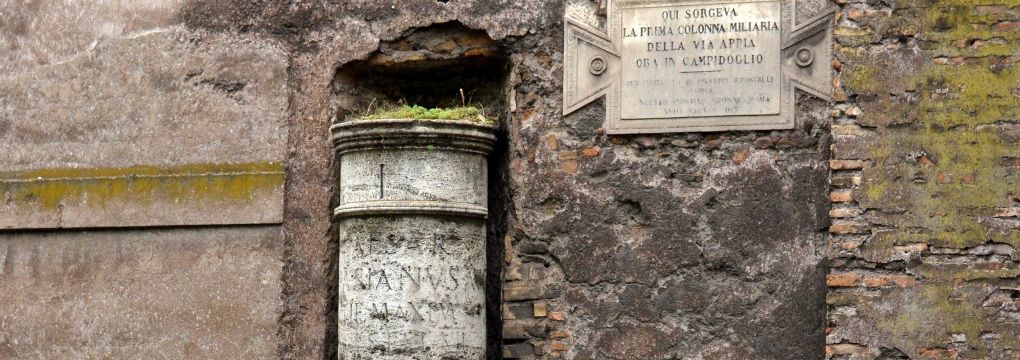
In 776 AD, Pope Adrian I started a big city renovation, including its walls and gates. Porta San Sebastiano was sometimes called Porta Appia or Porta Capena due to confusion with another gate. In 1327, it became the site of battles between the Guelphs and Ghibellines.
By 1450, the gate was officially named Porta San Sebastiano because of its proximity to the Basilica of Saint Sebastian, a popular pilgrimage destination. During this time, Pope Nicholas V had the gate restored. Later, in 1536, for the arrival of King Charles V, Pope Paul III had it decorated as a triumphal arch. This tradition was repeated for Marcantonio Colonna’s victory parade after the Battle of Lepanto in 1571.
Modern Era: The Creation of the Museum of the Walls
Over time, Porta San Sebastiano remained one of the most important gateways into Rome. In the 1840s, architect Luigi Canina removed nearby walls and buildings to make the gate more accessible.
Between 1940 and 1943, the gate was used as a residence and studio for Ettore Muti, a Fascist Party official. Architect Luigi Moretti restored the structure during this period. After World War II, the gate was abandoned but later repurposed in the 1960s and 70s as a small exhibition space. In 1989, it officially became the Museum of the Walls, featuring two floors of exhibits with seven rooms covering ancient, medieval, and modern history. Visitors can also enjoy a 400-meter panoramic walk along the Aurelian Walls up to Porta Ardeatina.
How to Visit
Today, the Museum of the Walls offers free admission to all visitors. As schedules may occasionally change, it’s always best to double-check the latest opening hours and notices on the museum’s official channels before your visit.
Porta San Sebastiano and the Museum of the Walls can also be included as a stop on one of our Private Golf Cart or Dolce Vita tours, creating a perfect combination of history, panoramic views, and a relaxing ride along the Appian Way and through Rome’s historic streets. Ask our drivers to take you to the Museum of the Walls — it’s a great off-the-beaten-path viewpoint, with the chance to walk along the Aurelian Walls.
Information
Address: Via di Porta San Sebastiano, 18 – Rome
Hours
Tuesday to Sunday 10.00am – 4.00pm
Last admission: 1 hour before closing time
Closing days: Monday, May 1st, December 25th
For updates and visiting guidelines, please check the official website


Comment (0)