
The ancient Romans erected the grand Theatre of Marcellus in the Campo Marzio, a district traditionally dedicated to theatrical performances. Notably, this site had housed the theatrum et proscenium ad Apollinis since 179 B.C., a structure connected to the nearby Temple of Apollo.
Origin and Construction of the Theatre of Marcellus
Julius Caesar initially started the project for the Theatre of Marcellus. He expropriated the area and demolished the existing buildings. Afterward, Augustus continued the project. Through additional expropriations and demolitions, he expanded the area to construct a building larger than Caesar’s original plan.
The Theatre of Marcellus was likely completed by 17 B.C. Augustus inaugurated it in either 13 or 11 B.C., dedicating it to Marcus Claudius Marcellus. Marcellus, the son of Octavia (the emperor’s sister), was Augustus’ nephew and designated successor. However, Marcellus died prematurely at Baiae in 27 B.C.
Later Restorations and Transformations
Over the years, Vespasian and Alexander Severus restored the theatre, keeping it in use through the 4th century. Later on, the Pierleoni and Fabi families transformed it into a fortress, taking advantage of its elevated position near the Tiber. In the 16th century, Baldassarre Peruzzi built a noble palace for the Savelli family on its upper levels. Two centuries later, the Orsini family acquired the property.
Between 1926 and 1932, the Municipality of Rome took over the lower part of the ancient theatre. They conducted a complete restoration, removing the surrounding structures and reclaiming some of the rooms.
Architectural Features
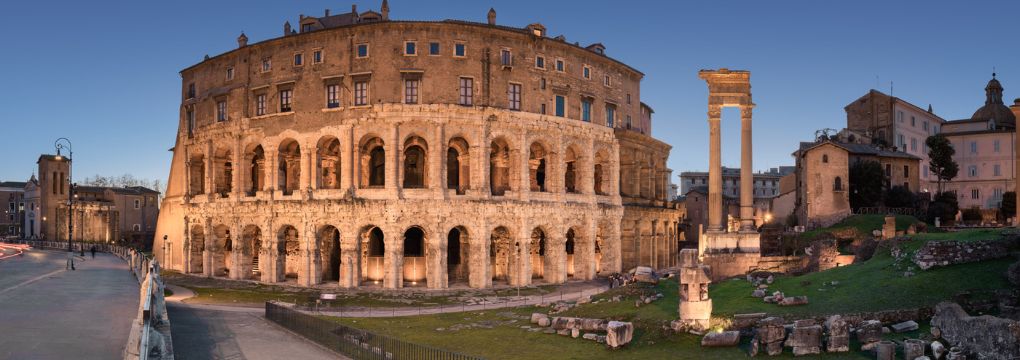
The Theatre of Marcellus stood as a majestic structure with a 130-meter diameter, fully showcasing Roman-style theatre. Builders constructed its semicircular cavea on blocks of tuff, using opus reticulatum and brickwork, and supported it with white marble seating. They designed the exterior with a travertine façade in a triple order; today, the lower two orders remain. These consist of arcades on pilasters, with Doric and Ionic half-columns. Moreover, colossal marble masks on the keystones of the lower arches represented tragedy, comedy, and satirical drama.
Additionally, builders decorated the shallow stage with columns and statues of white and polychrome marble. On either side, two halls with triple naves opened, with a large apse behind them to protect the theatre from potential flooding by the Tiber. Furthermore, a velarium covered the theatre, which seated approximately 15,000 to 20,000 people.
Modern Accessibility to the Theatre of Marcellus
Recently, authorities reopened a passage to the public. This passage connects Via Montanara, the remnants of the square at the foot of the Tarpeian Rock (demolished in the 1930s), with the Portico of Octavia and the Jewish Quarter. In addition, deterrent posts and chains mark the pedestrian path, keeping it clear of archaeological remains and redesigning the area’s accessibility. Thus, this layout allows visitors to approach the Theatre of Marcellus more closely. They can admire the grandeur of Roman architecture, right up to the arches, thereby enhancing their experience.
Surrounding Archaeological Area
The archaeological area around the Theatre of Marcellus also includes the remains of the Temples of Apollo Sosianus and Bellona.
Temple of Bellona –The Romans built the Temple of Bellona in 296 B.C. They dedicated this rectangular structure to Bellona, the ancient Roman goddess of war. The temple featured six columns at the front and eleven along each side, set on a high podium with a frontal staircase. Today, only the cement core of the Augustan-era podium remains.
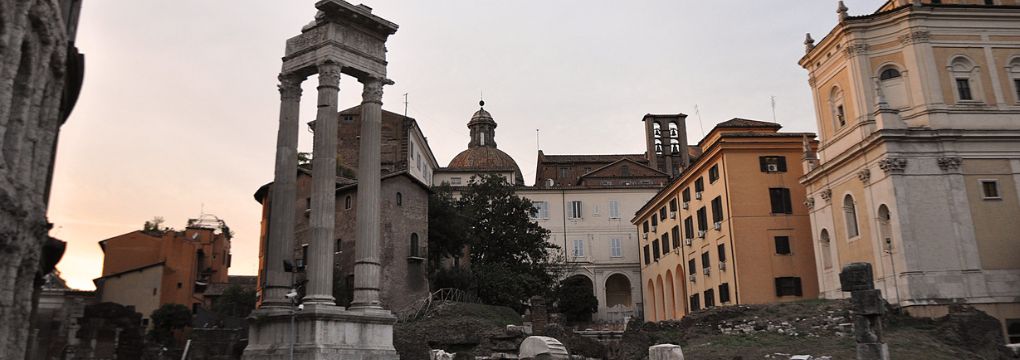
Temple of Apollo –The Romans erected the Temple of Apollo in 431 B.C. Over time, they restored and rebuilt it multiple times, with the final reconstruction by Gaius Sosius during the Augustan era. This structure was similar to the Temple of Bellona, with two lateral staircases. Currently, three white marble Corinthian columns, reconstructed in 1940, stand as remnants.


Comment (0)