
The Mouth of Truth (Bocca della Verità) is a large ancient marble disc carved with a bearded face, probably a Roman drain cover, in the portico of the church of Santa Maria in Cosmedin. A medieval legend says it bites the hand of anyone who lies. You can see it every day from 9:30 to 17:50, except January 1.
Cover photo: Dnalor 01, CC BY-SA 3.0, via Wikimedia Commons
Every day, visitors come to a church portico near the Tiber to put a hand into the open mouth of a stone face and test an old legend. Rome’s tourism office calls the Mouth of Truth one of the most famous symbols of the city, and it stands in one of Rome’s oldest corners: the Forum Boarium, the ancient cattle market between the Tiber and the Capitoline, Palatine and Aventine hills. We are Facile Tours, a local tour operator in Rome since 2012, and several of our golf cart and Fiat 500 tours pass this square. This guide explains what the marble disc probably was, the legend of the liars’ hands, the history of Santa Maria in Cosmedin and its bell tower, how the visit works and what to see nearby.
What is the Mouth of Truth?
The Mouth of Truth is a round marble slab carved with a man’s face. The face has a beard, and its eyes, nose and mouth are pierced right through. The disc stands on a Corinthian capital against the wall of the portico of the Basilica of Santa Maria in Cosmedin, where it has been since 1632, according to Rome’s official tourism website, Turismo Roma.
| Mouth of Truth | At a glance |
|---|---|
| What it is | A round marble slab carved with a bearded face, with pierced eyes, nose and mouth |
| Size | About 1.8 m (6 ft) in diameter (Turismo Roma) |
| Where | Portico of the Basilica of Santa Maria in Cosmedin, Piazza della Bocca della Verità 18 |
| In the portico since | 1632 |
| What it probably was | A Roman drain cover; the basilica sees in it the god Faunus |
| The legend | It bites the hand of anyone who lies |
The square in front of the church is named after it: Piazza della Bocca della Verità, “the square of the Mouth of Truth”.
What was the Mouth of Truth originally?
No one knows for sure, and the two official sources give different answers.
- A Roman drain cover. According to Turismo Roma, the disc was probably a manhole cover from Roman times. It links it to the Cloaca Maxima, the great drain that ran from the Suburra through the Forum to the Tiber near the ancient Pons Aemilius. Marble covers decorated with reliefs were set along it, and the face on this one may be Jupiter, a faun or a river god.
- An image of the god Faunus. The basilica’s website mentions the drain-cover idea, but points out that the holes on the sides of the disc held metal clamps, so it once hung upright on a wall. The basilica believes that the face is Faunus, an ancient Italic god of fields and flocks, and that the Romans probably placed it in a temple of Ceres that stood where the church is now.
Either way, the disc is ancient, and it reached the church portico much later. According to Turismo Roma, the name “Mouth of Truth” dates from 1485.
What is the legend of the Mouth of Truth?
The legend is medieval: the mouth would bite off the hand of anyone who did not tell the truth. According to Turismo Roma, the story was popular with jealous husbands, who brought their wives to the stone. Each woman had to put her hand in the mouth and swear that she had not been unfaithful.
The basilica’s website tells the best-known version. A young Roman nobleman, sure that his wife was cheating on him, made her swear her innocence before the Mouth of Truth. She asked her lover to push through the crowd on the day of the test, pretending to be mad, and to hug her in front of everyone. Then, with her hand in the mouth, she swore that no man had ever embraced her except her husband and that madman. It was true, her hand came out unharmed, and the husband was satisfied. The basilica adds a practical explanation for the legend: the judges probably hid a man with a sharp sword behind the stone.
The legend found a new audience in 1953 with the film Roman Holiday: in its best-known scene, Gregory Peck pulls his hand out of the mouth as if it had been bitten off, a trick he improvised on set, according to Turismo Roma. Read more in our post on Roman Holiday and its Rome locations.
What is the history of Santa Maria in Cosmedin?
The church behind the Mouth of Truth is much older than the mask’s fame. According to Turismo Roma, it is first recorded in the 6th century AD as Santa Maria in Schola Graeca. The riverbank here, near Rome’s ancient port, was home to a Greek community, and this bank of the Tiber was called Ripa Graeca.
- 8th century: Pope Hadrian I enlarged and decorated the church in 782. It stands over the Ara Maxima, the great altar of Hercules, whose tuff core still survives in the back half of the church, according to Turismo Roma. For a time he entrusted it to Greek monks who had fled to Rome during the iconoclast crisis, according to the basilica’s history page.
- The name: Cosmedin comes from a Greek word for “decorated”, according to the basilica. Turismo Roma links it to a famous monastery in Constantinople, the Kosmidion.
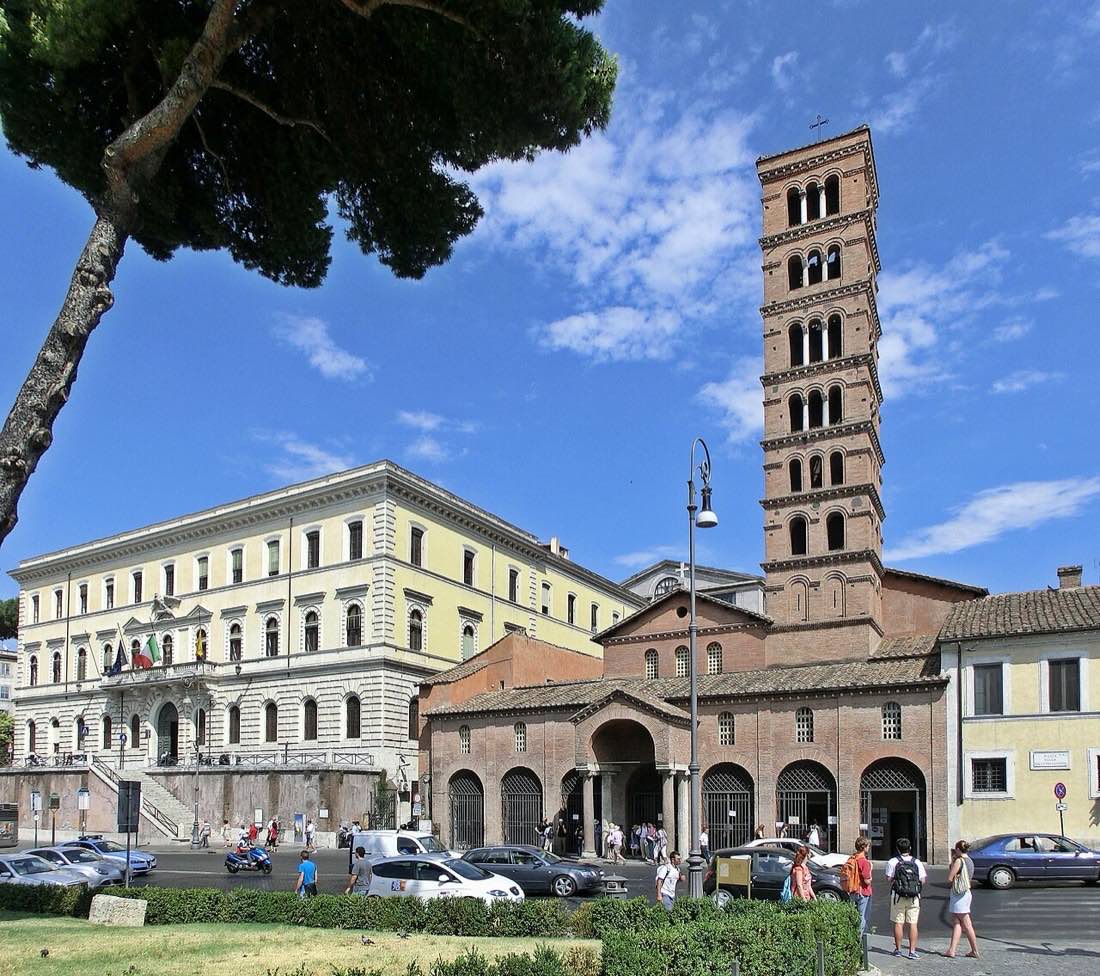
- 12th century: after damage during Robert Guiscard’s invasion, the church took the form you see today. The portico and the bell tower are the work of Alfano, the papal chamberlain of Pope Callixtus II, who led almost all the restoration work of that century. His tomb, from 1120–1123, is still at the basilica.
- Inside: the interior was restored to its 8th-century form. It has three naves divided by four pillars and 18 ancient columns, 11 of them with Roman capitals, a Cosmatesque marble floor, fragments of 8th- and 9th-century frescoes, the enclosure for the choir (schola cantorum) built under Callixtus II, and a Gothic canopy over the altar, the work of Deodato in 1294.
- Since 1963: on June 1, 1963, Pope Paul VI gave the basilica to the Patriarch of the Melkite Greek Catholic Church, Maximos IV Saigh. Today it is the seat of that Church’s representative to the Holy See, and the Divine Liturgy is celebrated in the Byzantine rite.
What is special about the bell tower and the crypt?
The bell tower. The Romanesque bell tower rises 34.2 m (about 112 feet) above the square, with seven floors of windows divided by small columns into two or three arches, and one of its bells dates from 1289, according to Turismo Roma. Like the portico, it was built in the 12th century under Alfano. You see it from the square.
The crypt. Under the church is the crypt of Pope Hadrian I, from the 8th century. According to the basilica’s website, it was dug into the massive ancient foundations under the church, which the basilica links to the temple of Ceres and Turismo Roma to the Ara Maxima of Hercules. It is a small hall with six columns in three narrow aisles, ending in a small apse. The altar was cut from a Roman stone marker (cippus) and held the relics of St. Cyrilla, and the columns have no bases, sunk deep into the floor. Neither official website says whether the crypt is open to visitors, so ask at the church.
How do you visit the Mouth of Truth? Hours, tickets and tips
| Visit facts | Details |
|---|---|
| Where | Portico of the Basilica of Santa Maria in Cosmedin, Piazza della Bocca della Verità 18 |
| Opening hours | Every day 9:30–17:50 (the Mouth of Truth follows the basilica’s hours) |
| Closed | January 1 |
| Sunday | Divine Liturgy in the Byzantine rite at 10:30 |
| Ticket | Not mentioned by the basilica’s website or Turismo Roma |
| Phone | +39 06 6787759 |
| Nearest metro | Circo Massimo (line B), about 15 minutes on foot (our estimate) |
- Hours. The Mouth of Truth is in the portico, so you can see it when the basilica is open: every day from 9:30 to 17:50, closed on January 1, according to the basilica’s website. The Italian page of Turismo Roma lists a break from 13:00 to 14:00, while the English page does not, and both say that hours can change. If you plan to go around lunchtime, call the church first.
- Ticket. Neither the basilica’s website nor Turismo Roma mentions a ticket or a booking to see the Mouth of Truth.
- The photo. The classic photo is the one with your hand in the mouth. It is a popular spot, so you may have to wait your turn: take your photo and leave room for the next visitors.
- A place of worship. Santa Maria in Cosmedin is a working church. On Sundays the Divine Liturgy is celebrated at 10:30, and the main feasts have their own program on the basilica’s website, according to Turismo Roma. Visit the church quietly, especially during services.
- Getting there. The square lies between the Tiber and the west end of the Circus Maximus. The nearest metro station, Circo Massimo (line B), is at the other end of the Circus, about 15 minutes on foot, and the Colosseum is about 15–20 minutes away (our estimates).
What else can you see around the Mouth of Truth?
The Mouth of Truth is a good start for a short walk through one of Rome’s oldest areas. The Forum Boarium, the ancient cattle market, lay here, according to Turismo Roma. Legend says that Hercules killed the giant Cacus here, after Cacus stole the oxen of Geryon from him, and the tuff core of the Ara Maxima, the great altar of Hercules, survives inside Santa Maria in Cosmedin.
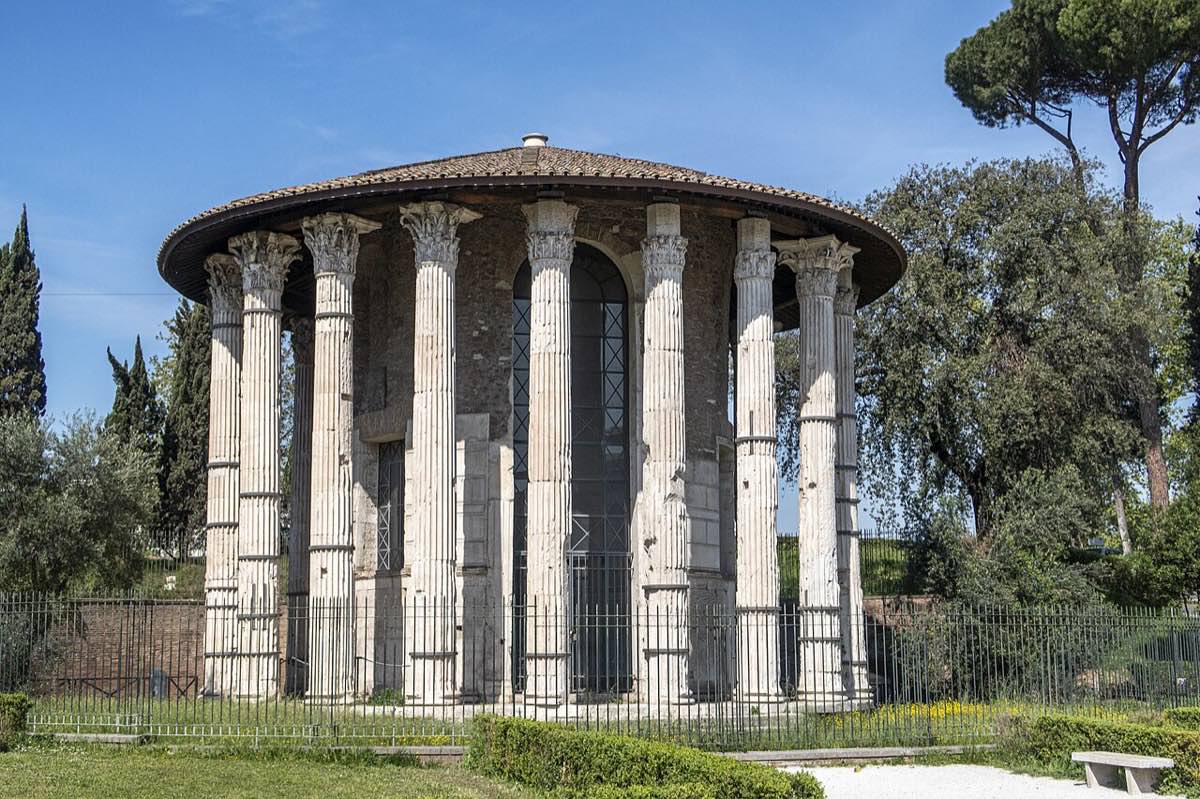
The Temple of Hercules Victor. Across the square stands a small round temple with a ring of 20 columns. The Soprintendenza Speciale di Roma, the Ministry of Culture’s office for the city, considers it the oldest surviving marble building in Rome. It was long believed to be a temple of Vesta, but an inscription names Hercules Olivarius. A Roman olive oil merchant, Marcus Octavius Herennius, had it built toward the end of the 2nd century BC, perhaps to a design by the Greek architect Hermodoros of Salamis. It became the church of Santo Stefano in 1140 and later Santa Maria del Sole, and the architect Giuseppe Valadier restored it in 1809, according to Turismo Roma. Visits inside are suspended while the area is being rearranged, according to the Soprintendenza, so for now you see it from the outside.
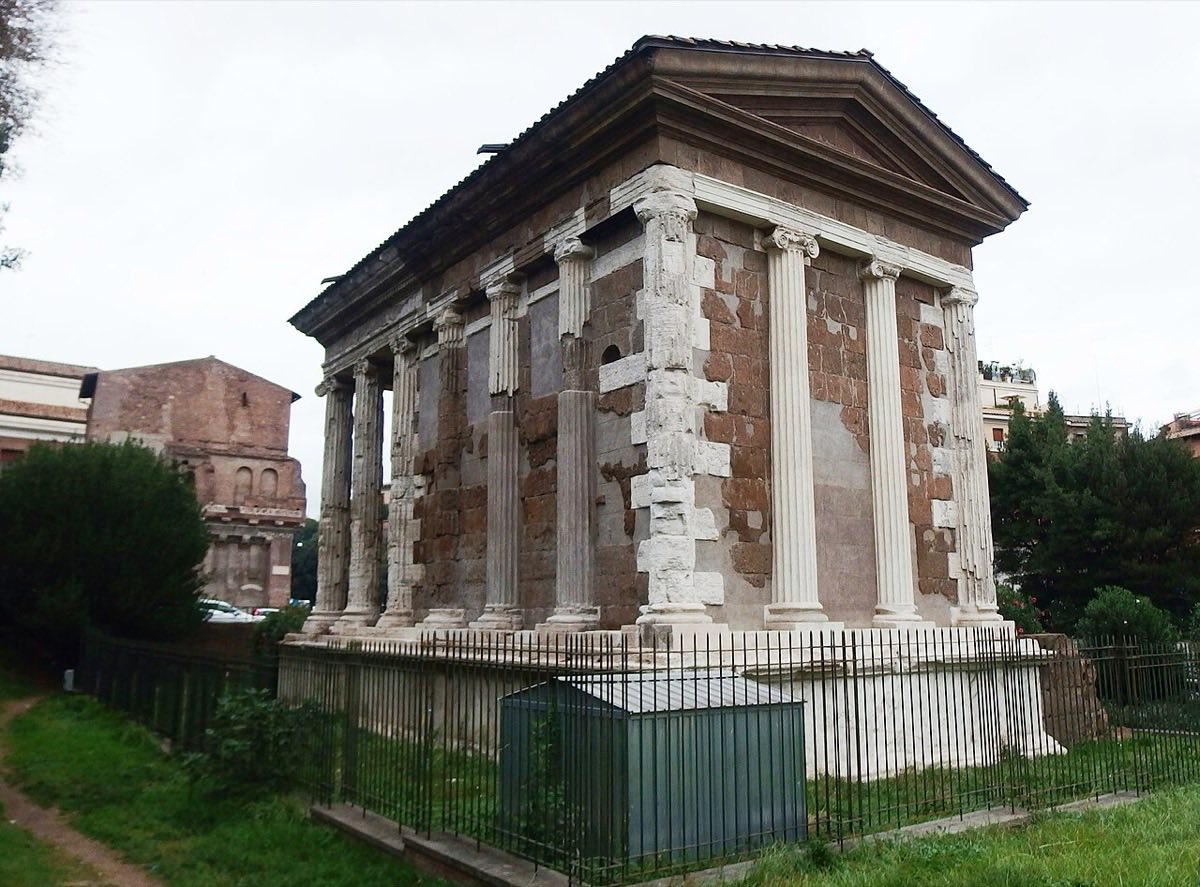
The Temple of Portunus. A few steps away is a rectangular temple dedicated to Portunus, the god of river ports, also known as the Temple of Fortuna Virilis. It stood by the Portus Tiberinus, the first commercial port on the Tiber. Its origins go back to the 4th or 3rd century BC, but its present appearance probably dates from the second half of the 2nd century BC, with later work in the 1st century BC. It stands on a high podium, with four Ionic columns at the front. In the 9th century it became a church, later known as Santa Maria Egiziaca, until it was deconsecrated in 1916; inside are frescoes from the Byzantine period with stories from the life of Mary. According to Turismo Roma, the monument can be seen from the outside.
Two Roman arches. Close by are the four-sided Arch of Janus, probably from the 4th century AD, and the elegant Arch of the Argentarii, from 204 AD, both listed by Turismo Roma among the monuments of the Forum Boarium.
The Circus Maximus. A few minutes’ walk east, the long grassy valley of the Circus Maximus begins: ancient Rome’s chariot-racing track, between the Palatine and the Aventine. Read our guide to the Circus Maximus for its history, hours and tickets. From its west end, the streets up the Aventine lead to the Orange Garden and the Aventine Keyhole.
The Theater of Marcellus. Walk north for about 7–10 minutes (our estimate) and you reach one of the most striking buildings of ancient Rome. Julius Caesar began it, and Augustus finished it and dedicated it in 13 or 11 BC to his nephew and chosen heir, Marcellus, according to the Sovrintendenza Capitolina, the City of Rome’s heritage office. It measured 130 m (about 430 feet) across and held about 15,000 spectators, up to 20,000 when needed. In the Middle Ages it became a fortress of the Pierleoni and Fabi families, and in the 16th century the architect Baldassarre Peruzzi built a palace on top of it for the Savelli family; the palace later passed to the Orsini. Turismo Roma says the theater can be seen only from the outside, and a pedestrian path from Via Montanara to the Portico of Octavia and the Jewish Quarter has reopened. Read our posts on the Theater of Marcellus and the Jewish Quarter.
The Mouth of Truth is a stop on the ancient Rome itinerary of the free Nemo audio guide app.
| Place | On foot from the Mouth of Truth (our estimate) | Can you go inside? |
|---|---|---|
| Temple of Hercules Victor | 1–2 minutes, across the square | No: visits are suspended for works in the area |
| Temple of Portunus | 1–2 minutes | No, it is seen from the outside |
| Circus Maximus (west end) | About 5 minutes | Yes, it is a free public park |
| Theater of Marcellus | About 7–10 minutes | No, it is seen from the outside |
See the Mouth of Truth with us
The Mouth of Truth is on the route of five of our tours. On all of them you see the Mouth of Truth and the temples from the outside, as part of the ride, like the other sights, and our drivers are not licensed tour guides. If the photo with your hand in the mouth matters to you, plan it on your own, before or after the tour.
- Roman Holiday tour by vintage Fiat 500: a private 4-hour tour of the film’s locations in a restored original Fiat 500 converted to electric or, depending on group size, a Fiat 850 Spiaggina. The route includes Santa Maria in Cosmedin and the Mouth of Truth, with the Spanish Steps, Via Margutta, the Pantheon, the Trevi Fountain, the Colosseum, Castel Sant’Angelo and St. Peter’s Square. A Trevi Fountain ticket and a snack are included. €690 for 1–3 people, €1,380 for 4, then €270 per person from 5 to 21. Pickup in the historic center at 9:30, 10:00, 14:30, 18:00 or 18:30.
- Private golf cart tour: the example route of the 3-hour tour includes the Orange Garden, the Mouth of Truth and the Temple of Hercules, right after the Colosseum and the Circus Maximus; the route always adapts to your pickup point and interests. €450 for 1–3 people, then €150 per person from 4 to 21, with the Trevi Fountain ticket and a stop for gelato or coffee. Pickup in the historic center at 9:30, 10:00, 14:30, 18:00 or 18:30. A 2-hour version, from November to mid-April, covers fewer stops.
- Vintage Fiat 500 tour: a private 3-hour tour with no fixed route. The typical route includes the Mouth of Truth and the temples of Hercules and Portunus, with the Colosseum, the Circus Maximus and the Orange Garden. A Trevi Fountain ticket and a short food stop are included. From €590 for 1–3 people, €1,180 for 4, then €240 per person.
- Shared golf cart tour: a fixed route from our office at Via del Colosseo 11A, at 9:30 or 14:30: the Colosseum, the Circus Maximus, the Orange Garden, the Mouth of Truth and the temples of Hercules and Portunus, then the Capitoline Hill, Piazza Navona, the Pantheon and the Trevi Fountain. €59 per person for 2 hours, ending at the Trevi Fountain, or €99 for 3 hours, which adds the Spanish Steps, the Villa Borghese Gardens and Piazza del Popolo and ends back at Via del Colosseo. You share carts of up to 7 people with other travelers.
- Semi-private golf cart tour: 3 hours on a fixed route that includes the Mouth of Truth and the two temples, with pickup at your hotel or Airbnb in the historic center between 9:30 and 10:00 or between 14:30 and 15:00. No more than 6 guests in the cart; €120 per person, up to 5 per booking.
Good to know on these tours:
- Groups: the private golf cart tour and the two Fiat 500 tours take up to 21 guests guaranteed (on the 2-hour golf cart tour, the maximum depends on the start time), with larger groups on request. The shared tour takes up to 21 per booking, and the semi-private tour up to 5.
- Pickup: the private and semi-private tours pick you up in the historic center; if you stay further out, you meet us at our office, Via del Colosseo 11A. The shared tour starts only from the office.
- Children: golf carts take children of any age, and child seats are available on private golf cart tours only. A folded stroller fits on board; just tell us when you book. Fiat 500 tours take children aged 3 and over, with no child seats, and some of the cars have no seat belts, because they were built before seat belts were required.
- Wheelchairs: on a private golf cart tour, wheelchair users move onto a seat of the golf cart, and the folded wheelchair travels on board in place of the two back seats. Contact us before booking if the traveler cannot move from the wheelchair to a seat. The shared and semi-private tours are not suitable for wheelchair users.
- Weather: the golf carts have rain covers and run in the rain. In rain or wet weather, the Fiat 500 tours run in golf carts; if none is available, we offer another date or time.
- Cancellation: full refund if you cancel at least 72 hours before the tour, 50% if you cancel at least 48 hours before; later cancellations and no-shows are not refunded.
| Way to see it | The Mouth of Truth | Time | Price |
|---|---|---|---|
| On your own | Up close, with the hand photo in the portico | As long as you like | No ticket mentioned on the official websites |
| Shared golf cart tour (ours) | Seen from the outside, on a fixed route | 2 or 3 hours | from €59 per person |
| Semi-private golf cart tour (ours) | Seen from the outside, on a fixed route | 3 hours | €120 per person |
| Private golf cart tour (ours) | Seen from the outside, on the example route | 3 hours | from €450 for 1–3 people |
| Vintage Fiat 500 tour (ours) | Seen from the outside, on the typical route | 3 hours | from €590 for 1–3 people |
| Roman Holiday Fiat 500 tour (ours) | Seen from the outside, as a film location | 4 hours | from €690 for 1–3 people |
If the Mouth of Truth is all you want to see, you do not need a tour: walk there, take your photo and visit the church and the temples on your own. Our tours make sense when you want to see it together with the Circus Maximus, the Aventine and the historic center in a few hours, without long walks. Not sure which tour suits you? Read our guide to the best tours in Rome for first-time visitors, or see all our golf cart tours in Rome and vintage Fiat 500 tours in Rome.
Explore it with us
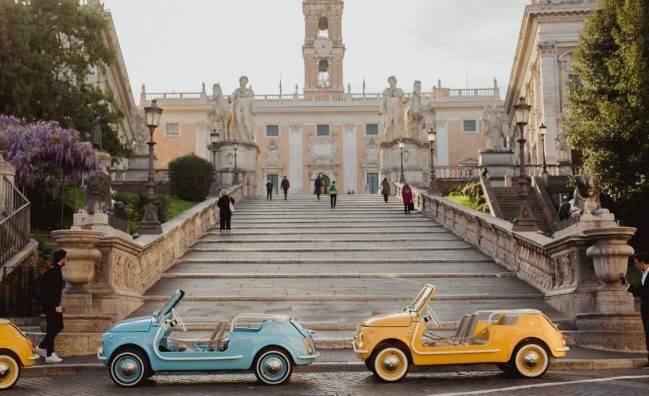 Roman Holiday Tour by Fiat 5004 hours past the film’s locations, the Mouth of Truth included · from €690 for 1–3 peopleBook now
 Shared Golf Cart Tour of Rome2 or 3 hours from Via del Colosseo 11A, on a fixed route with the Mouth of Truth · €59 per personBook now
 Private Golf Cart Tour of Rome3 hours with pickup in the center, on a route that adapts to you · from €450 for 1–3 peopleBook now
FAQ
What are the Mouth of Truth opening hours?
The Mouth of Truth follows the hours of the Basilica of Santa Maria in Cosmedin: every day from 9:30 to 17:50, closed on January 1, according to the basilica’s website. The Italian page of Rome’s tourism website lists a break from 13:00 to 14:00, so if you plan to go around lunchtime, call the church on +39 06 6787759.
Do you need a ticket to see the Mouth of Truth?
Neither the basilica’s website nor Rome’s official tourism website mentions a ticket or a booking. The mask is in the church portico, and you can see it during the basilica’s opening hours.
What is the legend of the Mouth of Truth?
According to a medieval legend, the mouth bites off the hand of anyone who lies. Jealous husbands brought their wives to swear their faithfulness with a hand in the mouth, and the basilica’s website suggests that judges hid a man with a sword behind the stone.
What was the Mouth of Truth originally?
Probably a Roman drain cover, perhaps from the Cloaca Maxima, according to Rome’s tourism office, with a face that may be Jupiter, a faun or a river god. The basilica believes it is an image of the god Faunus that once hung on a wall. It has stood in the church portico since 1632.
Where is the Mouth of Truth?
In the portico of the Basilica of Santa Maria in Cosmedin, at Piazza della Bocca della Verità 18, between the Tiber and the west end of the Circus Maximus. The temples of Hercules Victor and Portunus stand across the square.
Can you visit the church of Santa Maria in Cosmedin?
Yes. The basilica is open every day from 9:30 to 17:50, except January 1. Inside are 18 ancient columns, a Cosmatesque marble floor and a Gothic canopy over the altar from 1294. It is a Melkite Greek Catholic church, and the Divine Liturgy is celebrated on Sundays at 10:30, so visit quietly during the service.

Comment (0)