
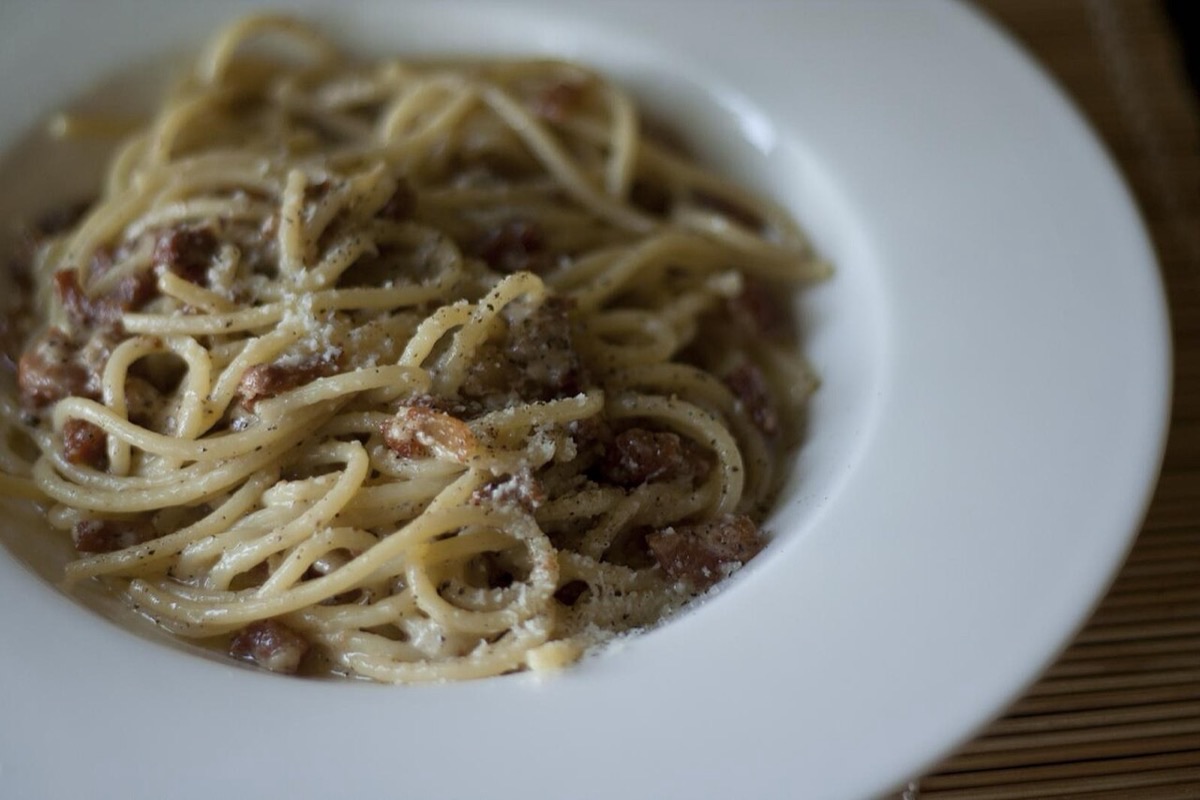
Authentic Roman carbonara is pasta with guanciale (cured pork cheek), eggs, Pecorino Romano and black pepper, with no cream, bacon or garlic. Cacio e pepe is even simpler: Pecorino, pepper and starchy pasta water. Together with gricia and amatriciana, they form Rome’s four classic pastas, built on the same few ingredients.
Cover photo: Luca Nebuloni, CC BY 2.0, via Wikimedia Commons
We have shown visitors around Rome since 2012, and we run cooking classes and food tours in the city. This post looks at Rome’s four classic pastas as one family: the few ingredients they share, how we make carbonara and cacio e pepe at home, with quantities for two people and the mistakes to avoid, where the dishes come from, and how to order them in Rome. For the rest of Roman cooking, from artichokes to the maritozzo, see our guide to Roman food.
What are Rome’s four classic pastas?
Rome’s classic pastas are one family. As Turismo Roma, the city’s official tourism website, explains, Roman cooking was a poor cuisine: it took a few cheap ingredients, such as guanciale, Pecorino, black pepper, eggs and tomato, and combined them in different ways. Change one ingredient and you get a different dish:
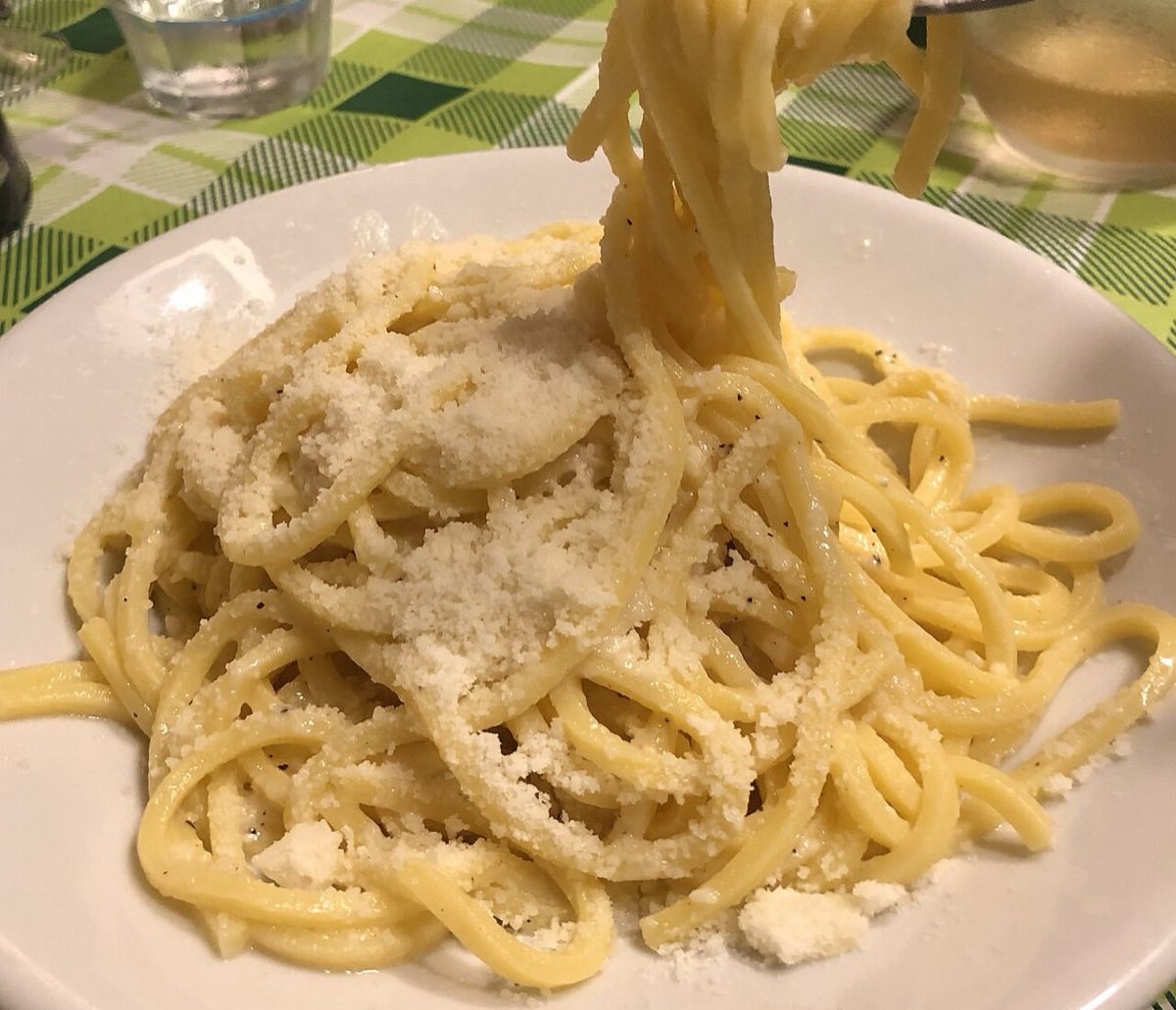
- Cacio e pepe: Pecorino Romano and black pepper. Cacio is the old central Italian word for cheese.
- Gricia: cacio e pepe plus guanciale.
- Carbonara: gricia plus eggs.
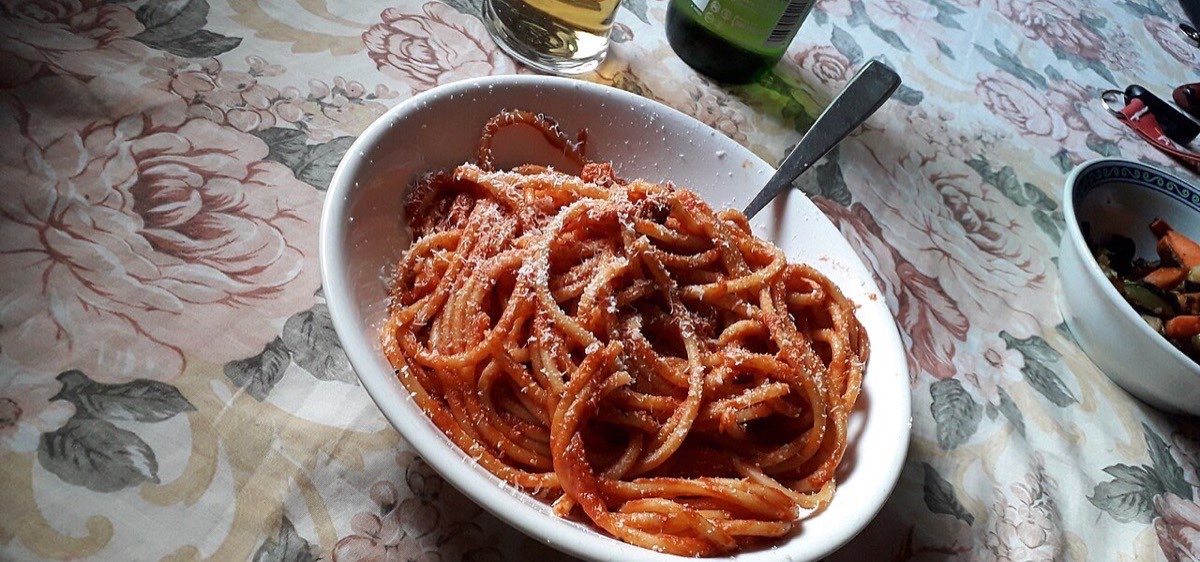
- Amatriciana: gricia plus tomato.
| Pasta | Main ingredients | Typical shapes | What to expect |
|---|---|---|---|
| Cacio e pepe | Pecorino Romano, black pepper, starchy pasta water | Tonnarelli, spaghetti | Sharp, salty and peppery; the hardest of the four to get right |
| Gricia | Guanciale, Pecorino Romano, black pepper | Rigatoni, spaghetti | Savory and rich, with crisp pieces of guanciale |
| Carbonara | Guanciale, eggs, Pecorino Romano, black pepper | Spaghetti, rigatoni | A golden, creamy sauce; the richest of the four |
| Amatriciana | Guanciale, tomato, Pecorino; often a splash of white wine and chili | Bucatini, rigatoni | A red sauce, sweet tomato against salty guanciale |
Romans also argue about the shape. Turismo Roma describes two schools: short pasta, especially rigatoni, or long pasta, especially bucatini or tonnarelli. There is no single correct answer, so in a trattoria take the shape the kitchen suggests.
Which ingredients do you need for Roman pasta?
With so few ingredients, each one matters.
- Guanciale: cured pork cheek, usually coated in black pepper. It is fattier than pancetta, which comes from the belly. Cooked slowly, its fat melts and the lean part turns crisp, and that fat becomes the base of the sauce. In our carbonara and gricia we add no oil or butter: the guanciale gives all the fat we need. Bacon is usually smoked, and it tastes different.
- Pecorino Romano: a hard sheep’s milk cheese, registered in the EU as a Protected Designation of Origin (PDO, DOP in Italian) since 1996, as the EU’s eAmbrosia register shows. According to the Pecorino Romano Consortium, it is made from whole sheep’s milk only in Lazio, Sardinia and the province of Grosseto in Tuscany, and aged at least 5 months as a table cheese or 8 months for grating, when its taste becomes sharp and intense. Despite the name, about 92% of it was made in Sardinia in the 2024–25 season, the Consortium says. On the rind, look for the name and the logo with a sheep’s head. Pecorino alone just means sheep’s milk cheese, and there are many kinds.
- Eggs: for two people we use one whole egg and two extra yolks. The yolks give color and richness, and the white makes the sauce a little lighter.
- Black pepper: whole peppercorns, freshly ground or crushed. In cacio e pepe, pepper is half the name.
- Pasta: good dried durum wheat pasta, such as spaghetti, rigatoni or bucatini. We prefer bronze-die pasta, whose rough surface holds the sauce better. Tonnarelli are fresh egg pasta with a square cut, like a thick spaghetti, and a classic with cacio e pepe.
How do you make authentic carbonara at home?
This is how we make carbonara. It is our method, not an official rule: every Roman family has its own version.
| Ingredient | For 2 people |
|---|---|
| Spaghetti or rigatoni | 200 g (7 oz) |
| Guanciale | 100 g (3.5 oz) |
| Eggs | 1 whole egg and 2 yolks |
| Pecorino Romano, finely grated | 50 g (1.75 oz), plus a little to serve |
| Black pepper | Freshly ground, to taste |
| Salt | A little, for the pasta water only |
- Cut the guanciale. Remove the hard rind, then cut it into strips or cubes about 1 cm (½ inch) thick.
- Put the water on. Bring about 2 liters (2 quarts) of water to a boil and salt it lightly: guanciale and Pecorino are already salty.
- Render the guanciale. Put it in a cold, wide pan, with no oil, over medium-low heat. Cook it for 8 to 10 minutes, stirring now and then, until the fat turns clear and the edges are golden and crisp. Turn off the heat.
- Make the egg cream. In a bowl, beat the egg and the yolks with the Pecorino and plenty of pepper into a thick paste.
- Cook the pasta one minute less than the package says. Before draining it, keep a cup of the cooking water.
- Toss it in the fat. Move the pasta into the guanciale pan and toss it over low heat for about a minute, so every strand is coated. Then take the pan off the heat and wait about 30 seconds: it should be hot, but no longer sizzling.
- Add the eggs off the heat. Pour in the egg cream with 2 or 3 tablespoons of the cooking water and toss quickly. The heat of the pasta thickens the eggs into a glossy sauce. Too thick? Add a spoonful of water. Too runny? Keep tossing for a few seconds, or put the pan back on very low heat for a moment, stirring all the time.
- Serve at once, with a little more Pecorino and pepper on top.
The eggs in carbonara are thickened by the heat of the pasta, not fully cooked. For dishes with raw or lightly cooked eggs, the US Food and Drug Administration advises using pasteurized eggs, especially when cooking for children, older adults, pregnant women or people with weakened immune systems.
What are the most common carbonara mistakes?
- Adding cream. Roman carbonara has no cream: the creamy texture comes from the eggs, the Pecorino and the starchy water.
- Using bacon. Smoked bacon changes the taste of the dish. If you cannot find guanciale, unsmoked pancetta is the closest substitute, but it is leaner, so the result is less rich.
- Scrambling the eggs. If the pan is still on the heat, the eggs set into lumps. Always add them off the heat, and keep tossing.
- Adding garlic, onion or parsley. None of them belongs in the Roman version.
- Salting too much. Use little salt in the water and none in the sauce. The guanciale and the Pecorino bring enough.
- Letting it wait. Carbonara thickens as it cools, so cook it last and eat it immediately.
- Swapping the cheese. Parmigiano Reggiano is milder and sweeter. Some cooks mix the two cheeses, which is a matter of taste; we use only Pecorino Romano.
How do you make cacio e pepe at home?
Cacio e pepe has only three ingredients, and that makes it the trickiest of the four: everything depends on technique and heat. This is our method.
| Ingredient | For 2 people |
|---|---|
| Tonnarelli or spaghetti | 200 g (7 oz) |
| Pecorino Romano, very finely grated | 80 g (about 3 oz), plus a little to serve |
| Black peppercorns | 1 to 2 teaspoons, freshly crushed |
| Water | About 1.5 liters (1.5 quarts) for the pasta, with very little salt |
- Grate the Pecorino very finely, on the finest side of the grater, and let it come to room temperature.
- Toast the pepper. Crush the peppercorns and toast them in a wide, dry pan over low heat for about a minute, until they smell fragrant. Turn off the heat.
- Cook the pasta in less water than usual, with very little salt. Less water means starchier water, and the starch is what binds the sauce.
- Make the cheese cream. Take a ladle of the cooking water and let it cool for a minute. In a bowl, mix the Pecorino with a few spoonfuls of this warm water into a smooth, thick cream.
- Finish the pasta in the pan. About two minutes before it is ready, move the pasta into the pepper pan with a ladle of cooking water. Let it finish cooking over medium heat, tossing, until most of the water is absorbed.
- Take the pan off the heat and wait about 30 seconds. Add the cheese cream and toss hard, adding cooking water a spoonful at a time, until the sauce is creamy and coats every strand.
- Serve immediately, with a pinch of pepper and a little Pecorino on top.
Why does cacio e pepe go lumpy?
Almost every failed cacio e pepe has the same cause: too much heat.
- The pan or the water is too hot. Pecorino then melts into rubbery lumps and strings instead of a cream. Add the cheese off the heat, and mix it with warm water, never boiling water.
- The cheese is grated too coarsely. Coarse Pecorino melts unevenly. Use the finest side of the grater.
- There is not enough starch. Pasta cooked in a large pot of water leaves thin water that cannot bind the sauce. Use less water.
- Adding butter, oil or cream. Some recipes add them to make the sauce easier. The Roman classic is just Pecorino, pepper and the pasta water.
- Using pre-ground pepper. It has little aroma. Crush whole peppercorns just before cooking.
- Salting the water as usual. Pecorino Romano is salty, so go easy on the salt.
Where do carbonara and the other Roman pastas come from?
Gricia and amatriciana come from the mountains northeast of Rome. According to Visit Lazio, the official tourism website of the Lazio Region, shepherds moving their flocks across the Laga Mountains made gricia, and at the end of the 18th century, with tomatoes from the Americas, the dish became amatriciana, named after the town of Amatrice. Since March 13, 2020, “Amatriciana tradizionale” has been registered in the EU as a Traditional Speciality Guaranteed (TSG), as the eAmbrosia register shows. Visit Lazio lists its three essential ingredients: guanciale, Pecorino (Amatriciano, or Pecorino Romano PDO from Lazio) and peeled tomatoes or passata.
Carbonara is younger than most people think, and its origin is still debated. It is missing from the classic Italian cookbooks of the first half of the 20th century, such as those by Pellegrino Artusi and Ada Boni. The first printed recipes appeared in the early 1950s: one in a 1952 guide to Chicago restaurants, and the first Italian one in 1954, in the magazine La Cucina Italiana, made with pancetta, garlic and Gruyère. The dish spread across Italy in the 1960s, after the chef Luigi Carnacina included it in his book La grande cucina.
How it was born, nobody knows for sure. These are the main theories:
- The charcoal burners. The name may come from the carbonari, the charcoal burners who worked in the Apennine mountains, and their simple pasta with cheese and eggs.
- The American soldiers. After the Allies entered Rome in June 1944, Roman cooks may have combined the eggs and bacon from the soldiers’ rations with pasta. Several food historians favor a post-war origin.
- An older family of dishes. Pasta with cheese and eggs, cacio e ova, was cooked in central and southern Italy long before. Carbonara may be its Roman version, made with guanciale like gricia.
None of these stories has been proved. What we do know is that carbonara is a 20th-century dish that Romans made their own. Italian pasta makers even celebrate Carbonara Day every April 6, since 2017.
How do you order Roman pasta in Rome?
- Look under primi. Pasta is a first course on Italian menus, served before meat or fish. Ordering just a pasta is normal, especially at lunch.
- Read the full name. Menus usually pair the sauce with a shape: spaghetti alla carbonara, rigatoni alla gricia, bucatini all’amatriciana, tonnarelli cacio e pepe.
- Spot the non-Roman versions. A carbonara “with cream” or “with bacon” may taste good, but it is not what Romans mean by carbonara.
- Try the kosher versions. Each of these pastas also has a kosher version, Turismo Roma explains, made with dried veal or goose instead of pork and without Pecorino, because Jewish dietary law forbids pork and mixing meat with cheese. Look for it in the kosher restaurants of the Jewish Quarter.
- Vegetarians, check the cheese. Cacio e pepe has no meat, but Pecorino Romano is made with lamb’s rennet, according to the Consortium, so strict vegetarians may prefer to skip it.
- Choose a trattoria. Neighborhoods like Testaccio and Trastevere are full of them. Many close between lunch and dinner.
Visiting in December? Roman tables change for the holidays: see what Romans eat in our guide to Christmas food in Rome.
Make fresh pasta with us in Rome
To be clear: none of our classes is a carbonara class. They teach fresh pasta, which you can then dress at home with the recipes above. If you only want to taste the four classics, a trattoria costs less than any class. A class is worth it when you want to learn by doing, with a chef next to you.
Our pasta making class is a shared class, taught in English by local chefs. It starts at 11:00, 15:00 or 18:30 and lasts 3 hours; we send you the meeting point when you book. You make the dough from scratch and shape it into traditional pasta formats, served with seasonal sauces. Then you sit down with the group to eat what you made, with unlimited wine for adults and soft drinks for children. It costs €79 per person from December to March and €89 from April to November.
If you would rather make pizza, our pizza making class runs at the same times (11:00, 15:00 or 18:30, 3 hours) and costs €79 per person all year.
The market tour and cooking class starts at 9:30, Monday to Saturday: you shop at the Campo de’ Fiori market with a chef, then cook a five-course meal with homemade pasta, such as ravioli or fettuccine, for €190 per person. The meeting point depends on the venue of your class and is sent with your booking confirmation.
Prefer to taste? Our food tour through Trastevere, Campo de’ Fiori and the Jewish Ghetto is a 2.5-hour shared walk, starting at 10:00 and 17:00 in Piazza Trilussa, that ends with fresh pasta, wine and dessert, for €150 per person. It runs rain or shine.
Children are welcome with an adult. On the pasta class, children up to 3 join free if you tell us when you book, and older children pay the adult price, as on the market class and the food tour. Wine is served only to adults. Classes and the food tour are non-refundable once we confirm your booking. The food tour does not run on December 25 or January 1. If you plan a cooking class on December 25 or January 1, check the calendar when you book: not every class runs on those days. For other holiday dates, check the available dates when you book. Our cooking classes are not suitable for celiacs or a gluten-free diet.
A class is also a good plan for a wet afternoon: see what to do in Rome when it rains. Not sure which to choose? Read our guide food tour or cooking class, and see all our cooking classes and food tours.
Explore it with us
 Pasta Making Class3-hour shared class: fresh pasta with seasonal sauces, then a meal with wine · from €79 per personBook now
 Trastevere & Ghetto Food Tour2.5-hour shared food walk with tastings, pasta and wine · €150 per personBook now
 Market Tour & Cooking Class4.5 hours: Campo de’ Fiori market with a chef, then a five-course meal · €190 per personBook now
FAQ
What is authentic carbonara made of?
Roman carbonara is made with guanciale (cured pork cheek), eggs, Pecorino Romano and black pepper, tossed with spaghetti or rigatoni. The creamy sauce comes from the eggs, the cheese and a little starchy pasta water. There is no cream, garlic or onion.
Does real carbonara have cream?
No. In Rome, carbonara has no cream: the eggs thicken with the heat of the pasta, off the stove, and the Pecorino and the pasta water make the sauce smooth. If the eggs scramble, the pan was too hot.
Can I use bacon or pancetta instead of guanciale?
You can, but the dish will taste different. Smoked bacon adds a smoky flavor that Roman carbonara does not have. If you cannot find guanciale, unsmoked pancetta is the closest substitute, though it is leaner.
Why is my cacio e pepe lumpy?
Usually because the pan or the water was too hot when the cheese went in, or because the Pecorino was grated too coarsely. Grate it very finely, mix it with warm, not boiling, pasta water into a cream, and add it to the pasta off the heat.
Is cacio e pepe vegetarian?
It has no meat: just Pecorino Romano, black pepper and pasta. According to the Pecorino Romano Consortium, the cheese is made with lamb’s rennet, so strict vegetarians who avoid animal rennet may prefer another dish.
Can you learn to make pasta in Rome?
Yes. Our shared pasta making class costs €79 per person from December to March and €89 from April to November, and teaches fresh pasta, not carbonara. If you plan a pasta class on December 25 or January 1, check the calendar when you book: not every class runs on those days. Our cooking classes are not suitable for celiacs or a gluten-free diet.
Comment (0)