
The Vittoriano, also called the Altare della Patria, is the huge white marble monument to Victor Emmanuel II, the first king of united Italy, in Piazza Venezia. Entry to the monument and the Tomb of the Unknown Soldier is free, every day 9:30–19:30. The panoramic elevator to the terrace, 70 meters (230 feet) up, needs the €18 VIVE ticket.
Cover photo: Paolo Costa Baldi, CC BY-SA 3.0, via Wikimedia Commons
Whichever way you cross the center of Rome, sooner or later you see the Vittoriano rising over Piazza Venezia, between Via del Corso and the Roman Forum. Many visitors walk past without knowing that it holds Italy’s Tomb of the Unknown Soldier, or that an elevator takes you to a 360° view over the city. We are a local tour operator in Rome, and several of our golf cart and Fiat 500 tours pass Piazza Venezia. This guide explains why the Vittoriano was built, what is free and what needs a ticket, the rules, its nicknames and what is nearby.
What is the Vittoriano, and why was it built?
The Vittoriano is the Monument to Victor Emmanuel II (Monumento a Vittorio Emanuele II), the king who led the unification of Italy. Victor Emmanuel II (1820–1878) became King of Sardinia in 1849 and the first King of Italy in 1861, and Rome became the capital in 1871. When the king died, on January 9, 1878, he was buried in the Pantheon, and a law of May 16, 1878, ordered a national monument in his memory. The base of his statue still calls him “Father of the Fatherland”.
The name Altare della Patria (Altar of the Fatherland) strictly belongs to the central part, with the statue of the Goddess Rome and the Tomb of the Unknown Soldier, but in everyday Italian it is used for the whole monument. Today it is run by VIVE, the Ministry of Culture’s institute for the Vittoriano and Palazzo Venezia.
| Fact | Details |
|---|---|
| Official name | Monument to Victor Emmanuel II (Vittoriano) |
| Built | First stone 1885, inaugurated 1911; the bronze quadrigae were added in 1927 |
| Architect | Giuseppe Sacconi (1854–1905) |
| Material | White Botticino marble, from near Brescia |
| Entry to the monument | Free, every day 9:30–19:30 |
| Terrace and museums | €18 VIVE ticket |
| Changing of the guard | Every hour, on the hour |
| Nearest metro | Colosseo (lines B and C), about 15 minutes on foot |
Who designed the Vittoriano, and how long did it take?
The first competition, in 1880, drew 311 entries, but the winning design was set aside. A second one, in 1882, asked for an equestrian statue of the king against an architectural backdrop on the Capitoline Hill, and it was won by Giuseppe Sacconi, an architect from the Marche region, barely thirty years old.
The first stone was laid on March 22, 1885, after the demolition of the medieval cloisters of the Aracoeli convent and the so-called Tower of Paul III. The digging also uncovered a stretch of the Servian Walls from the 6th century BC. Sacconi first thought of travertine, the classic stone of Rome, but the choice fell on white Botticino marble from near Brescia.
Sacconi died in 1905, with the monument still largely unfinished, and three architects, Gaetano Koch, Manfredo Manfredi and Pio Piacentini, completed his work. King Victor Emmanuel III inaugurated it on June 4, 1911, for the 50th anniversary of unification, even though parts were not finished: the statue of the Goddess Rome came in 1925, the two bronze quadrigae in 1927. After restoration work, the monument reopened to the public on September 24, 2000.
What is the Altare della Patria, and when is the changing of the guard?
At the center of the monument stands the Altar of the Fatherland, decorated by the sculptor Angelo Zanelli and completed in 1925: the statue of the Goddess Rome, holding a spear and a small winged Victory, stands in a niche with a gold mosaic background, between long marble reliefs.
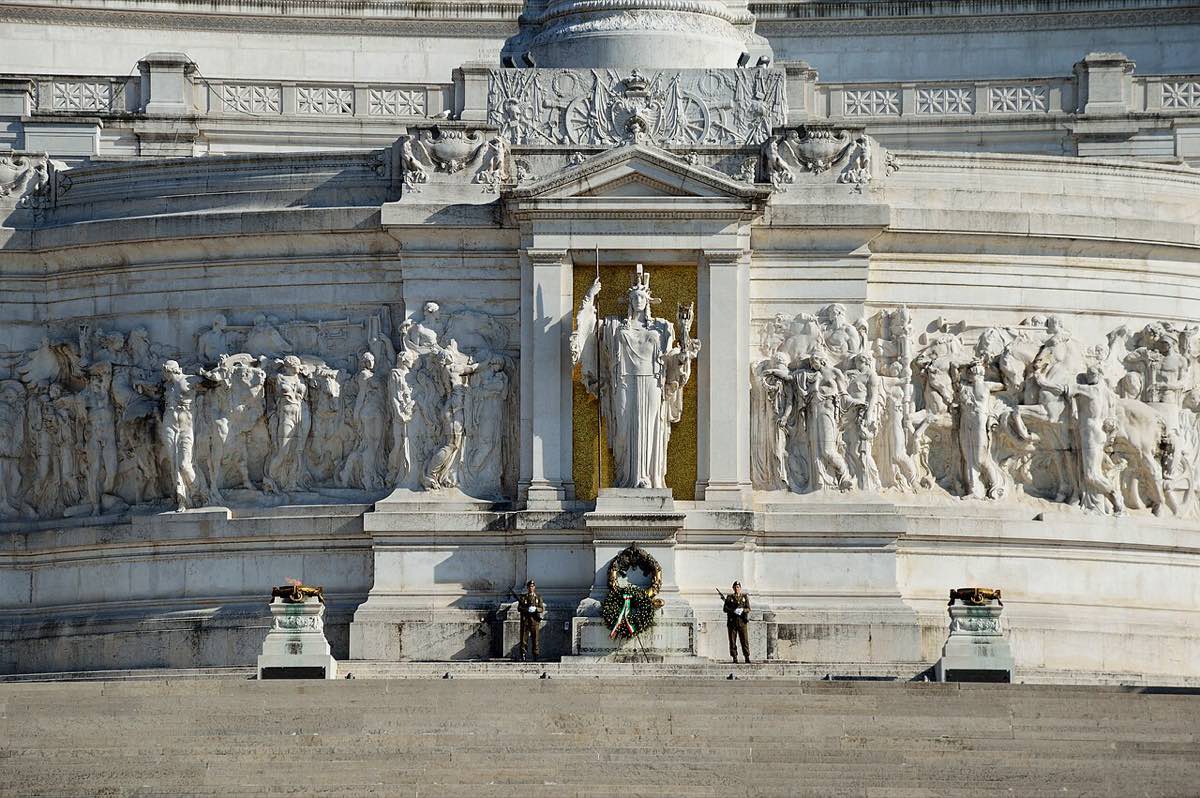
Below the goddess lies the Tomb of the Unknown Soldier, an Italian soldier who died in the First World War and was never identified, buried here to honor all the fallen. Eleven unknown bodies were brought to the Basilica of Aquileia, where Maria Bergamas, a mother from Trieste who had lost her son in the war, chose one. A slow train carried the coffin to Rome, and on November 4, 1921, it was buried here. The tomb carries the words IGNOTO MILITI (“to the unknown soldier”), and a perpetual flame burns in two braziers in front of it.
The guard of honor: two armed soldiers have guarded the tomb 24 hours a day since November 4, 1921. The corps of the Italian armed forces take turns, on a calendar set every year. Each shift lasts sixty minutes, so you can watch the changing of the guard every hour, on the hour.
The President of the Republic lays a laurel wreath here on April 25, June 2 and November 4, and foreign heads of state do the same on official visits. On those mornings the Vittoriano can close to visitors until the ceremony ends, so check the official notices page before you go. This is a war memorial: keep your voice down near the tomb.
How do you get to the terrace, and how much are the tickets?
The Panoramic Terrace, also called the Terrazza delle Quadrighe after the two bronze chariots that crown it, is at the very top of the monument, 70 meters (230 feet) above the city. Since 2007, two panoramic elevators at the back of the monument, on Terrazza Italia, take you up in about a minute.
The monument itself is free, but the elevator needs the VIVE ticket, which also covers the museums:
| Area | Opening hours | Entry |
|---|---|---|
| Vittoriano and Altar of the Fatherland | Every day 9:30–19:30, last entry 18:45 | Free |
| Panoramic Terrace (elevator) | Every day 9:30–19:30, last entry 19:00 | VIVE ticket |
| Main Colonnade (Sommoportico) | Every day 9:30–19:30, last entry 19:00 | VIVE ticket |
| Museo Centrale del Risorgimento | Every day 9:30–19:30, last entry 19:00 | VIVE ticket |
| Palazzo Venezia museum | Every day 9:30–19:30, last entry 18:45 | VIVE ticket |
| Ticket offices | Every day 9:30–18:45 | – |
| VIVE ticket | Price |
|---|---|
| Full price | €18, temporary exhibitions included |
| EU citizens aged 18 to 25 | €5 |
| Under 18s, visitors with disabilities and one companion, other categories | Free |
| First Sunday of the month | Free for everyone, valid that day only |
The ticket gives one entry to each site and is valid for seven days from the visit date you choose. It covers the Main Colonnade, priority access to the terrace by the panoramic elevator, the Sala Zanardelli, the Museo Centrale del Risorgimento, Palazzo Venezia and the temporary exhibitions. Buy it on the official VIVE ticket shop or at the ticket offices on Terrazza Italia, inside the Vittoriano, and at Via del Plebiscito 118 (Palazzo Venezia). The Ministry of Culture lists who can enter free on its concessions page. The next free first Sundays should be December 6, 2026 and January 3, 2027, and the paid areas are closed on December 25.
What can you see from the Vittoriano terrace?
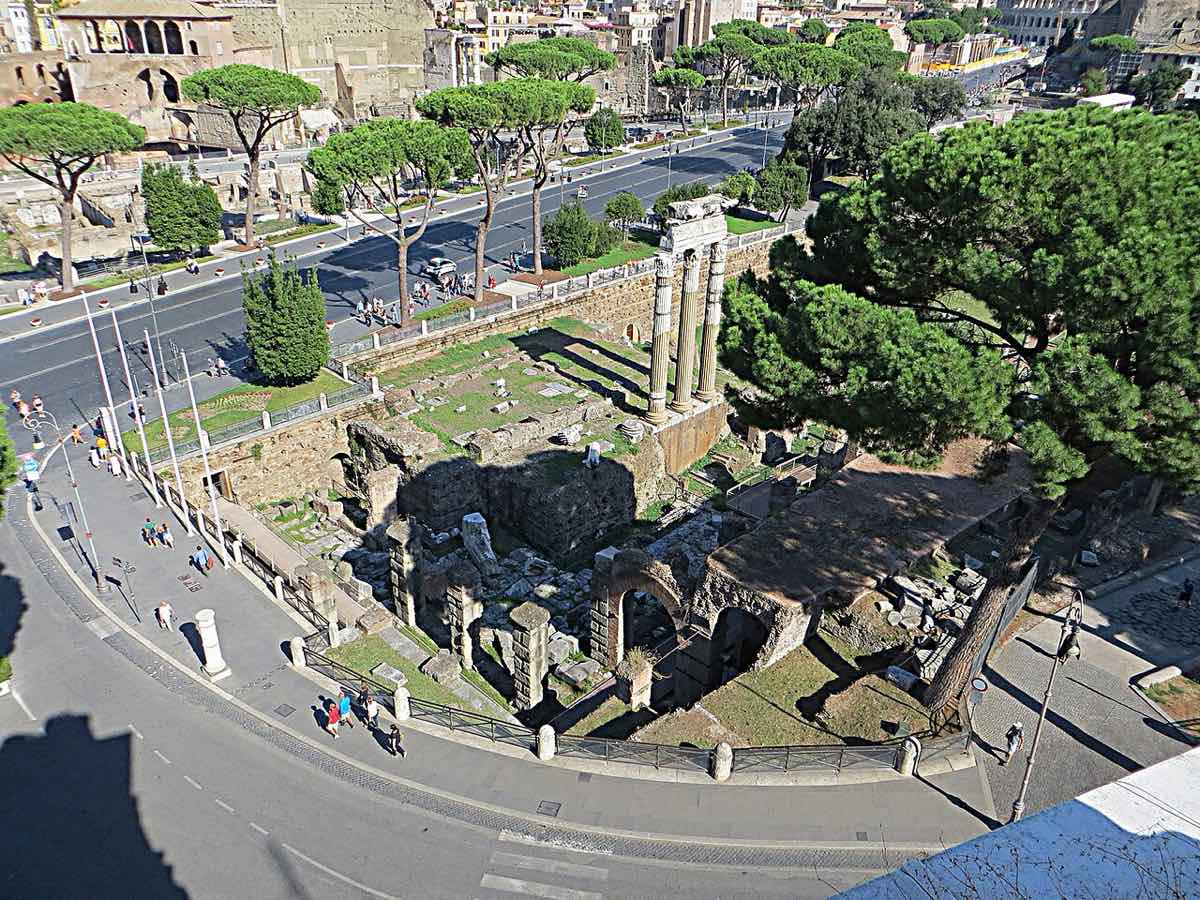
From the top you get a 360° view, with panels that help you name the sights:
- Toward the Forum: the Roman Forum, the Basilica of Maxentius and the Colosseum.
- Toward the Capitoline: the Capitoline Hill, with Santa Maria in Aracoeli and Michelangelo’s Piazza del Campidoglio.
- Toward the west: a line of domes, from Sant’Andrea della Valle and St. Peter’s to the Gesù.
- Toward the city center: Piazza Venezia, the straight line of Via del Corso and the Quirinal Palace, home of the President of the Republic.
Up close you see the two bronze quadrigae, 11 meters (36 feet) tall: the Quadriga of Unity by Carlo Fontana and the Quadriga of Liberty by Paolo Bartolini, for the two founding values of the monument. A cafeteria-restaurant on the terrace looks over the Forum and the Colosseum. In late fall and winter the sun sets before the terrace closes, so you can watch the sunset from the top. For more viewpoints, see our guide to the panoramic views of Rome.
What is inside the Vittoriano?
- Museo Centrale del Risorgimento: the museum of Italian unification, opened in 1970, tells the story from the ideals of the French Revolution, in the late 18th century, to the end of the First World War.
- Main Colonnade (Sommoportico): the portico near the top, 70 meters (230 feet) long, with 16 columns that stand for the regions of Italy in the late 19th century.
- Palazzo Venezia: across the square, the 15th-century palace of the Venetian cardinal Pietro Barbo, later Pope Paul II. Its main garden, the Giardino Grande, is free.
All three are included in the VIVE ticket.
What are the rules and the dress code at the Vittoriano?
The Vittoriano is a national memorial, and VIVE asks visitors to dress and behave with respect. These are the main rules from its 2026 visitor regulations:
| Rule | Details |
|---|---|
| Dress code | No swimwear, bare chests, bare feet, very revealing clothes, masks or costumes. Brides and grooms in wedding clothes may enter |
| Bags | Nothing larger than 40 × 35 × 15 cm (about 16 × 14 × 6 inches): no suitcases or large backpacks |
| Food and drink | Only in the cafeteria-restaurant. In the outdoor areas you may drink water, but not stop or sit down to eat or drink |
| Photos | Allowed for personal use, without flash, tripods or selfie sticks |
| Animals and strollers | Only guide dogs, on a leash and with a muzzle. Strollers are allowed: staff show you the elevators |
| Not allowed | Flags and banners, bicycles and scooters, smoking outside the cafeteria-restaurant area |
| Groups | Groups of 11–25 must book and use headsets; larger groups cannot enter |
Toilets are free with a ticket or a cafeteria receipt; otherwise they cost €1. There is no Wi-Fi.
Why is the Vittoriano called the “wedding cake” or the “typewriter”?
The Vittoriano has never pleased everyone. Its size and its bright white marble stand out among the warm colors of old Rome, and after the Second World War it also carried the memory of the Fascist regime, which had used it as a stage. VIVE’s own history of the monument recalls that it became fashionable to mock it with avant-garde insults, “from ‘cream cake’ to ‘typewriter'”. English-speaking visitors often call it the “wedding cake”, for its white, stacked tiers. Opinions have changed since: in 2019 it welcomed more than three million visitors.
What is happening in Piazza Venezia?
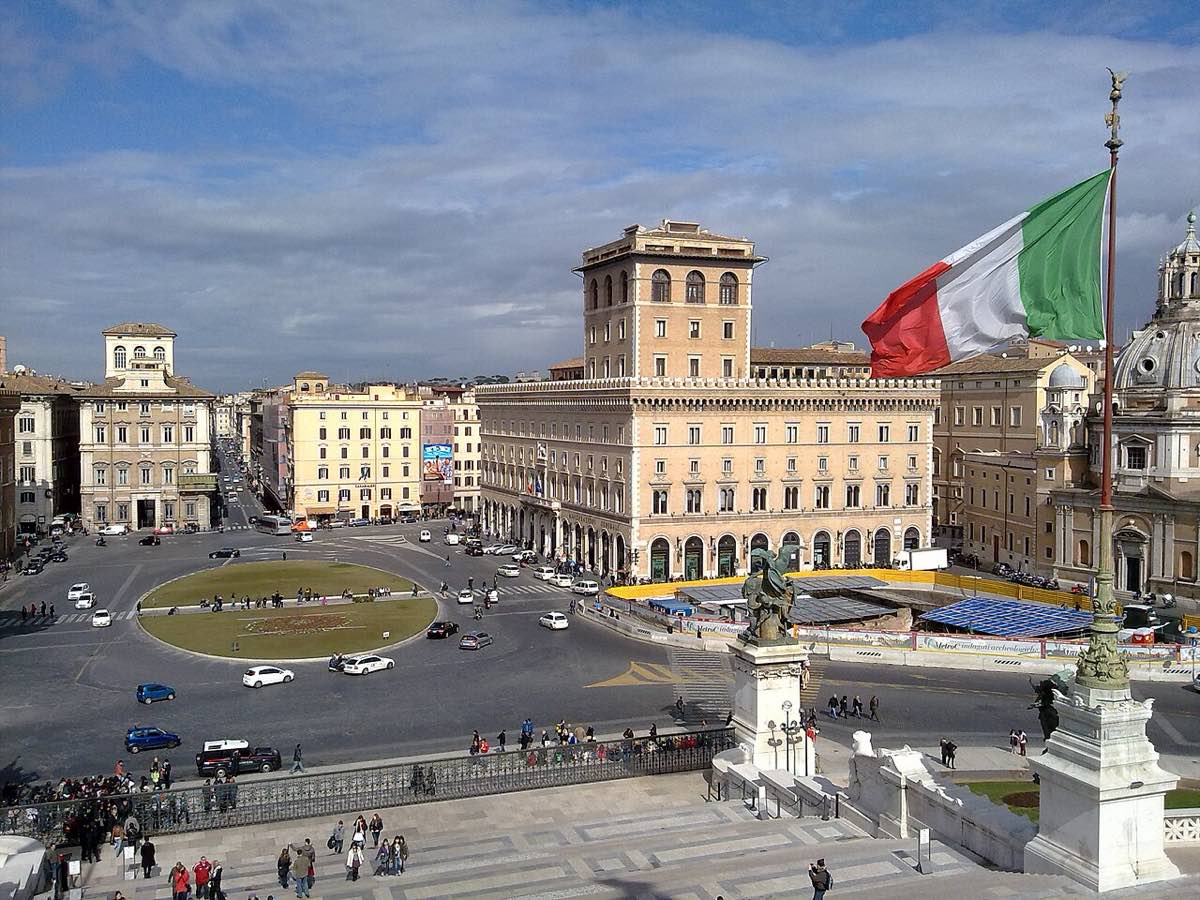
Under the square, the new Venezia station of Metro C is being built. The ten silos of the building site have become giant canvases with the “Murales” project, started in 2024: after Pietro Ruffo’s constellations, which we described in our post on the first mural on the Metro C silos, came works by Marinella Senatore and Elisabetta Benassi, and since May 2026 “Futuro a vista” by Pierpaolo Ferrari of the Toiletpaper collective. When it is finished, the station’s stairs and elevators will connect Palazzo Venezia, the Vittoriano, the ancient Hadrian’s Auditoria and the Imperial Forums. The official sources we read give no opening date, so for now the nearest metro stop is Colosseo.
The free Nemo audio guide app tells the story of Piazza Venezia on its ancient Rome itinerary.
What is near the Vittoriano?
- The Cordonata and the Capitoline Hill: right beside the Vittoriano, Michelangelo’s Cordonata, a gently sloping ramp of wide steps, climbs to Piazza del Campidoglio. Next to it, the steep staircase of Santa Maria in Aracoeli was built in the 14th century as an offering for the end of the plague, and below it are the remains of a Roman apartment block (insula).
- The Imperial Forums: on the east side of the monument lie Trajan’s Forum and Column, Trajan’s Markets and the Forum of Augustus. Via dei Fori Imperiali, built in the Fascist period, runs straight to the Colosseum, about 15 minutes on foot: see our Colosseum guide.
- Via del Corso: the long shopping street that starts in Piazza Venezia follows the ancient Via Flaminia to Piazza del Popolo. Via dei Condotti, off to the right, leads to the Spanish Steps, about 20 minutes on foot.
- The Trevi Fountain and the Pantheon: each about 10–15 minutes on foot. Read our guide to the Trevi Fountain.
How do you get to the Vittoriano?
- Entrances: you enter the monument from Piazza Venezia. For step-free access, use the entrance on the Aracoeli side, with a wheelchair lift and an elevator to Terrazza Italia, where the two panoramic elevators start. Courtesy wheelchairs are available there, and VIVE says 90% of the public areas can be reached by elevator. More tips in our guide to Rome with kids, seniors and limited mobility.
- Metro: the nearest station is Colosseo, on lines B and C, about 15 minutes on foot along Via dei Fori Imperiali. Line C runs from 5:30 to 23:30 from Sunday to Thursday, and until 1:30 on Fridays and Saturdays. Tickets and passes are explained in our guide to getting around Rome.
When is the best time to visit the Vittoriano?
- Morning, from 9:30, is usually calmer, but check the VIVE notices first, because ceremonies can close the monument for part of the morning.
- On the hour, stop by the Altar for the changing of the guard.
- The first Sunday of the month is free, so expect more people.
- How long: allow about an hour for the monument and the terrace, and two or three hours more for the museum and Palazzo Venezia.
See the Vittoriano with us
Several of our tours pass Piazza Venezia and the Vittoriano, together with the Capitoline Hill and the Imperial Forums. On every tour you see the monument from the outside: to go up to the terrace, come back on your own before or after the tour. Our drivers are not licensed tour guides, but they know the city well.
- Private golf cart tour: the example route of the 3-hour version includes Piazza Venezia and the Vittoriano, Trajan’s Markets and the Capitoline Hill with views over the Roman Forum, along with the Colosseum, the Pantheon and the Trevi Fountain. Pickup in the historic center, a Trevi Fountain ticket and a stop for gelato or coffee are included. €450 for 1–3 people, then €150 per person from 4 to 21. A 2-hour version (€350 for 1–3 people, November to mid-April) covers fewer stops, so tell us when you book if the Vittoriano is a must.
- Vintage Fiat 500 tour: 3 hours, private, on a route your driver plans around your interests; the typical route includes Via del Corso, Piazza Venezia and the Roman Forum, and the Capitoline Hill. A Trevi Fountain ticket and a short food stop are included. From €590 for 1–3 people, €1,180 for 4, then €240 per person from 5 to 21.
- Roman Holiday tour by vintage Fiat 500: 4 hours, private, on the film’s locations, including Piazza Venezia and Piazza del Campidoglio with its view of the Roman Forum. A Trevi Fountain ticket and a snack are included. From €690 for 1–3 people, €1,380 for 4, then €270 per person from 5 to 21.
- Shared golf cart tour: from our office at Via del Colosseo 11A, at 9:30 or 14:30, on a fixed route. Both versions pass the Capitoline Hill and Piazza Venezia: 2 hours for €59 per person, or 3 hours for €99 per person, adding Via del Corso, Trajan’s Markets and the Spanish Steps.
- Semi-private golf cart tour: 3 hours on a fixed route with Piazza Venezia and the Roman Forum, Trajan’s Markets and the Capitoline Hill, with pickup in the historic center and no more than 6 guests in the cart. €120 per person, up to 5 per booking.
Good to know on these tours:
- Groups: the private golf cart tour and the Fiat 500 tours take up to 21 guests guaranteed (on the 2-hour private tour, the maximum depends on the start time), with larger groups on request. Our golf carts carry 3, 5 or 7 passengers plus the driver.
- Children: golf carts take children of any age, and child seats are available on private golf cart tours only. A folded stroller fits on board; just tell us when you book. Fiat 500 tours take children aged 3 and over, with no child seats. Our Fiat 500s are restored original Fiat 500s converted to electric; some have no seat belts, because they were built before seat belts were required.
- Wheelchairs: on a private golf cart tour, wheelchair users move onto a seat of the golf cart, and the folded wheelchair travels on board in place of the two back seats. Contact us before booking if the traveler cannot move from the wheelchair to a seat. The shared and semi-private tours are not suitable for wheelchair users.
- Weather: the golf carts have rain covers and run in the rain. In rain or wet weather, the Fiat 500 tours run in golf carts; if none is available, we offer another date or time.
- Cancellation: full refund if you cancel at least 72 hours before the tour, 50% if you cancel at least 48 hours before; later cancellations and no-shows are not refunded.
If the Vittoriano is all you want to see, you don’t need a tour: walk in from Piazza Venezia for free, and buy the VIVE ticket for the terrace. Our tours are the better choice when you want to see it together with the Colosseum, the Capitoline Hill, the Pantheon and the Trevi Fountain in a few hours, without long walks. To compare the options, read our guide to the best tours in Rome for first-time visitors, or see all our golf cart tours in Rome and vintage Fiat 500 tours in Rome.
Explore it with us
 Private Golf Cart Tour of Rome3 hours with pickup in the center, including Piazza Venezia and the Vittoriano · from €450 for 1–3 peopleBook now
 Private Dolce Vita Tour by Vintage Fiat 5003 hours, private, with Piazza Venezia, the Roman Forum and the Capitoline Hill on the typical route · from €590 for 1–3 peopleBook now
 Shared Golf Cart Tour of Rome2 or 3 hours from Via del Colosseo 11A, with the Capitoline Hill and Piazza Venezia · from €59 per personBook now
FAQ
Is the Vittoriano free to visit?
Yes. Entry to the Vittoriano and the Altar of the Fatherland, with the Tomb of the Unknown Soldier, is free every day from 9:30 to 19:30 (last entry 18:45). You need the €18 VIVE ticket only for the panoramic elevator to the terrace, the Main Colonnade, the Museo Centrale del Risorgimento and Palazzo Venezia.
How much is the ticket for the Vittoriano terrace?
The VIVE ticket costs €18, or €5 for EU citizens aged 18 to 25, and it is free for under 18s and visitors with disabilities with one companion. It includes the panoramic elevator, the Main Colonnade, the museum and Palazzo Venezia, with one entry to each, valid for seven days.
When is the changing of the guard at the Altare della Patria?
Every hour, on the hour. Two armed soldiers have guarded the Tomb of the Unknown Soldier day and night since November 4, 1921, and each shift lasts sixty minutes. The corps of the Italian armed forces take turns on a calendar set every year.
What are the Vittoriano opening hours?
The monument is open every day from 9:30 to 19:30, with last entry at 18:45. The terrace, the Main Colonnade and the museum take visitors until 19:00, and the ticket offices close at 18:45. The paid areas are closed on December 25, and ceremonies can close the monument for part of a morning.
Why is the Vittoriano called the “wedding cake”?
It is a nickname, from its white marble tiers. The official history of the monument recalls that after the Second World War it became fashionable to mock it as a “cream cake” or a “typewriter”. In 2019 it welcomed more than three million visitors.
Is there a dress code at the Vittoriano?
Yes. The Vittoriano is a national memorial, so swimwear, bare chests, bare feet, very revealing clothes, masks and costumes are not allowed. Bags larger than 40 × 35 × 15 cm (about 16 × 14 × 6 inches) are not allowed either, and food is allowed only in the cafeteria-restaurant.

Comment (0)