
The Talking Statues of Rome: Ancient Gossip in Stone
Rome is full of surprises. Just when you think you’ve seen it all—the Colosseum, the Vatican, the Trevi Fountain—something totally unexpected pops up. Ever heard of the talking statues of Rome? Yep, statues that talk… well, kind of.
Let’s rewind to the 1500s. Back then, if you had something bold or critical to say about the government or the Pope, you couldn’t just tweet it or write a blog post. People who dared to speak out publicly often faced serious consequences. So, the clever citizens of Rome came up with a brilliant plan: they wrote witty, anonymous messages—sometimes poems, sometimes full-on rants—and stuck them onto statues in the middle of the night. By morning, everyone could read them. And just like that, the talking statues of Rome came to life.
These statues, scattered across the historic center, gave the people a voice. Originally, they had nothing in common. But over time, Romans turned them into powerful symbols of humor and protest.
Meet the Statues
There are six main talking statues, each with its own personality, nickname, and backstory. Let’s take a little tour!
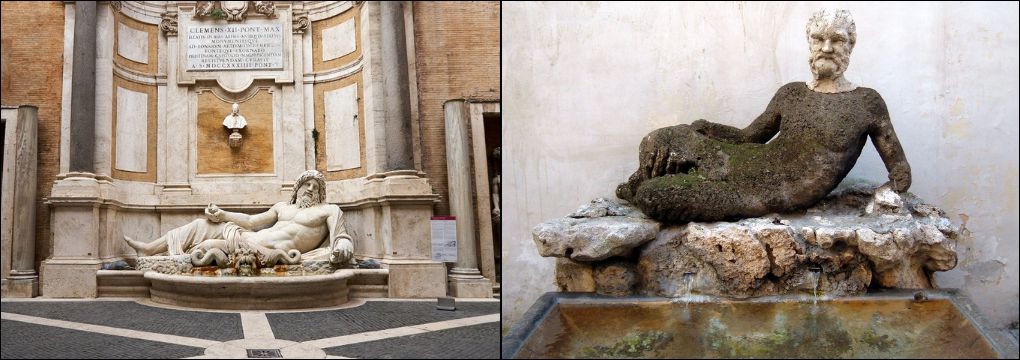
Marforio – The Chill Interlocutor
Marforio lounges in the courtyard of Palazzo Nuovo on Capitoline Hill. He has a flowing beard, a draped cloak, and a shell in one hand. Experts say the statue probably represents Oceanus or the River Nera.
Archaeologists found him in the 1500s near the Arch of Septimius Severus in the Roman Forum. The name “Marforio” might come from “Martis Forum,” or the Temple of Mars. Romans loved using him as Pasquino’s witty partner—he often “replied” to Pasquino with clever comebacks in an ancient version of Twitter.
Il Babuino – The Monkey-Looking Rebel
Head toward the Spanish Steps and you’ll meet Il Babuino, a strange-looking Silenus lying on one side. Locals thought he looked like a baboon (babuino), and the nickname stuck.
Originally, builders placed him as part of a fountain on the main façade of Palazzo Grandi. In 1738, they moved him to the left side of the building during renovations. Later, in 1877, they moved him again to the courtyard. In 1957, restorers reassembled him with the original fountain basin and placed him in a spot close to the original one. Romans loved his wit so much that they gave his verses their own name: babuinate.
Pasquino – The King of Sass
Pasquino is the OG. The one that started it all. You’ll find him near Piazza Navona, at the corner of Palazzo Braschi. Historians believe workers unearthed him in the late 1400s. Sculptors in ancient Rome likely carved him in the 1st century AD as part of a dramatic group showing Menelaus holding the dying Patroclus.
In 1501, Cardinal Oliviero Carafa placed the statue in what was then Piazza di Parione. During the Feast of Saint Mark (April 25), locals dressed Pasquino like a deity and covered him in witty poems during academic contests. No one knows for sure where his name came from—it might have been a sharp-tongued barber, a tavern owner, or a Latin teacher whose students thought the statue resembled him.
People called the notes posted on him pasquinades, and Pasquino became the ultimate stone-age influencer.
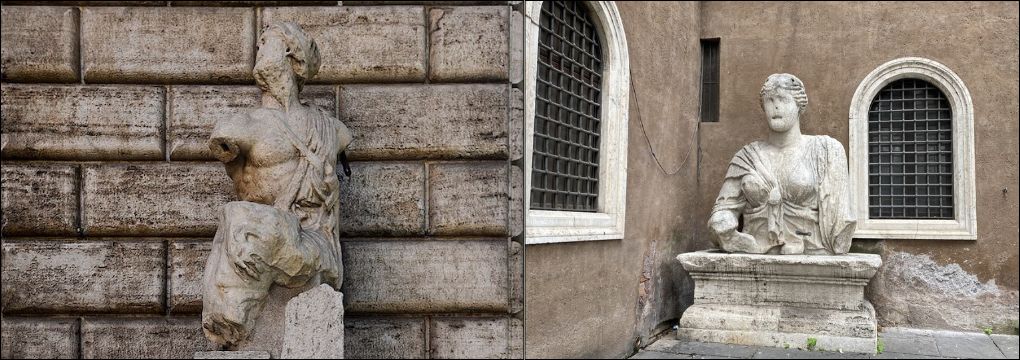
Madama Lucrezia – The Queen of Mystery
Madama Lucrezia stands tall—about 3 meters—on the corner of Palazzo Venezia in Piazza San Marco. She’s a large, slightly damaged bust of what was probably the goddess Isis.
Cardinal Lorenzo Cybo installed her there around 1500. The name “Madama Lucrezia” may refer to Lucrezia D’Alagno, a close friend of Alfonso of Aragon and Pope Paul II. Or it might come from Lucrezia, the wife of Giacomo dei Piccini from Bologna, who owned nearby property in the 1500s. No matter who she was, she joined the sarcastic statue squad with pride.
Il Facchino – The Working-Class Hero
Il Facchino, or “The Porter,” is the most relatable of them all. He holds a barrel and wears the classic outfit of the water carriers who used to fill barrels from the Tiber or Trevi Fountain and deliver them around the city.
You’ll find him on Via Lata. Jacopo Del Conte sculpted him in the late 1500s. At some point, vandals damaged his face at night because they believed he looked like Martin Luther. Brutal—but he still made the squad.
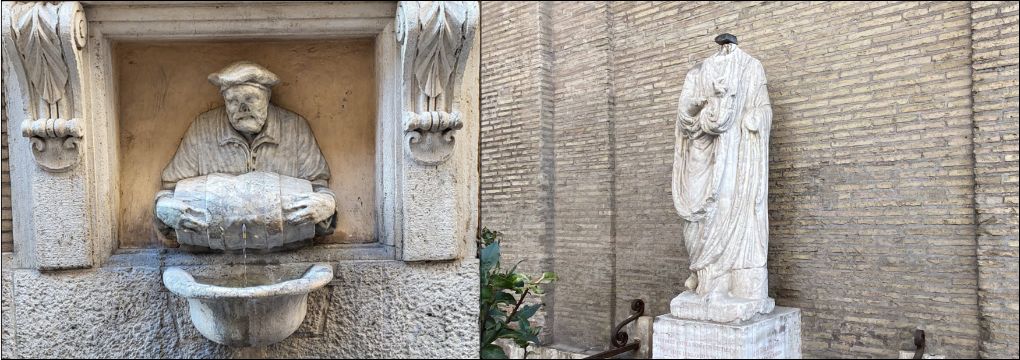
Abate Luigi – The Headless Whisperer
Abate Luigi wears a toga but has no head. Sculptors carved him during the late Roman Empire, likely to represent a magistrate or civil figure.
The statue bounced around Rome until city officials gave him a permanent home in Piazza Vidoni, next to the Church of Sant’Andrea della Valle. People started calling him “Abate Luigi” because he reminded them of a witty church sacristan from a nearby parish.
Why did people do this?
Posting anonymous notes on statues became the people’s way of expressing opinions, especially when it was too risky to say things out loud. Politics, taxes, scandals—no topic was off-limits. And the best part? The statues “talked” back to each other with clever replies. It was like an early form of public debate mixed with street art and stand-up comedy.
Can You See Them Today?
Absolutely! The talking statues of Rome are still around (most of them, anyway), and you can visit them all on foot. A few even still get the occasional modern-day pasquinade. Walking this route is a quirky, off-the-beaten-path way to explore the city—and learn how Romans have always had a way with words.
If you’re into hidden gems, old-school humor, or just love the idea of statues throwing shade across the centuries, the talking statues of Rome are a must-see. They remind us that even way back when, people found creative ways to speak up—and that wit, rebellion, and a good sense of humor never go out of style.


Comment (0)