
Checked on November 9, 2026 · The inside visits on the website of the Soprintendenza Speciale di Roma and on its booking page; the Museo della Via Ostiense on the websites of the Ministry of Culture and Turismo Roma; the Non-Catholic Cemetery on its official website; metro and trains on Roma Mobilità; walking times from OpenStreetMap routes; our prices on our booking pages.
The Pyramid of Cestius is the marble tomb of Gaius Cestius, a Roman politician, built between 18 and 12 BC and later set into the Aurelian Walls. It stands at Porta San Paolo, by Piramide metro (line B). You can see it from outside at any time; the painted burial chamber opens only on free special days, booked in advance.
Cover photo: Rabax63, CC BY-SA 4.0, via Wikimedia Commons
Romans call this corner of the city simply “Piramide”, like the metro station. A white pyramid that looks as if it came from Egypt rises out of the old city walls, beside a medieval gate and a quiet garden cemetery where Keats and Shelley are buried. Facile Tours is a local tour operator based at Via del Colosseo 11A, and in this guide we put together what the official sites say today: who Cestius was and why he chose a pyramid, what the inscription says about the 330 days, how to get inside, Porta San Paolo, the Non-Catholic Cemetery and the best view of the pyramid, how to get there and what to see nearby. For the rest of the district, from the market to the trattorias, read our Testaccio guide.
What is the Pyramid of Cestius?
The Pyramid of Cestius (Piramide Cestia in Italian) is a Roman tomb in the shape of a pyramid, 36.4 m (about 119 feet) high on a square base of 29.5 m (about 97 feet) per side. Its core is Roman concrete faced with brick, and the outside is clad in slabs of white marble from Luna, in today’s Carrara area. It was built along the Via Ostiense, the road from Rome to the sea at Ostia, for Gaius Cestius, a Roman politician and a member of the epulones, the college of priests who organized the sacred banquets for the gods. Turismo Roma, the City’s tourism website, adds that he served as praetor and as tribune of the plebs.
The tomb went up between 18 and 12 BC. The Soprintendenza Speciale di Roma, the state office that looks after the monument, dates it with two clues from Cestius’s will: a law against luxury, passed in 18 BC, stopped his heirs from placing some precious tapestries in the burial chamber, and Agrippa, the son-in-law of the emperor Augustus, who died in 12 BC, was among the people named in the will.
Almost three centuries later, between 272 and 279 AD, the emperor Aurelian built a new wall around Rome, and the pyramid became part of it. Being part of the city’s defenses helped it survive. It still bears the marks of more recent history: in September 1943, Porta San Paolo was the scene of fighting against German troops, and according to the Soprintendenza many bullet marks are still visible on the pyramid’s marble.
Why is there a pyramid in Rome?
After Octavian, the future emperor Augustus, defeated Antony and Cleopatra at the Battle of Actium in 31 BC, Egypt came under Roman rule, and Egyptian styles became fashionable in Rome, tombs included. The Soprintendenza describes the Pyramid of Cestius as the only survivor of a series of pyramids built in Rome in the 1st century BC. According to Turismo Roma, two stood where the twin churches of Piazza del Popolo are today, and another, known as the Meta Romuli (“tomb of Romulus”), stood near today’s Via della Conciliazione until Pope Alexander VI demolished it in 1499. At that time people believed the Pyramid of Cestius was the Meta Remi, the tomb of Remus, the twin brother of Romulus; its inscription settled the question.
Look at its shape and you will notice that it is narrower and steeper than the great pyramids of Giza: Roman builders borrowed the idea, not the exact model.
What does the inscription on the Pyramid of Cestius say?
Two Latin inscriptions are carved high on the marble. The larger one gives the owner’s name and offices: C·CESTIUS·L·F·POB·EPULO·PR·TR·PL·VII·VIR·EPULONUM, which means “Gaius Cestius Epulo, son of Lucius, of the Pobilia tribe, praetor, tribune of the plebs, member of the Board of Seven for the sacred banquets”.
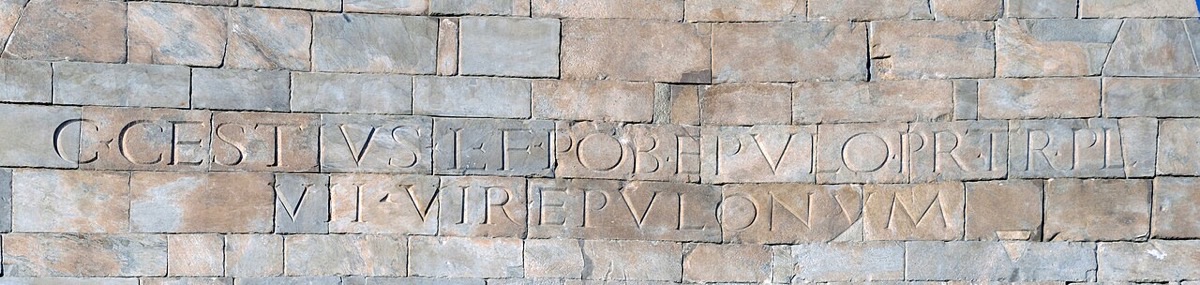
The smaller inscription, lower down, explains the famous 330 days. It begins OPUS ABSOLUTUM EX TESTAMENTO DIEBUS CCCXXX: “the work was completed, as the will required, in 330 days”. It goes on to say that the work was supervised by his heir, Pontius Mela, and by Pothus, a freedman. The Soprintendenza confirms that Cestius’s will set the deadline: his tomb had to be built in 330 days. The letters are high up, so use your phone’s zoom to read them.
Can you go inside the Pyramid of Cestius?
Only on special opening days. The Soprintendenza says the site can be visited only during special openings and events, so on most days you see the pyramid from the outside.
Inside is a single burial chamber of about 23 square meters (about 250 square feet), with a barrel vault. It was walled up at the time of the burial, following Egyptian custom. Its walls are painted in panels, with figures of nymphs alternating with ritual vases on a light background, and four winged Victories at the corners of the vault hold a wreath and a ribbon. In the middle of the vault there was probably a scene of the dead man rising to the gods. The tomb was probably first broken into in the Middle Ages, through a tunnel dug on the north side, and the urn with the ashes and much of the painting were lost.
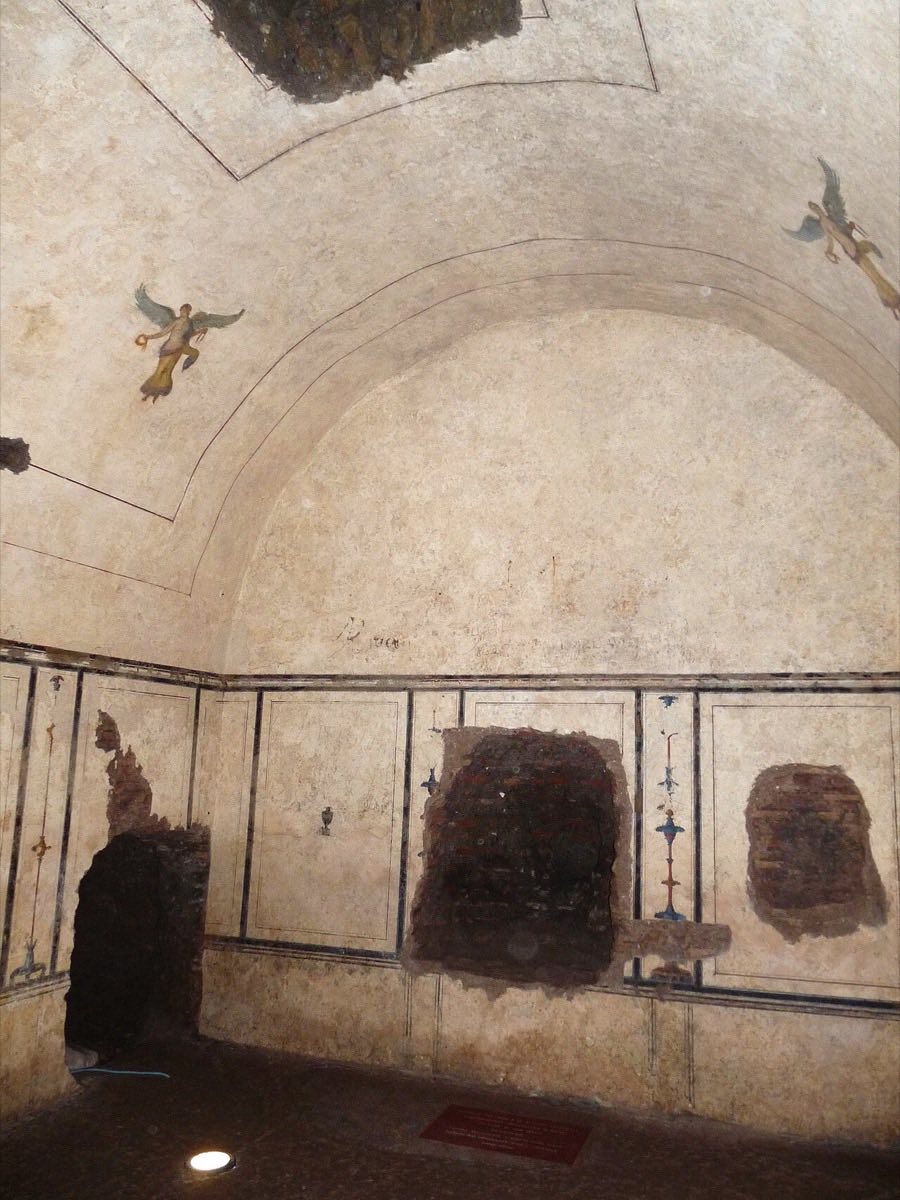
How the current openings work, according to the Soprintendenza’s announcement (in Italian):
- Dates: the current cycle runs on Sundays until December 20, 2026. The dates left are November 29 and December 6, 13 and 20, with visits starting at 10:00, 11:00 and 12:00.
- Price and booking: free, but booking on Eventbrite is compulsory. Visits are unguided, for up to 50 people per slot.
- Availability: when we checked on November 9, 2026, the booking page showed the November and December visits as sold out. When the first visits after the works filled up in September, the Soprintendenza said it would announce any new dates on its website and social media, so check there before you plan.
- Entrance: on Viale del Campo Boario, beside the pyramid.
- On the day: for the visits in September and October, the Soprintendenza asked visitors to arrive at least 10 minutes early and wear comfortable shoes. You reach the chamber through a narrow tunnel, one at a time and with your head down. Those visits lasted 45 minutes.
- After December 20: no further dates had been announced when we checked. If the dates above have passed, look for new ones on the Soprintendenza’s news page.
The restoration. The burial chamber was restored in 2001 and again between 2012 and 2015. The latest works, started in 2025 and funded by Italy’s recovery plan (PNRR), made the access stairs safe, replanted the garden after a survey of its plants, added new lighting for the pyramid and the frescoes, and put up information panels to make the site more accessible.
If you cannot get a place, the outside is always free: you see the pyramid from the streets around it and from inside the Non-Catholic Cemetery (see below).
What is Porta San Paolo, and can you visit the Museo della Via Ostiense?
Right next to the pyramid stands Porta San Paolo, a gate of the Aurelian Walls with two round brick towers. It was built in the 3rd century AD on two archways, from which the Via Ostiense and the ancient Via Laurentina began. According to the Ministry of Culture, the gate and the pyramid stand in one of the best-preserved stretches of the walls, and the gate took its present name in the Middle Ages from the Basilica of St. Paul Outside the Walls, reached along the Via Ostiense, the pilgrims’ road that started here toward the sea. In Roman times it was called Porta Ostiensis.
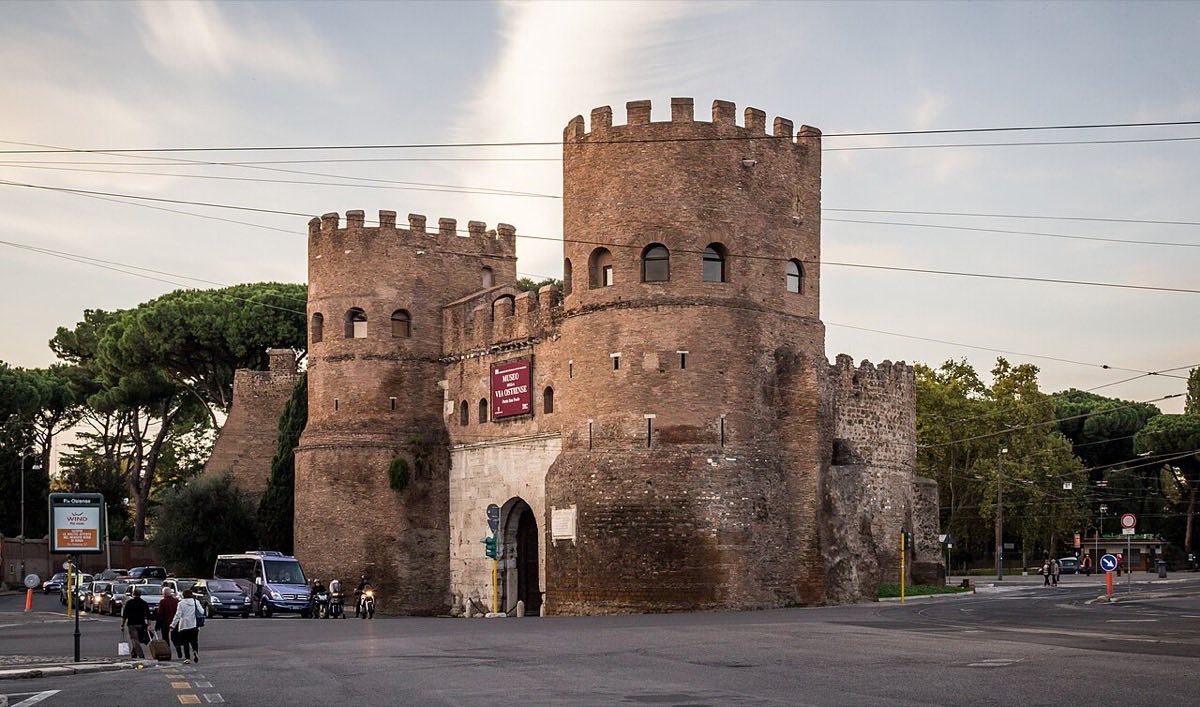
Inside the gate is the Museo della Via Ostiense, with finds from the land between Rome and Ostia: casts of inscriptions and funerary stones, paintings from a 3rd-century tomb found near St. Paul’s, and two models of ancient Ostia and of the imperial harbors of Claudius and Trajan. The east tower keeps frescoes from the late 13th or early 14th century. The museum is closed at the moment: the Ministry of Culture lists it as “temporarily closed” and Turismo Roma as “Closed at the moment”, and neither gives hours, prices or a reopening date. You can still see the gate from the outside, from Piazzale Ostiense.
Another gate of the same walls, Porta San Sebastiano on the Appian Way, has its own museum about the walls: see our guide to Porta San Sebastiano and the Museum of the Walls.
What is the Non-Catholic Cemetery next to the Pyramid?
Along the walls beside the pyramid lies the Non-Catholic Cemetery in Rome, also called the Protestant Cemetery. Burials began here by 1716, when Pope Clement XI allowed members of the exiled Stuart court of England to be buried in front of the pyramid, and it is one of the oldest burial grounds in Europe that is still in use. It is run privately by an association of 15 embassies and pays for itself.
Most visitors come for two English Romantic poets. John Keats died in Rome in 1821, at 25, and lies in the Old Cemetery, the lawn in front of the pyramid, next to his friend, the painter Joseph Severn. His gravestone does not show his name, only the line “Here lies One Whose Name was writ in Water”. Percy Bysshe Shelley, who drowned off the coast of Tuscany in 1822, at 29, is buried in another part of the cemetery. The Italian thinker Antonio Gramsci, the writers Carlo Emilio Gadda and Andrea Camilleri and the Beat poet Gregory Corso are buried here too, according to the cemetery’s list of notable graves.
What you need to know, from the cemetery’s official website:
- Entrance: Via Caio Cestio 6, a side street off Via Marmorata on the north side of the pyramid; the gate is halfway down the street, on the left. It is about 3 minutes on foot from the pyramid (our estimate).
- Hours: Monday to Saturday 9:00–17:00, Sundays and holidays 9:00–13:00; last entry 30 minutes before closing. It is closed on January 1 and 6, for two weeks in mid-August and on December 8, 24, 25, 26 and 31, and closes at 13:00 on Easter Sunday, Easter Monday, April 25, May 1, June 2 and June 29. It may close at short notice.
- Entry: there is no ticket; the cemetery asks each visitor for a contribution of at least €5.
- Groups: up to 14 people, only with a reservation and with their own guide.
- Rules: this is an active cemetery, with funerals and families visiting. Keep photos to a minimum and do not post them on social media, as the cemetery asks. Eating, drinking, smoking and dogs are not allowed, and children must be with an adult. Paths are uneven and there are architectural barriers.
A colony of cats has lived around the pyramid since at least 1850, and volunteers look after them.
Where is the best view of the Pyramid of Cestius?
- From the Old Cemetery: the cemetery’s website promises “an excellent view” of the pyramid from the Old Cemetery, where Keats is buried. It is the classic view, with the pyramid rising behind the graves and the trees. You cannot reach the pyramid from the cemetery, though.
- The north-west side: two columns stand at the corners of the pyramid’s sunken enclosure on this side, as in our cover photo. Turismo Roma says the tomb once had four columns, one at each corner.
- From Piazzale Ostiense: the square by the metro station shows the pyramid next to Porta San Paolo and the walls, which is the best way to see how the tomb became part of the city’s defenses.
How do you get to the Pyramid of Cestius?
- Metro: take line B to Piramide, two stops from Colosseo. The pyramid and Porta San Paolo are right by the station. According to Roma Mobilità, the City’s mobility agency, line B runs from 5:30 to 23:30 from Sunday to Thursday, and on Fridays and Saturdays the last trains leave the end stations at 1:30.
- Trains: Roma Ostiense railway station is next to Piramide, with trains toward Fiumicino airport (FL1) and Civitavecchia (FL5). The Roma–Lido line to Ostia, also called Metromare, ends at Roma Porta San Paolo station, by the gate. Roma Mobilità says the Lido service is currently modified for works on the line, so check before you travel. Our Ostia Antica guide explains the train ride to the ancient port.
- Tram: Roma Mobilità lists tram 3 among the connections at Ostiense. Since November 23, 2026, trams have been back on the whole line, from Trastevere station to Valle Giulia; on weekdays from 21:00, buses still replace them between Trastevere station and Porta Maggiore because of works on Viale del Parco del Celio. Check Roma Mobilità on the day.
- On foot: from the Orange Garden on the Aventine, it is about 1.2 km (16 minutes) downhill, by our estimate.
For tickets and the rest of the network, read our guide to getting around Rome.
What else is near the Pyramid of Cestius?
- Testaccio Market: the covered food market of the Testaccio district, about 850 m (11 minutes) on foot from the pyramid. It is open Monday to Saturday from 7:00 to 15:30, according to its website.
- Monte Testaccio: a hill made of the shards of millions of Roman amphorae, about 10 minutes on foot; it opens only for booked visits. Hours, dates and history are in our Testaccio guide.
- The Aventine: one of the seven hills of Rome, about 16 minutes uphill, with the free Orange Garden and its view over the city, and the Aventine Keyhole, where the line can take more than 40 minutes. The free Nemo audio guide app explains both on one of its Rome itineraries.
- The Baths of Caracalla: one stop away on metro line B, at Circo Massimo; see our guide to the Baths of Caracalla.
| Sight | What it is | Free or ticket | Hours source |
|---|---|---|---|
| Pyramid of Cestius | Roman tomb built between 18 and 12 BC | Outside: free, always visible. Inside: free, booking compulsory, special days only | Soprintendenza Speciale di Roma |
| Porta San Paolo and Museo della Via Ostiense | 3rd-century gate of the Aurelian Walls, with a museum on the road to Ostia | Gate: free from outside. Museum: closed at the moment | Ministry of Culture |
| Non-Catholic Cemetery | Garden cemetery in use since 1716, with the graves of Keats and Shelley | No ticket; a contribution of at least €5 is requested | Cemetery website |
| Testaccio Market | Covered food market | Free entry | Market website |
| Monte Testaccio | Hill made of Roman amphora shards | €4 (€3 reduced); booking at 060608 | Sovrintendenza Capitolina |
| Orange Garden and Aventine Keyhole | Garden with a view over Rome; keyhole view of St. Peter’s dome | Free | Sovrintendenza Capitolina (Orange Garden); the keyhole is in a public square |
Can you see the Pyramid of Cestius on a tour with us?
None of our tours stops at the Pyramid of Cestius or goes inside it: the chamber opens only on the Soprintendenza’s own days, booked as explained above. The pyramid is close to our routes, though, and you can see it from the outside:
- Private golf cart tour of Rome: the 3-hour route includes the Orange Garden and the Aventine Keyhole, just up the hill from the pyramid, with the Colosseum, the Circus Maximus, the Pantheon and the Trevi Fountain. The route adapts to your pickup point and interests, so you can ask your driver to pass by the Pyramid of Cestius, which you see from the outside. Your driver picks you up at your hotel or Airbnb in the historic center (otherwise you meet at our office, Via del Colosseo 11A), at 9:30, 10:00, 14:30, 18:00 or 18:30. The Trevi Fountain ticket and a culinary stop, such as gelato or coffee, are included. The 3-hour tour costs €450 for 1–3 people, then €150 per person, up to 21 guests guaranteed, with larger groups on request; the 5-hour tour costs €750 for 1–3 people; the 2-hour tour, from November to mid-April, costs €350 for 1–3 people, and its maximum group size depends on the start time.
- Private golf cart tour by night: 2 hours with no fixed route: you choose the places, such as the Colosseum, the Trevi Fountain or the Aventine Keyhole, with the monuments lit up and less traffic. From €450 for 1–3 people at 20:00; later starts cost more.
- Ostia Antica: the Lido train from Porta San Paolo takes you to the ancient port on your own. If you prefer a private car, our Ostia Antica & Painted Houses tour from Rome picks you up at your hotel in the historic center at 9:30: 5 hours in all, with up to 3 hours at the site, including the House of Diana, usually closed to visitors. It costs €505 for 1–7 people (€980 for 8–14), from Tuesday to Sunday; entrance tickets and an official guide or audio guide are extras you add when booking.
Good to know on the golf cart tours:
- Sights and drivers: you see the sights from the outside, unless a ticket is included. Our drivers are drivers, not licensed tour guides, but they know the city well.
- Weather: the golf carts have rain covers and run in the rain.
- Children: there is no minimum age. Child seats are available on private golf cart tours only. A folded stroller fits on board; just tell us when you book.
- Wheelchairs: on our private tours, wheelchair users move onto a seat of the golf cart, and the folded wheelchair travels on board in place of the two back seats. Contact us before booking if the traveler cannot move from the wheelchair to a seat.
- Cancellation: full refund if you cancel at least 72 hours before the tour, 50% if you cancel at least 48 hours before.
See all the Facile Tours golf cart tours in Rome.
Facile Tours runs these three private tours, all with pickup in the historic center:
Explore it with us
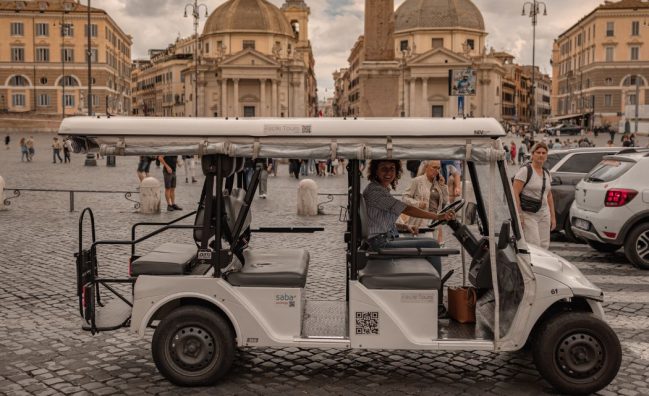 Private Golf Cart Tour of Rome3 hours with pickup in the center, including the Orange Garden and the Aventine Keyhole · from €450 for 1–3 peopleBook now
 Golf Cart Tour by Night2 hours from 20:00; you choose the stops, such as the Aventine Keyhole · from €450 for 1–3 peopleBook now
 Ostia Antica & Painted Houses5 hours from Rome with the House of Diana; tickets and guide optional · €505 for 1–7 peopleBook now
FAQ
What is the Pyramid of Cestius?
It is the tomb of Gaius Cestius, a Roman politician and priest, built between 18 and 12 BC in the shape of a pyramid, 36.4 m (about 119 feet) high and clad in white marble. In the 3rd century AD it became part of the Aurelian Walls, next to the gate now called Porta San Paolo.
Can you go inside the Pyramid of Cestius?
Only on special opening days of the Soprintendenza Speciale di Roma. The current cycle runs on Sundays until December 20, 2026, with free, unguided visits at 10:00, 11:00 and 12:00, booked on Eventbrite; when we checked on November 9, they were sold out. Any new dates are announced on the Soprintendenza’s website.
Why is there a pyramid in Rome?
Egyptian styles became fashionable in Rome after the Battle of Actium in 31 BC, when Egypt came under Roman rule, and some wealthy Romans chose pyramid-shaped tombs. The Pyramid of Cestius is the only one that survives; another one stood near the Vatican until 1499.
How do you get to the Pyramid of Cestius?
Take metro line B to Piramide, two stops from Colosseo: the pyramid is next to the station, beside Porta San Paolo. Roma Ostiense railway station is right next to it, and the Roma–Lido trains from Ostia end at Porta San Paolo station.
Can you see the Pyramid from the Non-Catholic Cemetery in Rome?
Yes. The cemetery says there is an excellent view of the pyramid from its Old Cemetery, where Keats is buried, but you cannot reach the pyramid from the garden. The cemetery is open Monday to Saturday 9:00–17:00 and on Sundays and holidays 9:00–13:00, and it asks each visitor for a contribution of at least €5.
Is there a tour that stops at the Pyramid of Cestius?
None of our tours stops at the pyramid or goes inside it. Our private golf cart tour includes the Orange Garden and the Aventine Keyhole, just up the hill, and its route adapts to your interests, so you can ask the driver to pass by the pyramid and see it from the outside. The 3-hour tour costs €450 for 1–3 people.
Comment (0)