
The seven hills of Rome are the Palatine, Capitoline, Aventine, Quirinal, Viminal, Esquiline and Caelian, all on the left bank of the Tiber around the Roman Forum. You can walk six of them for free; the Palatine is inside the Colosseum Archaeological Park and needs a ticket. The Janiculum, Pincian and Vatican hills are not among the seven.
Cover photo: Jean-Pol GRANDMONT, CC BY 4.0, via Wikimedia Commons
Rome has been the City of Seven Hills since ancient times. The hills are still there, but today they are covered with churches, palaces, gardens and busy streets, and some feel more like gentle slopes than hills. We are Facile Tours, a local tour operator in Rome, and several of our golf cart and Fiat 500 tours pass four of them: the Capitoline, the Aventine, the Palatine and, on two of our tours, the Quirinal. This guide explains what each hill is today and what you can see on it, why the number is seven, which famous hills are not on the list, and how to walk several hills in one morning, with distances you can check on a map.
What are the seven hills of Rome?
The seven hills are the Palatine, the Capitoline, the Aventine, the Quirinal, the Viminal, the Esquiline and the Caelian. In Italian they are the Palatino, Campidoglio, Aventino, Quirinale, Viminale, Esquilino and Celio. All seven rise on the left (east) bank of the Tiber:
- the Palatine and the Capitoline face each other across the Roman Forum;
- the Aventine lies south of the Palatine, beyond the Circus Maximus, above the river;
- the Caelian lies south-east, just behind the Colosseum;
- the Quirinal, the Viminal and the Esquiline are three long ridges that reach toward the center from the north-east, between the Trevi Fountain and Termini station.
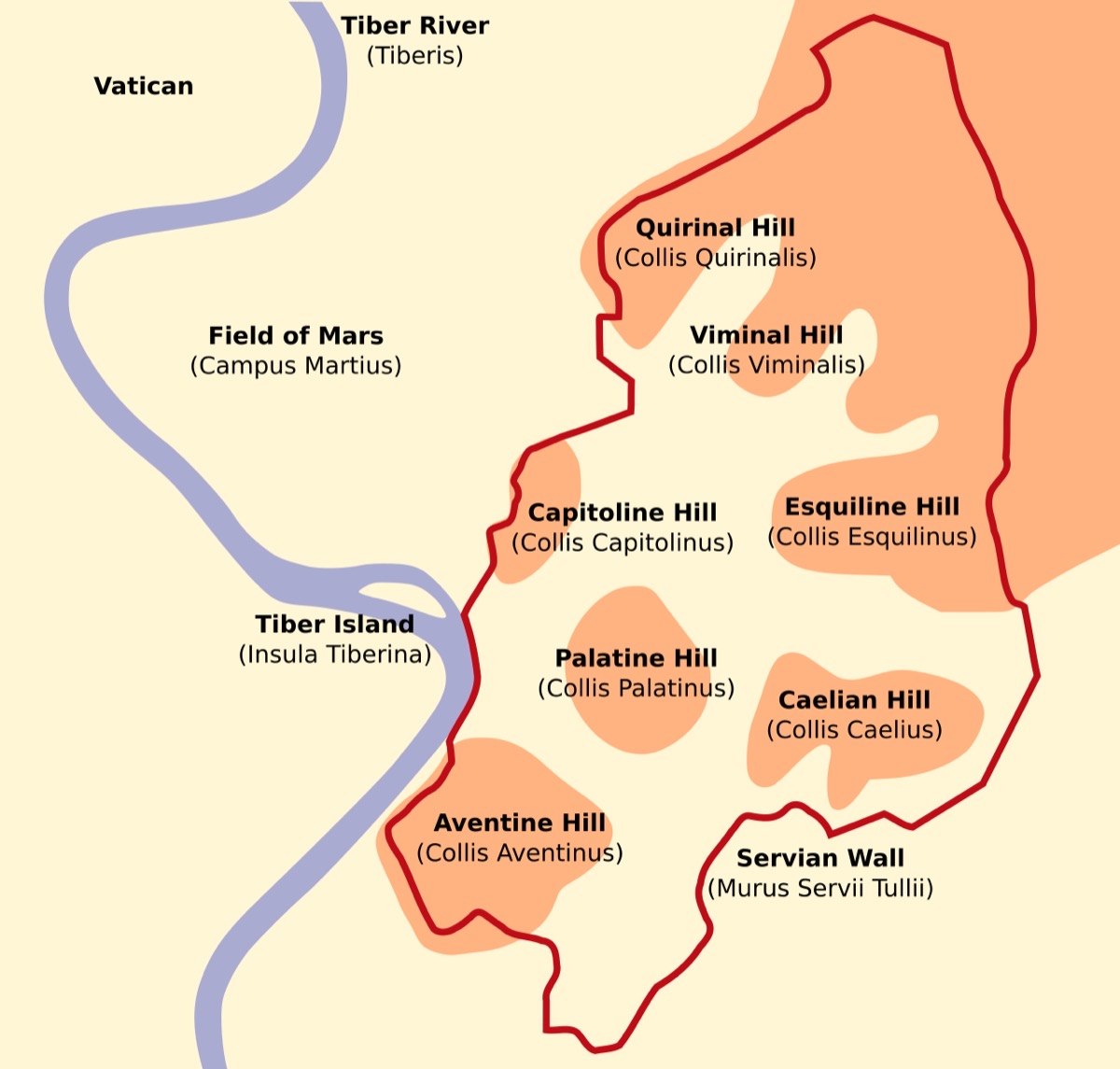
None of them is very high: the Esquiline, for example, reaches 65 meters (213 feet) above sea level. But their names are everywhere in modern Rome. Italians say “il Quirinale” for the President of the Republic, “il Viminale” for the Ministry of the Interior and “il Campidoglio” for the city government, because each one sits on its hill.
Why are there seven hills?
The number goes back to ancient Rome, but the list changed over time. The oldest trace is the Septimontium, a festival held every December 11 with sacrifices on the hills of the early city. According to the Treccani encyclopedia, its places were the Palatine, the Cermalus, the Velia, the Oppius, the Cispius, the Fagutal, the Subura and the Caelian: eight names, most of them heights of the Palatine and the Esquiline, and no Capitoline, Aventine, Quirinal or Viminal. Scholars still debate why there are eight. The traditional explanation of the name is septem montes, “seven hills”, but some prefer saepti montes, “fenced hills”, hills enclosed by fortifications.
The classic list of seven came later, as the city grew. It matches the hills enclosed by Rome’s Republican city wall, the Servian Wall, named after King Servius Tullius, though most of what survives was built in the 4th century BC. You can still see a long stretch of it in front of Termini station. Hills outside that wall, such as the Janiculum, the Pincian and the Vatican, never joined the list.
According to legend, Romulus founded Rome on the Palatine on April 21, 753 BC, and the other hills joined the city one by one. That is why Rome still celebrates its birthday every April 21.
What can you see on the Palatine Hill?
The Palatine rises between the Roman Forum and the Circus Maximus. Legend places Romulus’s city here, and archaeologists have found Iron Age settlements on the hill. In the last centuries of the Republic it became the district of Rome’s aristocracy, and then the hill of the emperors: Augustus lived here, and his successors built the huge palaces whose ruins cover it today, the Domus Tiberiana, the Domus Flavia and the Domus Augustana. The Latin name of the hill, Palatium, gave us the word “palace”. In the 16th century the Farnese family laid out gardens on top of the ruins, the Farnese Gardens, with views over the Forum.
The Palatine is part of the Colosseum Archaeological Park, so you need a ticket. The standard ticket, valid for 24 hours, covers the Colosseum, the Roman Forum and the Palatine; the Forum Pass SUPER covers the Forum, the Imperial Fora and the Palatine, without the Colosseum. Inside, the House of Augustus is closed on Mondays, the House of Livia is closed for restoration, and the Palatine Museum shows only its lower floor.
- Hours: from October 25, 2026 to February 28, 2027, the Forum and Palatine area is open from 9:00 to 16:30, with last admission at 15:30. It is closed on December 25, 2026 and January 1, 2027.
- Free entry: on the first Sunday of the month, April 25, June 2 and November 4.
- Tickets and prices: see our guide to the Colosseum and the Park’s official ticket page.
To see the Palatine for free, walk along the Circus Maximus: the ruins of the imperial palace rise right above the old racetrack, as in the photo at the top of this page. Read our guide to the Circus Maximus.
If you would rather walk the hill with an expert, our private Colosseum, Roman Forum and Palatine tour takes you there with a licensed guide, tickets included: 3 hours, €455 for 1–2 people, €495 for 3, then €135 per person (up to 20). It is non-refundable, and it does not run on the free-entry days.
What is on the Capitoline Hill?
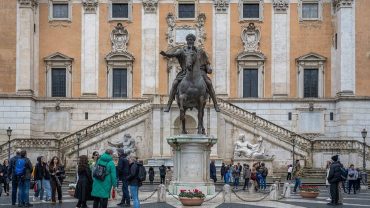
The Capitoline (Campidoglio) is the smallest of the seven hills and the closest to Piazza Venezia. In ancient times it had two summits: one held the Temple of Jupiter, the most important temple of Rome, and the other the citadel. Since the 12th century it has been the seat of Rome’s city government.
Today you come here for Piazza del Campidoglio, the square designed by Michelangelo, reached by the Cordonata ramp; for the Capitoline Museums, with the bronze She-wolf and the original statue of Marcus Aurelius; and for the free viewpoints over the Roman Forum behind City Hall. The white marble Vittoriano monument stands against the north side of the hill, on Piazza Venezia.
Our guide to the Capitoline Hill has the full story, with museum hours and tickets, and our guide to the Vittoriano covers the monument and its panoramic terrace.
What is on the Aventine Hill?
The Aventine is the southernmost of the seven hills, above the Tiber and the Circus Maximus. Today it is a quiet residential hill of villas, convents and churches, and it holds two of Rome’s best-loved free sights.
- The Orange Garden (Giardino degli Aranci, officially Parco Savello) is a small park next to the church of Santa Sabina, laid out in 1932, with a terrace over the Tiber toward St. Peter’s dome. It is free and open from 7:00 to 18:00 from October to February, to 20:00 in March and September, and to 21:00 from April to August. Read our guide to the Orange Garden.
- The Aventine Keyhole, a few steps away on Piazza dei Cavalieri di Malta, frames St. Peter’s dome at the end of a garden path when you look through the keyhole of a door. It is free, but the line can take more than 40 minutes. Read our guide to the Aventine Keyhole.
What is on the Quirinal Hill?
The Quirinal is the northernmost of the seven hills, a long ridge above the Trevi Fountain. It took its name from an ancient temple of the god Quirinus. In antiquity a saddle of land joined it to the Capitoline, until Emperor Trajan cut it away in the early 2nd century AD to make room for his forum. Trajan’s Markets were built into the cut slope of the hill, and you can see their curved brick facade from Via dei Fori Imperiali.
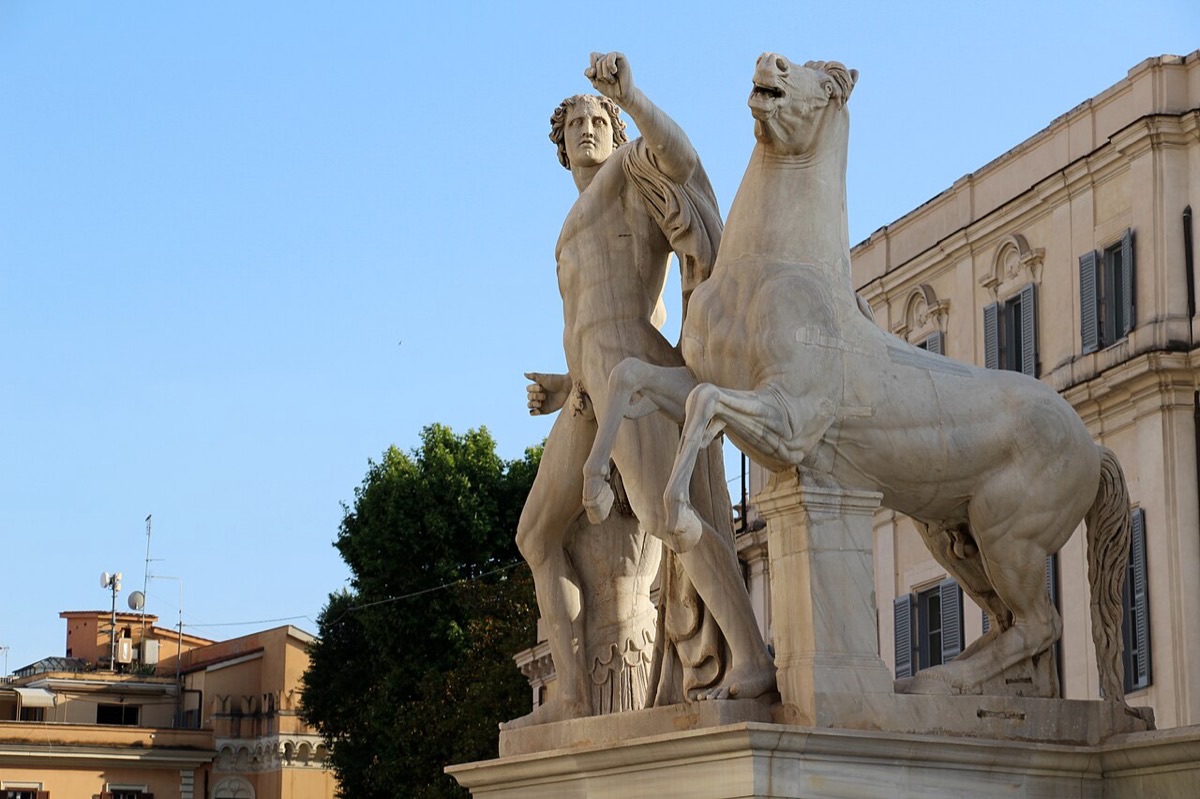
At the top, Piazza del Quirinale is a wide square with a famous view over the rooftops toward St. Peter’s dome; we list it among our panoramic views of Rome. In the middle stands the Fountain of the Dioscuri: two colossal ancient statues of Castor and Pollux with their horses, which gave the hill its old nickname, Monte Cavallo (“Horse Hill”). Pope Pius VI added the obelisk from the Mausoleum of Augustus in 1786, and Pope Pius VII the granite basin from the Roman Forum in 1818.
On one side of the square is the Quirinale Palace. It grew from a villa built for Pope Gregory XIII in 1583–1585; from 1587, under Sixtus V, it was the popes’ summer residence. In 1870 it became the palace of the kings of Italy, and since 1948 it has been the home of the President of the Italian Republic. Along Via del Quirinale, two small Baroque churches stand a few minutes apart: Bernini’s Sant’Andrea al Quirinale and Borromini’s San Carlo alle Quattro Fontane, at the crossroads of the Four Fountains.
You can visit the palace, but only with a booking:
- Days and hours: Tuesday, Wednesday, Friday, Saturday and Sunday, 9:30–16:00, last entry 14:30. The palace closes to the public in summer, from late July to mid-September.
- Itineraries: three, each about 1 hour and 20 minutes: the state rooms; a themed route called “Vasella, Gardens and Carriages”; and the contemporary art and design collection.
- Price: free, with a mandatory booking charge of €2.50.
- Booking: on the Quirinale’s official website, by phone at +39 06 42012191 (daily 9:00–17:00) or at the Infopoint, Salita di Montecavallo 15.
- On the day: tickets carry the visitor’s name and are non-refundable, so bring an ID and arrive 15 minutes early. Children under 12 must be with an adult. The guided tour is in Italian only.
Two of our tours pass the Quirinale Palace, seen from the outside: the 90-minute golf cart tour with audio guide and the Dolce Vita Dress-Up tour by Fiat 500. Both are described below.
What is on the Viminal Hill?
The Viminal is a narrow ridge between the Quirinal and the Esquiline, and many visitors cross it without noticing. Its name probably comes from the osier thickets (vimini, wicker) that once covered it. In ancient times it was a residential district; the remains of a street along its crest were found when the Teatro dell’Opera, Rome’s opera house, was built.
Today the hill is best known for the Ministry of the Interior, in the large palace on Piazza del Viminale; Italians simply say “il Viminale” when they mean the ministry. The Treccani encyclopedia counts the Baths of Diocletian among the buildings of the Viminal. Built between 298 and 306 AD, they were the biggest baths in Rome. Their great central hall is now the church of Santa Maria degli Angeli, redesigned by Michelangelo, and other parts hold the Museum of the Baths, part of the National Roman Museum, with its own ticket. Termini station is right next door.
What is on the Esquiline Hill?
The Esquiline is really a group of heights: in Republican times its name covered the Cispius, the Oppius and the Fagutal. Its edge was once a burial ground. Later the area was reclaimed, and it became a place of grand gardens, like those of Maecenas. After the great fire of 64 AD, Nero built part of his Golden House on the Oppian height.
- Santa Maria Maggiore, at the summit of the hill, is one of the four papal basilicas of Rome. Legend says a snowfall in August of the year 352 showed where to build it, and every August 5 white petals fall during a celebration that recalls the miracle. Its treasures include Arnolfo di Cambio’s Nativity scene, the relic of the Holy Crib and the tombs of several popes; Pope Francis, who died in 2025, is buried here too. The basilica is also one of the stops of the Seven Churches pilgrimage.
- San Pietro in Vincoli (St. Peter in Chains) stands at the top of a flight of steps off Via Cavour, on the way down toward the Colosseum. It was built in the 5th century to keep the chains said to have bound St. Peter, still displayed in the church. It is also the home of Michelangelo’s Moses, carved in 1513 for the tomb of Pope Julius II and here since 1545.
- The Domus Aurea, the remains of Nero’s Golden House, lies inside the Colle Oppio park. It opens only from Friday to Sunday, with its own ticket and booking, and it is closed on the first Sunday of the month.
What is on the Caelian Hill?
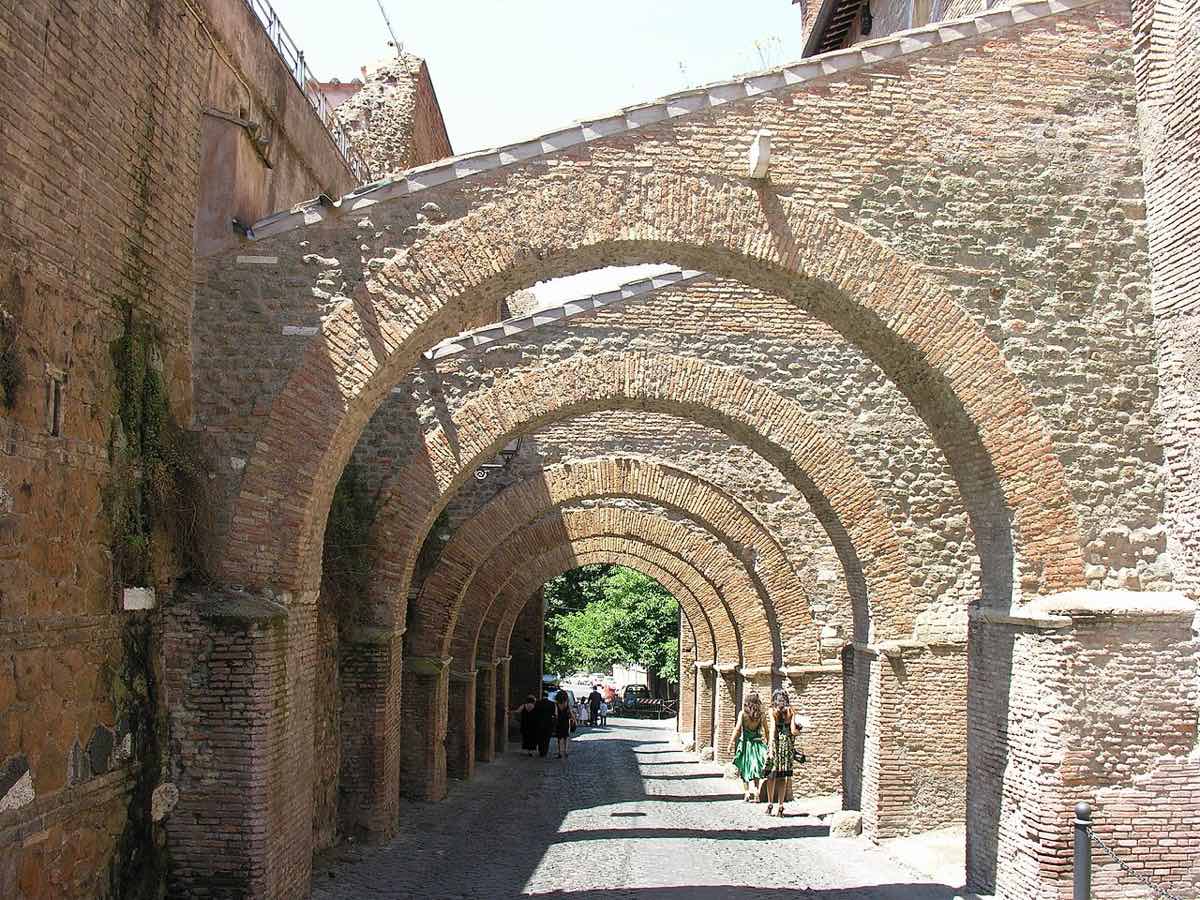
The Caelian rises just south of the Colosseum, and it is the greenest and quietest of the seven. The ancient Romans said its name came from an Etruscan leader, Caeles Vibenna. The best way up is the Clivo di Scauro, a cobbled lane that climbs under a row of brick arches beside the church of Santi Giovanni e Paolo.
- Case Romane del Celio: under the church lie Roman houses of the 2nd to 4th centuries AD. They are open every day from 10:00 to 16:00 (the ticket office closes an hour earlier; closed on January 1 and December 25). They are also closed for renovation work from November 16 to 20, 2026. A ticket costs €8, plus €2 if you book online, and children under 6 enter free. The entrance is on the Clivo di Scauro. Details are on the official website.
- Villa Celimontana: a public park in the grounds of the Mattei family’s late-16th-century villa, with an Egyptian obelisk of Ramesses II; the villa is the seat of the Italian Geographical Society. The park is free and open from 7:00 to sunset, with entrances on Piazza dei Santi Giovanni e Paolo and Via della Navicella. For more green spaces, see our guide to parks in Rome.
- Churches: further along the hill are the round church of Santo Stefano Rotondo, from the 5th century, and the church and monastery of Santi Quattro Coronati. At the foot of the hill, on the way back to the Colosseum, the Basilica of San Clemente stands on top of a 4th-century church and a 3rd-century temple of Mithras; to visit the excavations, book online.
The seven hills at a glance
| Hill | What is on it today | Best thing to see | Free or ticket |
|---|---|---|---|
| Palatine | Ruins of the imperial palaces, inside the Colosseum Archaeological Park | The palace ruins and the Farnese Gardens, with views over the Forum | Ticket (with the Colosseum and the Forum, or Forum Pass SUPER) |
| Capitoline | Rome’s City Hall and the Capitoline Museums | Michelangelo’s Piazza del Campidoglio and the view over the Roman Forum | Square and viewpoints free; museums with a ticket |
| Aventine | A quiet district of villas, convents and churches | The Orange Garden and the Aventine Keyhole | Free |
| Quirinal | The Quirinale Palace, home of the President of the Republic | Piazza del Quirinale, with the Dioscuri and the view | Square free; palace free with a €2.50 booking charge |
| Viminal | The Ministry of the Interior and the opera house, with the Baths of Diocletian | Santa Maria degli Angeli, inside the baths | Church free; Museum of the Baths with a ticket |
| Esquiline | Santa Maria Maggiore, San Pietro in Vincoli and the Colle Oppio park | Santa Maria Maggiore and Michelangelo’s Moses | Churches free; Domus Aurea with a ticket |
| Caelian | Churches, convents and Villa Celimontana | The Clivo di Scauro and the Case Romane del Celio | Lane and park free; Case Romane €8 |
Six of the seven hills cost nothing to walk. For more ideas, see our list of free things to do in Rome.
Which famous hills are not among the seven?
Rome has more than seven hills, and some of the best known are not on the list, because they lay outside the ancient city wall.
- The Janiculum (Gianicolo): the long ridge on the right bank of the Tiber, between Trastevere and the Vatican. It has some of the widest views over the city, and a cannon fires a blank shot from it every day at noon. It is often called Rome’s “eighth hill”, but it was never one of the seven. Read our guide to the Janiculum Hill.
- The Pincian (Pincio): the hill above Piazza del Popolo, joined to the park of Villa Borghese. It takes its name from the Pincii, a Roman family who owned land here; before them it was a hill of gardens, among them the gardens of Lucullus. Its terraces were laid out by Giuseppe Valadier between 1811 and 1823, and its avenues are lined with 229 busts of famous Italians. It is always open and free. See our guide to Villa Borghese.
- The Vatican Hill: on the right bank, behind St. Peter’s. It rises from 19 meters (62 feet) above sea level at St. Peter’s Square to 77 meters (253 feet) at its highest point. Here stood the Circus of Nero and the burial ground where, by tradition, St. Peter was buried. See our guide to visiting the Vatican.
- Monte Testaccio: a hill made by people, out of broken Roman amphorae (clay jars) dumped near the old river port. See our guide to Testaccio.
How can you see several hills in one morning?
The hills are close to each other, so four or five of them fit into a morning on foot. Expect climbs, steps and cobblestones. We worked out two routes, one through the southern hills and one through the northern hills. Distances and times come from walking routes calculated on OpenStreetMap; the times are walking only, at a steady pace, without stops, so plan about three hours for each route with visits and photos.
Route 1: the Capitoline, the Aventine, the Palatine from below and the Caelian (about 4 km or 2.5 miles, 55 minutes of walking)
| From → to | Distance | Walking time |
|---|---|---|
| Piazza del Campidoglio → Mouth of Truth | 730 m | 10 min |
| Mouth of Truth → Orange Garden, up the Clivo di Rocca Savella | 520 m | 7 min |
| Orange Garden → Aventine Keyhole | 370 m | 5 min |
| Aventine Keyhole → Piazza di San Gregorio, past the Circus Maximus | 1,450 m | 20 min |
| Piazza di San Gregorio → Clivo di Scauro and Santi Giovanni e Paolo | 200 m | 3 min |
| Santi Giovanni e Paolo → Colosseum | 730 m | 10 min |
Start on the Capitoline, with the view over the Forum. Walk down to the Mouth of Truth at Santa Maria in Cosmedin, then climb the Clivo di Rocca Savella, a steep lane that leads to one of the entrances of the Orange Garden. After the Keyhole, go down Via di Valle Murcia to the Circus Maximus, with the ruins of the Palatine above you, and continue to Piazza di San Gregorio. From there the Clivo di Scauro climbs onto the Caelian. Finish at the Colosseum. If you also want to visit the Palatine itself, its entrance at Via di San Gregorio 30 is about 460 meters (6 minutes) from Santi Giovanni e Paolo.
Route 2: the Quirinal, the Viminal and the Esquiline (about 3.6 km or 2.2 miles, 48 minutes of walking)
| From → to | Distance | Walking time |
|---|---|---|
| Trevi Fountain → Piazza del Quirinale | 470 m | 6 min |
| Piazza del Quirinale → Four Fountains, along Via del Quirinale | 500 m | 7 min |
| Four Fountains → Piazza del Viminale | 390 m | 5 min |
| Piazza del Viminale → Santa Maria Maggiore | 650 m | 9 min |
| Santa Maria Maggiore → San Pietro in Vincoli | 950 m | 13 min |
| San Pietro in Vincoli → Colosseum | 590 m | 8 min |
Start at the Trevi Fountain and climb to Piazza del Quirinale for the view. Follow Via del Quirinale past the two Baroque churches to the Four Fountains, cross the Viminal and walk on to Santa Maria Maggiore. From there, head down to San Pietro in Vincoli for Michelangelo’s Moses, and finish at the Colosseum.
A few tips for both routes:
- All seven in one day: the two routes together cover all seven hills in about 7.5 km (4.7 miles) and 1 hour 45 minutes of walking. Walk Route 2 in reverse from the Colosseum after Route 1, and keep the whole day free.
- Timing: the Orange Garden opens at 7:00, and the Quirinale Palace can be visited only five days a week, with a booking.
- Churches: dress modestly (shoulders and knees covered) in Santa Maria Maggiore, San Pietro in Vincoli and the other churches.
- Shoes: wear shoes with a good grip; the lanes are cobbled and steep in places.
- Getting back: both routes end at the Colosseum, which has a metro station on line B. Tickets and routes are in our guide to getting around Rome.
- Limited mobility: if climbs are hard for you, our guide to Rome with kids, seniors and limited mobility has practical tips, or see the hills from a golf cart (below). To fit the hills into a longer stay, see our Rome itinerary.
See the seven hills with us
Facile Tours runs golf cart and vintage Fiat 500 tours that pass four of the seven hills: the Capitoline, the Aventine and the Palatine, and, on two tours, the Quirinal, with the Quirinale Palace. On every tour you see them from the outside, and the drivers are not licensed guides. None of our routes includes the Viminal, the Esquiline or the Caelian. Our private golf cart tours adapt the route to your interests, so if one of those hills matters to you, ask when you book.
- Private golf cart tour: the 3-hour version includes the Capitoline Hill with its views over the Roman Forum, the Circus Maximus below the Palatine, and the Orange Garden and the Keyhole on the Aventine. It also covers the Colosseum, Piazza Navona, the Pantheon, the Trevi Fountain and the Spanish Steps, with a Trevi Fountain ticket and a stop for gelato or coffee. Its example route also passes Trajan’s Markets, on the slope of the Quirinal, and the Villa Borghese gardens. Pickup in the historic center. €450 for 1–3 people, then €150 per person. The 5-hour version (€750 for 1–3 people, then €250 per person) adds Trastevere, the Janiculum and the Vatican area. A 2-hour version, available from November 1 to April 15, covers fewer stops: €350 for 1–3 people, then €115 per person.
- Private golf cart tour by night: 2 hours, starting at 20:00, 21:00 or 22:00. You choose the stops from a list that includes the Palatine Hill, the Circus Maximus and the Aventine with its Keyhole. From €450 for 1–3 people (at 20:00), then €150 per person. To compare the evening options, read our guide to Rome at night by golf cart or Fiat 500.
- Shared golf cart tour: from our office at Via del Colosseo 11A, at 9:30 or 14:30. The 2-hour tour (€59 per person) passes the Circus Maximus, the Orange Garden, the Mouth of Truth and the Capitoline Hill and ends at the Trevi Fountain. The 3-hour tour (€99) adds the Spanish Steps, the Villa Borghese gardens, Piazza del Popolo and Trajan’s Markets, and returns to Via del Colosseo 11A.
- Dolce Vita tour by vintage Fiat 500: 3 hours, private. The typical route includes the Capitoline Hill, the Circus Maximus and the Orange Garden, Trajan’s Markets and the Colosseum, with a Trevi Fountain ticket and a short food stop. From €590 for 1–3 people, €1,180 for 4, then €240 per person.
- Romantic tour by vintage Fiat 500: 90 minutes for couples, with the Pincio Terrace, the Janiculum and the Orange Garden on the Aventine, plus St. Peter’s Basilica, Piazza del Popolo and the Circus Maximus. €390 for 1–2 people, up to 10 per booking.
- 90-minute golf cart tour with audio guide: shared, from our office at Via del Colosseo 11A, seven times a day from 9:00 to 19:00. The fixed route passes the Colosseum, the Pincio Terrace, Piazza del Popolo, Piazza Navona, the Pantheon, the Trevi Fountain and the Quirinale Palace, with an audio guide in 12 languages in the free Nemo app (bring your own headphones). €35 per person, up to 7 per booking.
- Dolce Vita Dress-Up tour by Fiat 500: 3.5 hours, private. You rent Dolce Vita-style clothes at a showroom on Via Metastasio, take a 1-hour walk through the historic center, then ride for 2 hours in a vintage Fiat 500 on a fixed route past the Pantheon, the Trevi Fountain, the Quirinale Palace, the Colosseum, the Orange Garden on the Aventine and the Mouth of Truth. From €620 for 1–2 people, up to 6 per booking.
Good to know on these tours:
- Groups: the private golf cart tours and the Dolce Vita tour take up to 21 guests guaranteed (on the 2-hour private tour, the maximum depends on the start time), with larger groups on request; the 90-minute tour takes up to 7 travelers per booking and the Dress-Up tour up to 6. Our golf carts carry 3, 5 or 7 passengers plus the driver.
- Children: golf carts take children of any age, except the 90-minute tour, which takes children from 4 and no strollers. Child seats are available on private golf cart tours only. On the other golf cart tours a folded stroller fits on board; just tell us when you book. Fiat 500 tours take children aged 3 and over, with no child seats. Our Fiat 500s are restored original Fiat 500s converted to electric; some have no seat belts, because they were built before seat belts were required.
- Wheelchairs: on a private golf cart tour, wheelchair users move onto a seat of the golf cart, and the folded wheelchair travels on board in place of the two back seats. Contact us before booking if the traveler cannot move from the wheelchair to a seat. The shared tours are not suitable for wheelchair users.
- Weather: the golf carts have rain covers and run in the rain. In rain or wet weather, the Fiat 500 tours run in golf carts; if none is available, we offer another date or time.
- Cancellation: full refund if you cancel at least 72 hours before the tour, 50% if you cancel at least 48 hours before; later cancellations and no-shows are not refunded.
If you like walking, the two routes above cost nothing, and you will see more of the Quirinal, the Esquiline and the Caelian than from any vehicle. A tour is the better choice when you want to see the Capitoline, the Aventine and the Palatine together with the Colosseum, the Pantheon and the Trevi Fountain in a few hours, without the climbs. To decide, read our guide on whether a golf cart tour is worth it, or see all the golf cart tours in Rome and vintage Fiat 500 tours in Rome that Facile Tours runs.
Explore it with us
 Private Golf Cart Tour of Rome3 hours with pickup in the center, with the Capitoline Hill, the Circus Maximus, the Orange Garden and the Aventine Keyhole · from €450 for 1–3 peopleBook now
 Shared Golf Cart Tour of Rome2 or 3 hours from Via del Colosseo 11A, with the Circus Maximus, the Orange Garden and the Capitoline Hill · from €59 per personBook now
 Dolce Vita Tour by Vintage Fiat 5003 hours, private, with the Capitoline Hill, the Circus Maximus and the Orange Garden · from €590 for 1–3 peopleBook now
FAQ
What are the names of the seven hills of Rome?
The seven hills of Rome are the Palatine, the Capitoline, the Aventine, the Quirinal, the Viminal, the Esquiline and the Caelian. In Italian they are the Palatino, Campidoglio, Aventino, Quirinale, Viminale, Esquilino and Celio. All seven are on the left bank of the Tiber, around the Roman Forum and the Colosseum.
On which hill was Rome founded?
According to legend, Romulus founded Rome on the Palatine Hill on April 21, 753 BC. Archaeologists have found Iron Age settlements there. Later the emperors built their palaces on the Palatine, and its Latin name, Palatium, gave us the word “palace”.
Is the Janiculum one of the seven hills of Rome?
No. The Janiculum, like the Pincian and the Vatican Hill, lies outside the ancient city wall that enclosed the seven hills, on the right bank of the Tiber. It is often called Rome’s “eighth hill” and has some of the best views over the city.
Can you walk all seven hills of Rome in one day?
Yes, if you like walking. Our two routes, one through the Capitoline, Aventine, Palatine and Caelian and one through the Quirinal, Viminal and Esquiline, add up to about 7.5 km (4.7 miles) and 1 hour 45 minutes of walking, with climbs and cobblestones. With visits, plan a full day.
Which of the seven hills are free to visit?
You can walk six of them for free: the Capitoline, the Aventine, the Quirinal, the Viminal, the Esquiline and the Caelian, with their squares, parks and churches. The Palatine is inside the Colosseum Archaeological Park and needs a ticket; until February 28, 2027 it is open from 9:00 to 16:30.
Can you see the seven hills on a golf cart tour?
Partly. Our 3-hour private golf cart tour passes the Capitoline Hill, the Circus Maximus below the Palatine, and the Orange Garden and the Keyhole on the Aventine, and our 90-minute golf cart tour passes the Quirinale Palace, all seen from the outside. None of our routes includes the Viminal, the Esquiline or the Caelian; on a private golf cart tour, ask when you book.

Comment (0)