
The Capitoline Hill (Campidoglio) is the smallest of Rome’s seven hills, home to the city government and to Piazza del Campidoglio, the square designed by Michelangelo. The square and the Cordonata ramp are free. The Capitoline Museums open daily 9:30–19:30; until January 10, 2027, with the Angeli exhibition, a non-resident ticket costs €16.50.
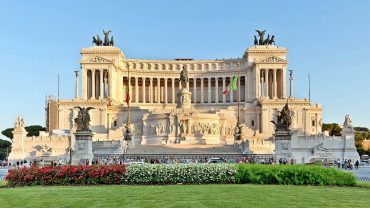
Cover photo: Wilfredor, CC0, via Wikimedia Commons
The Capitoline Hill is small, but it has been at the heart of Rome for more than 2,500 years. The ancient Romans built their most important temple here, the Temple of Jupiter. Since 1143 the hill has been the seat of the city government, and in the 16th century Michelangelo gave it the square we see today. It is also home to the Capitoline Museums, with the bronze She-wolf and the original statue of Marcus Aurelius. We are a local tour operator in Rome, and several of our golf cart and Fiat 500 tours pass the hill. This guide explains what to see in the square, why the Cordonata is a ramp of steps, where to find the free view over the Roman Forum, and the museums’ highlights, hours and tickets.
What is the Capitoline Hill?
The Capitoline Hill, Campidoglio in Italian, is the lowest and smallest of the seven hills of Rome, between Piazza Venezia and the Roman Forum. In ancient times it had two summits: the Capitolium, with the Temple of Jupiter, and the Arx, the citadel, where the church of Santa Maria in Aracoeli stands today. Piazza del Campidoglio lies in the dip between them, about 8 meters (26 feet) above the ancient ground level.
People lived on the hill as early as the Bronze Age, and in Roman times it was the city’s main stronghold. Some of Rome’s most famous stories are set here. Traitors were thrown from the Tarpeian Rock. In 390 BC, when the Gauls besieged the hill, the sacred geese of the goddess Juno woke the defenders with their cries and saved the citadel. Later a temple to Juno Moneta was built on the Arx, and it housed Rome’s first mint: the word “money” comes from her name.
| Fact | Details |
|---|---|
| Italian name | Campidoglio (Capitolium in Latin) |
| What it is | The smallest of Rome’s seven hills, seat of the city government |
| Main square | Piazza del Campidoglio, designed by Michelangelo from 1536 |
| Entry to the square | Free |
| Capitoline Museums | Every day 9:30–19:30, last entry 18:30 |
| Museum ticket | €16.50 for non-residents until January 10, 2027 (with the Angeli exhibition) |
| Free museum entry | Everyone on the first Sunday of the month; residents of Rome and its Metropolitan City every day |
| Stairways | The Cordonata to the square; 124 steps to Santa Maria in Aracoeli |
| Right next to it | Piazza Venezia, the Roman Forum, the Theater of Marcellus |
What was the Temple of Jupiter, and can you still see it?
The most important temple of ancient Rome stood on the Capitoline Hill. It was dedicated to Jupiter Optimus Maximus, “the best and greatest”, together with Juno and Minerva. According to tradition it was begun by the Etruscan king Tarquinius Priscus and finished by Tarquinius Superbus, the last king of Rome, and it was consecrated on September 13, 509 BC, in the first year of the Republic. Its base measured more than 50 meters (165 feet) on each side. Fires destroyed it more than once, the last time in 80 AD, and each time it was rebuilt.
Little is left today, and most of it lies under Palazzo Caffarelli, part of the museum complex. Inside the Capitoline Museums you can see its foundations: the huge blocks displayed in the glass Exedra of Marcus Aurelius and the so-called “Roman Wall”, the only part of the temple podium preserved at its full height. The excavations that uncovered them ended in 2000.
Who designed Piazza del Campidoglio?
Until the 16th century, the Capitoline Hill faced the Roman Forum. In 1536, for the visit to Rome of Emperor Charles V, Pope Paul III asked Michelangelo to redesign the square, which was then badly neglected. Michelangelo turned the hill around: his new square and its stairway face the Campus Martius, the modern city and St. Peter’s, and turn their back on the Forum.
He started with the centerpiece. In 1538 the ancient bronze statue of Marcus Aurelius was brought here from the Lateran, and Michelangelo designed its pedestal in the middle of the square. Around it he drew a trapezoid closed on three sides by palaces, with an oval paving. The star pattern inside the oval follows his idea, but it was laid only in 1940. Michelangelo did not see his square finished: Giacomo Della Porta completed Palazzo Senatorio, Carlo Rainaldi finished Palazzo Nuovo, and the work ended in 1655.
Standing at the top of the Cordonata and facing the square, this is what you see:
| Building | Where it stands | What is inside |
|---|---|---|
| Palazzo Senatorio | At the back, with the bell tower | Rome’s City Hall: the mayor’s offices and the hall of the City Assembly |
| Palazzo dei Conservatori | On your right | Capitoline Museums: the She-wolf, the Exedra of Marcus Aurelius and the picture gallery |
| Palazzo Nuovo | On your left | Capitoline Museums: the Dying Gaul, the Capitoline Venus and, in the courtyard, Marforio |
Palazzo dei Conservatori dates from the mid-15th century; Michelangelo redesigned its facade, and it has been a museum since 1876. Palazzo Nuovo, the “new palace”, was built in the 17th century by Girolamo and Carlo Rainaldi to mirror it.
What is the Cordonata, and who are Castor and Pollux?
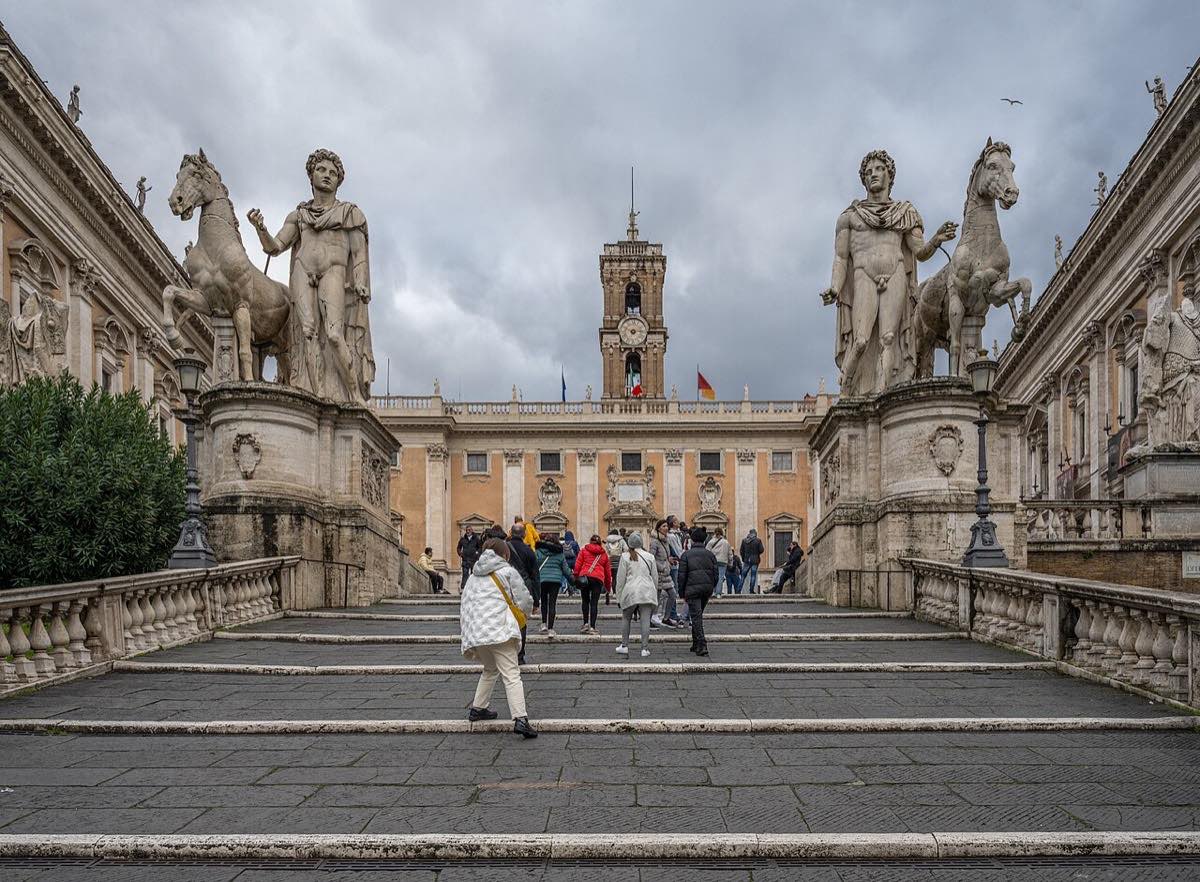
The Cordonata is the wide stairway that climbs from Piazza d’Aracoeli to the square. Michelangelo designed it with low, deep steps, a ramp more than a staircase, so that riders could go up on horseback: the city’s tourist board says it was built “to allow knights to climb easily”. It is still the grand way in, and the best way to see the square for the first time.
At the foot of the Cordonata sit two Egyptian lions of basalt, from the ancient temple of Isis and Serapis in the Campus Martius. They became fountains in 1587, when the Acqua Felice aqueduct reached the hill, and on special feast days wine flowed from their mouths instead of water.
At the top, on the balustrade, stand the colossal Dioscuri, Castor and Pollux, the twin sons of Jupiter in Roman myth, each beside his horse. The marble groups on the balustrade were added in the decades after Michelangelo. The two giants were restored in 2025 by the City of Rome’s heritage office, with funds from the Italian recovery plan.
Don’t confuse the Cordonata with the much steeper staircase on its left: that one has 124 steps and leads to the church of Santa Maria in Aracoeli (more below).
Is the statue of Marcus Aurelius in the square the original?
No. The bronze horseman in the middle of the square is a copy, set up in the late 1990s. The original is inside the Capitoline Museums, protected from the weather in the Exedra of Marcus Aurelius, a large glass hall designed by the architect Carlo Aymonino.
The statue is just over 4 meters (13 feet) high and was probably made in 176 AD, for the emperor’s triumph over the Germanic tribes, or in 180 AD, soon after his death. Late Roman descriptions of the city list 22 larger-than-life equestrian statues, the “equi magni”; this is the only one that survives. It escaped destruction because, in the Middle Ages, people believed it showed Constantine, the first Christian emperor, and it stood for centuries at the Lateran.
The statue was once gilded, and traces of gold can still be seen on the original. Romans used to say that when the horseman turned all gold again, the tuft of hair between the horse’s ears, nicknamed the “owl”, would sing and announce the end of the world. In the square, the copy looks toward the dome of St. Peter’s.
Why is Palazzo Senatorio the seat of Rome’s government?
Palazzo Senatorio, at the back of the square, has been the seat of the city government since 1143, when the free Municipality of Rome was born. It stands on the Tabularium, the state archive of ancient Rome, built in 78 BC by the consul Quintus Lutatius Catulus. In the Middle Ages the ancient building became a fortress, and then the palace of the senators. Michelangelo designed the double staircase at the front; the facade was finished only at the end of the 16th century by Giacomo Della Porta and Girolamo Rainaldi.
Today it houses the mayor’s offices and the Giulio Cesare hall, where the City Assembly meets: a working building, not part of the museum. The bell tower, built in 1578–1582 by Martino Longhi the Elder, holds the bell called the “Patarina”, which rings on April 21, Rome’s birthday, and when a new mayor is elected. On some occasions the city opens the palace for free guided visits: on November 1, 2026, for example, there were free tours in Italian, booked through the 060608 call center.
At the foot of the double staircase, the fountain of the goddess Roma sits between two huge reclining river gods, the Nile and the Tiber (once a statue of the Tigris). A copy of the She-wolf stands on a column near the palace’s Sixtus IV entrance.
Where is the best view of the Roman Forum from the Capitoline Hill?
You cannot see the Forum from the square itself: Palazzo Senatorio stands in the way. Walk around the palace instead. Via del Campidoglio, beside it, is the start of a circular walk around the hill, and from its viewpoint the view sweeps over the Forum all the way to the Colosseum. On the other side, the viewpoint on Via di Monte Tarpeo shows the foundations of the Tabularium rising above the Forum valley. Both are free and outdoors. The terrace of Palazzo Caffarelli, reached from Piazza Caffarelli, looks over another side of the city.
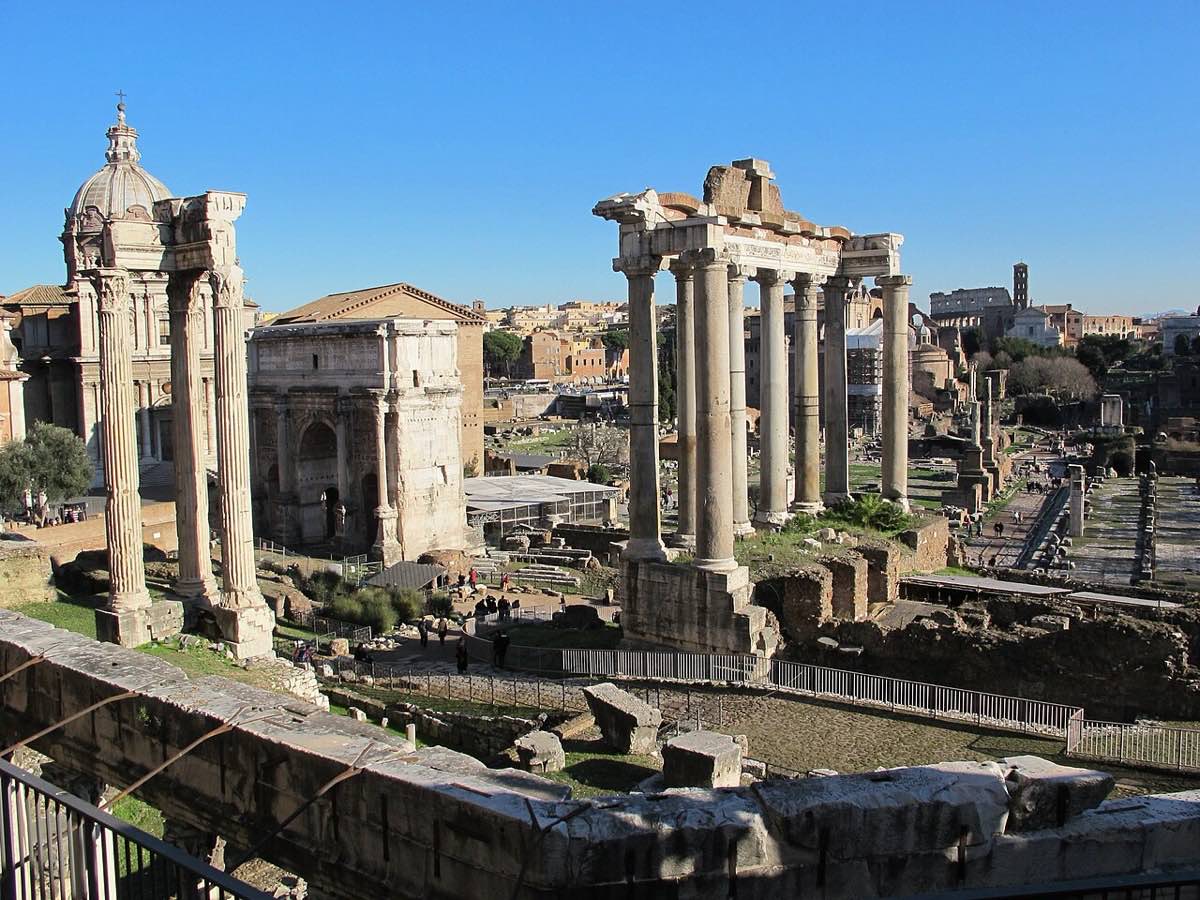
Inside the museums there is a second view, under cover. A gallery under the square, the Galleria di Congiunzione, links the two museum palaces and leads into the Tabularium. After a long corridor, where you pass the remains of the Temple of Veiovis, you reach the ancient arched gallery that opens onto the Roman Forum.
From the hill you see the Forum from above. To walk among its ruins you need a separate ticket: read our guide to the Colosseum. For more viewpoints around the city, see our panoramic views of Rome. Next door, the Vittoriano monument on Piazza Venezia has its own terrace at the top, reached by two panoramic elevators, with a 360-degree view.
What are the must-see works in the Capitoline Museums?
The Capitoline Museums trace their origin to 1471, when Pope Sixtus IV gave a group of ancient bronzes to the Roman people, among them the She-wolf and the Spinario. The city’s tourist board calls them the world’s first public museum, opened in 1734. The collections fill Palazzo dei Conservatori and Palazzo Nuovo, on the two sides of the square, linked by the gallery under it.
| Work | Where | What to look for |
|---|---|---|
| Capitoline She-wolf | Palazzo dei Conservatori, Hall of the She-wolf | The bronze symbol of Rome, from an Etruscan or Magna Graecia workshop of the 5th century BC. The twins Romulus and Remus were added in the 15th century |
| Marcus Aurelius | Exedra of Marcus Aurelius | The original bronze horseman, with a gilded bronze Hercules, the remains of a bronze colossus of Constantine and the foundations of the Temple of Jupiter |
| Dying Gaul (“Capitoline Gaul”) | Palazzo Nuovo, Hall of the Galatian | A wounded Celtic warrior in marble, about 60–40 BC, copied from a group dedicated at Pergamon by King Attalus I. It was taken to France from 1797 to 1816 |
| Capitoline Venus | Palazzo Nuovo, Cabinet of Venus | A marble Venus stepping out of her bath, found in Rome around 1666–1670 |
| Caravaggio | Picture gallery, Hall of St. Petronilla | St. John the Baptist (1602) and The Fortune Teller |
| Tabularium | Under Palazzo Senatorio | The ancient state archive and its gallery over the Roman Forum |
Look out for Marforio too, a reclining river god in the courtyard of Palazzo Nuovo and one of Rome’s talking statues. If you love Caravaggio, our guide on where to see Caravaggio in Rome lists his other works in the city. Until December 31, 2026, the garden of Villa Caffarelli also shows a full-size reconstruction of the colossal statue of Constantine, about 13 meters (43 feet) high, free to see.
Some rooms can be closed for work: in early November 2026 the halls of the Horti of Maecenas and the Pietro da Cortona room were closed. Check the museum’s notices before you go. Since June 9, 2026, and until further notice, Palazzo Nuovo is closed to visitors in wheelchairs, because of work on the ground-floor rooms that lead to the elevator. With so much to see, plan at least two to three hours for the museums.
What are the Capitoline Museums’ opening hours?
| Day | Hours |
|---|---|
| Every day | 9:30–19:30 |
| December 24 and 31 | 9:30–14:00 |
| May 1 and December 25 | Closed |
| January 1 | Special hours (in 2026: 11:00–20:00) |
Last admission is one hour before closing. The entrance is at Piazza del Campidoglio 1. For information, call the city’s museum call center, +39 060608, every day from 9:00 to 19:00. If you use a wheelchair, check access in the museum’s notices or call 060608 before you go, because some rooms can be closed to wheelchair users.
How much are Capitoline Museums tickets, and when is entry free?
Prices for visitors who do not live in Rome:
| Ticket | Full | Reduced |
|---|---|---|
| Capitoline Museums with the Angeli exhibition (until January 10, 2027) | €16.50 | €11.00 |
| Capitoline Museums when no exhibition is on | €15.00 | €9.50 |
| Diego Rivera exhibition only, at Villa Caffarelli (until December 13, 2026) | €15.00 | €13.00 |
| Super Combo: museums, Angeli and Diego Rivera | €23.50 | €19.50 |
| Capitolini Card: 7 days, with the Centrale Montemartini museum | €15.50, plus €5.50 for exhibitions | €11.50, plus €5.50 for exhibitions |
- The exhibition surcharge: the higher price applies while the exhibition Angeli is on, on the ground floor of Palazzo dei Conservatori, until January 10, 2027. It does not include the Diego Rivera exhibition at Villa Caffarelli, which has its own ticket.
- Reduced tickets: for non-residents aged 6 to 25, among others. Every Wednesday, in the last two hours before closing, non-residents get 50% off.
- Free entry: for children under 6, visitors with disabilities and a carer, and, since February 2026, residents of Rome and the Metropolitan City of Rome with an ID.
- First Sunday of the month: entry is free for everyone, subject to capacity (the Villa Caffarelli exhibition is not included). The next free Sundays are December 6, 2026 and January 3, 2027.
- Booking: buy on the official ticket website, through 060608, or at the ticket office for a later day, with a €1 booking fee. Tickets for the same day at the ticket office have no fee. Booked tickets cannot be refunded or changed. All prices are on the official tickets page.
- Guides: an audio guide costs €4 and a video guide €6, in English, Italian, French, German and Spanish.
The museums are also a good plan for a wet afternoon: see our ideas for what to do in Rome when it rains.
What is Santa Maria in Aracoeli?
To the left of the Cordonata, a far steeper flight of 124 marble steps climbs to the church of Santa Maria in Aracoeli, on the highest point of the hill, where the Arx and the Temple of Juno Moneta once stood. The staircase was built in 1348 as a vow to the Virgin Mary to end the plague, with marble taken from an ancient temple on the Quirinal Hill. Two centuries later, Pope Gregory XIII wanted the future Spanish Steps to be “like the one at the Aracoeli”.
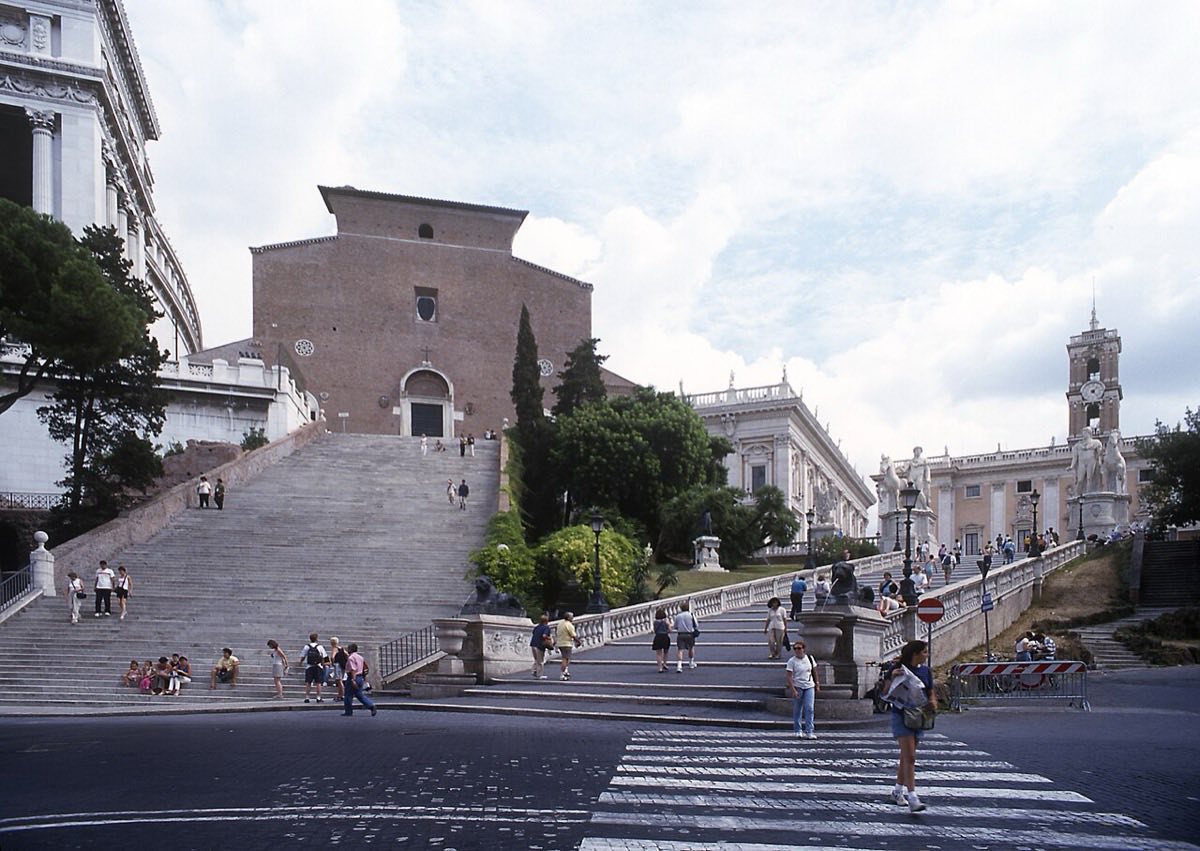
The name comes from a legend: a sibyl told Emperor Augustus of the coming of Christ, saying “This is the altar of the Son of God”, hence Ara Coeli, the “altar of heaven”. Franciscan friars still serve the church. Inside, look for the Cosmatesque floor, a tombstone carved by Donatello and the Bufalini Chapel, frescoed by Pinturicchio. In 1341 the poet Petrarch was named poet laureate on the Capitoline Hill. From the top of the steps, the view stretches over the domes of Rome as far as St. Peter’s. It is a working church, so dress modestly and avoid visiting during services.
Can you get married on the Capitoline Hill?
Yes, in a civil ceremony. The City of Rome holds civil weddings in the Sala Rossa (Red Hall) on the Capitoline Hill. It is booked at the city’s Marriage Office, at Via Luigi Petroselli 50, after the banns have been published. The fee, set by the city in December 2025, depends on where the couple lives: €174 if at least one partner lives in Rome; €348 on weekdays and €580 on weekends if one lives in the province of Rome; €1,392 on weekdays and €1,624 on weekends if neither does. The hall is closed on public and religious holidays. Details, in Italian, are on the City of Rome’s wedding page.
What is near the Capitoline Hill, and how do you get there?
- Piazza Venezia and the Vittoriano, at the foot of the hill: the Cordonata starts a short walk away.
- The Roman Forum, right behind Palazzo Senatorio, and the Colosseum, about 15 minutes on foot along Via dei Fori Imperiali.
- The Theater of Marcellus, on the other side of the hill, about 5 minutes on foot. Read our guide to the Theater of Marcellus.
- The Mouth of Truth at Santa Maria in Cosmedin, about 10 minutes on foot, and the Circus Maximus, about 15 minutes. See our guide to the Circus Maximus.
- The Pantheon and the Trevi Fountain, each about 15 minutes on foot. Read our guides to the Pantheon and the Trevi Fountain.
To get there, walk from Piazza Venezia, where many city buses stop; tickets and routes are in our guide to getting around Rome. If stairs are hard for you, our guide to Rome with kids, seniors and limited mobility has practical tips. To fit the hill into your days, see our Rome itinerary.
See the Capitoline Hill with us
Several of our tours pass the Capitoline Hill, together with the other sights of the historic center. On every tour you see the hill from the outside, and museum tickets are not included: to visit the Capitoline Museums, book a ticket for before or after the tour.
- Private golf cart tour: the 3-hour version includes the Colosseum, the Circus Maximus, Piazza Venezia and the Capitoline Hill with its views over the Roman Forum, plus Piazza Navona, the Pantheon, the Trevi Fountain and the Spanish Steps, with a Trevi Fountain ticket and a stop for gelato or coffee. Pickup in the historic center. €450 for 1–3 people, then €150 per person. A 2-hour version, €350 for 1–3 people (November to mid-April), covers fewer stops, so tell us when you book if the Capitoline Hill is a must.
- Semi-private golf cart tour: 3 hours on a fixed route with Piazza Venezia, the Roman Forum and the Capitoline Hill, the Colosseum and the Circus Maximus, with pickup in the historic center and no more than 6 guests in the cart. €120 per person, up to 5 per booking.
- Shared golf cart tour: from our office at Via del Colosseo 11A, at 9:30 or 14:30. Both versions include the Capitoline Hill: the 2-hour tour (€59 per person) ends at the Trevi Fountain, the 3-hour tour (€99) adds the Spanish Steps, Villa Borghese and Piazza del Popolo.
- Vintage Fiat 500 tour: 3 hours, private; the typical route includes Piazza Venezia, the Roman Forum and the Capitoline Hill. From €590 for 1–3 people, €1,180 for 4, then €240 per person.
- Roman Holiday tour by vintage Fiat 500: the film tour’s route includes Piazza del Campidoglio, with the view of the Roman Forum, as well as the Spanish Steps, the Trevi Fountain, Piazza Venezia, the Colosseum and the Mouth of Truth. 4 hours, private, with a Trevi Fountain ticket and a snack. From €690 for 1–3 people, €1,380 for 4, then €270 per person.
Good to know on these tours:
- Groups: the private golf cart tour and the Fiat 500 tours take up to 21 guests guaranteed (on the 2-hour private tour, the maximum depends on the start time), with larger groups on request. Our golf carts carry 3, 5 or 7 passengers plus the driver. Drivers are not licensed guides.
- Children: golf carts take children of any age, and child seats are available on private golf cart tours only. A folded stroller fits on board; just tell us when you book. Fiat 500 tours take children aged 3 and over, with no child seats. Our Fiat 500s are restored original Fiat 500s converted to electric; some have no seat belts, because they were built before seat belts were required.
- Wheelchairs: on a private golf cart tour, wheelchair users move onto a seat of the golf cart, and the folded wheelchair travels on board in place of the two back seats. Contact us before booking if the traveler cannot move from the wheelchair to a seat. The shared and semi-private tours are not suitable for wheelchair users.
- Weather: the golf carts have rain covers and run in the rain. In rain or wet weather, the Fiat 500 tours run in golf carts; if none is available, we offer another date or time.
- Cancellation: full refund if you cancel at least 72 hours before the tour, 50% if you cancel at least 48 hours before; later cancellations and no-shows are not refunded.
If the Capitoline Hill and its museums are all you want to see, you don’t need a tour: walk up the Cordonata from Piazza Venezia. Our tours are the better choice when you want to see the hill together with the Colosseum, the Pantheon and the Trevi Fountain in a few hours, without long walks. To compare all the options, read our guide to the best tours in Rome for first-time visitors, or see all our golf cart tours in Rome and vintage Fiat 500 tours in Rome.
Explore it with us
 Private Golf Cart Tour of Rome3 hours with pickup in the center, including the Capitoline Hill and its views over the Roman Forum · from €450 for 1–3 peopleBook now
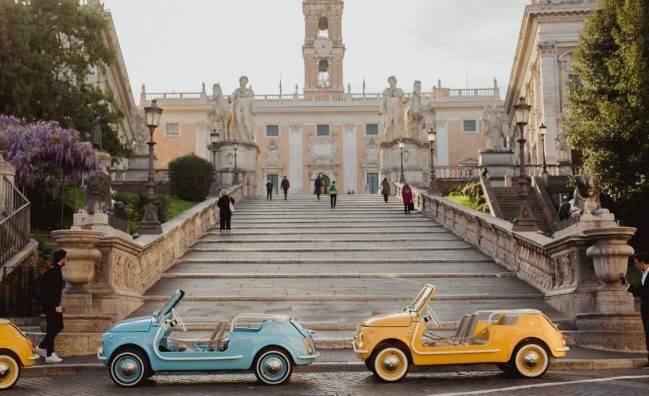 Roman Holiday Tour by Vintage Fiat 5004 hours, private, with Piazza del Campidoglio and the view of the Roman Forum · from €690 for 1–3 peopleBook now
 Shared Golf Cart Tour of Rome2 or 3 hours from Via del Colosseo 11A, with the Colosseum and the Capitoline Hill · from €59 per personBook now
FAQ
Is Piazza del Campidoglio free to visit?
Yes. Piazza del Campidoglio and the Cordonata, Michelangelo’s ramp of low steps that leads up to it, are public spaces and free to visit. You pay only to enter the Capitoline Museums, in the palaces around the square. The viewpoints over the Roman Forum behind Palazzo Senatorio are free too.
What are the Capitoline Museums’ opening hours?
The Capitoline Museums are open every day from 9:30 to 19:30, with last admission at 18:30. On December 24 and 31 they close at 14:00, and they are closed on May 1 and December 25. Check the museum’s notices before you go, as some rooms may be closed.
How much are Capitoline Museums tickets?
Until January 10, 2027, while the Angeli exhibition is on, a full ticket for non-residents costs €16.50 and a reduced one €11. When no exhibition is on, the price is €15 (€9.50 reduced). Booking online costs €1 extra; same-day tickets at the ticket office have no fee.
When are the Capitoline Museums free?
Entry is free for everyone on the first Sunday of each month, subject to capacity: the next ones are December 6, 2026 and January 3, 2027. It is always free for children under 6, for visitors with disabilities and a carer, and for residents of Rome and its Metropolitan City with an ID.
Is the Marcus Aurelius statue on the Capitoline Hill the original?
No. The statue in the square is a bronze copy, set up in the late 1990s. The original, from about 176–180 AD, is inside the Capitoline Museums, in the glass Exedra of Marcus Aurelius, together with the foundations of the Temple of Jupiter.
Where can you see the Roman Forum from the Capitoline Hill?
Walk around Palazzo Senatorio: from the viewpoints along Via del Campidoglio and Via di Monte Tarpeo you look over the Forum, as far as the Colosseum. Inside the museums, the ancient gallery of the Tabularium also opens onto the Forum.


Comment (0)