
The best gelato in Rome usually comes from shops that make it fresh: look for natural colors, seasonal fruit flavors and flat or covered metal tubs, not towering mounds. Order a cup or a cone with two or three flavors. Well-known places to try in the center include Giolitti, Gelateria del Teatro and Fassi.
Cover photo: Joy, CC BY 2.0, via Wikimedia Commons
In Rome there seems to be a gelateria on every corner of the historic center, and they are not all the same. We are a local tour operator, we have shown visitors around Rome since 2012, and gelato comes up on almost every tour. This guide explains what gelato is, how to recognize a good one, which flavors to try, how to order like a Roman and where to find well-known gelaterie in the center, with addresses checked on each shop’s own website. We do not rank them: every Roman has a favorite, so try a few.
What is the difference between gelato and ice cream?
In Italian, gelato simply means ice cream. The word comes from gelare, “to freeze”, and the Treccani dictionary defines it as a sweet food made from eggs, sugar, milk or cream, or from fruit juice and sugar, frozen while it is stirred until it becomes smooth and firm. So in Italy nobody asks “gelato or ice cream?”: there is gelato, and the question is whether it is good.
In English, “gelato” has come to mean Italian-style ice cream. In the United States, “ice cream” also has a legal definition: federal rules (21 CFR 135.110) say it must contain at least 10% milkfat and weigh at least 4.5 pounds per gallon, a minimum weight that limits how much air can be whipped in. Gelato is not one of the frozen desserts those rules define.
You will find many websites that quote exact figures for the fat and air in gelato. We have not found an official Italian figure, so we do not give one: recipes change from shop to shop and from flavor to flavor. Fruit flavors, for example, can be made without any milk, from fruit and sugar. What you can judge in Rome is how the gelato looks and tastes.
How can you spot good gelato in Rome?
Before you choose a gelateria, take ten seconds to look at the counter. These are the signs that Romans and food writers commonly suggest. Take them as rules of thumb, not guarantees.
| What to look at | Good sign | Think twice |
|---|---|---|
| Color | Pistachio a muted green-brown, banana off-white | Neon green, bright yellow, electric blue |
| Fruit flavors | Fruit in season | The same exotic fruit all year round |
| Tubs | Gelato level in steel tubs, or hidden in covered wells | Mounds piled high above the tub |
| Decoration | Little or none | Whole fruit, wafers and sauces on top |
| Flavor list | Shorter, and it changes with the season | Dozens of flavors that never change |
Flavors in season. Fruit gelato should follow the calendar: strawberries in spring, peaches and figs in summer, chestnut in fall, oranges and other citrus in winter. In November, for example, the flavor list of Come il Latte included chestnut and blood orange.
Covered wells. Some of the best-known gelaterie keep their gelato in pozzetti, round metal wells set into the counter and closed with lids, so you cannot see the gelato at all until it is served. Come il Latte, for example, says its closed counter keeps the gelato away from light and air. A covered counter is not a guarantee, and many good shops use open, flat tubs, but it tells you the shop is not selling with looks.
No towering mounds. Gelato piled high above the tub and decorated with fruit and sauces is made to catch your eye from the street. Many Romans trust a flat, plain tub more.
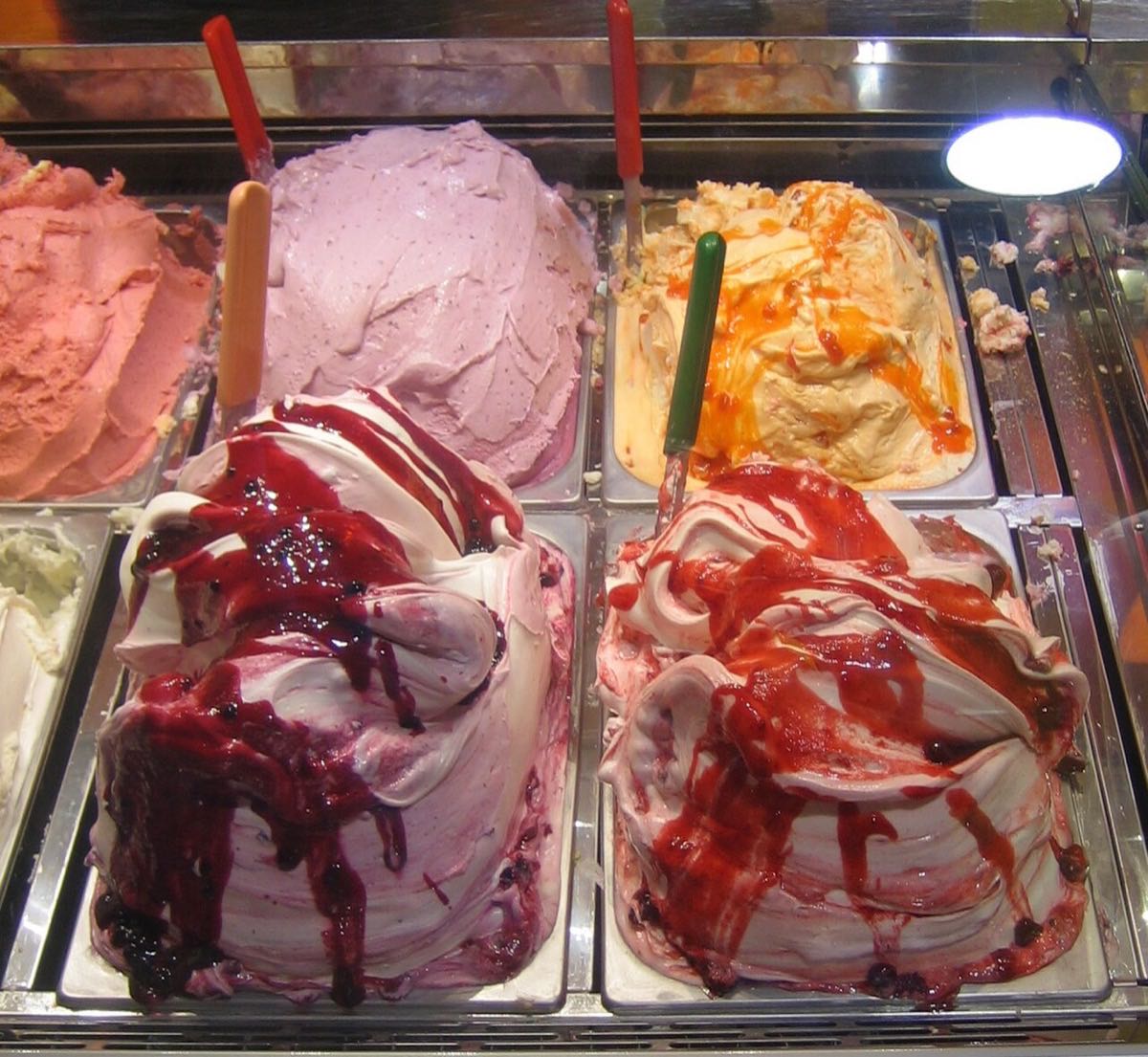
Finally, the words gelato artigianale (artisanal gelato) on a sign are not enough on their own: look at the gelato itself, and if the shop lets you, ask for a taste.
Which gelato flavors should you try in Rome?
Start with the classics: they are the best way to compare one gelateria with another. These are the names you will see on the labels.
| Flavor (Italian) | What it is | Good to know |
|---|---|---|
| Pistacchio | Pistachio | The classic test: it should taste of nuts and look muted green-brown |
| Nocciola | Hazelnut | Many shops name the origin, such as hazelnuts from Piedmont |
| Stracciatella | Milk gelato with shavings of dark chocolate | Not the same as the cheese called stracciatella |
| Fior di latte | Plain milk and cream gelato | The simplest flavor, so it shows the quality of the milk |
| Crema | Egg custard gelato | Pale yellow, because it is made with egg yolks |
| Cioccolato fondente | Dark chocolate | Rich and intense, a good partner for pistachio |
| Zabaione | Egg yolks and sugar, usually with a sweet wine such as Marsala | Ask before ordering it for children |
| Limone, fragola | Lemon, strawberry | Fruit flavors can be dairy-free: ask if you avoid milk |
| Ricotta e visciole | Ricotta with sour cherries | A Roman pairing, borrowed from a classic tart |
Rome also has a few frozen treats of its own:
- Ricotta and sour cherries. The ricotta and sour cherry tart is a classic of Rome’s Jewish Ghetto (bake it at home with our ricotta and sour cherry tart recipe), and some gelaterie turn it into a flavor. Gelateria del Teatro calls its version Vecchia Roma, “Old Rome”: ricotta, sour cherries and a butter crumble.
- The tartufo of Piazza Navona. At Tre Scalini, in Piazza Navona, the tartufo is a dome of dark chocolate gelato made with 13 kinds of Belgian cocoa, with whipped cream, a crisp wafer and a cherry hidden inside. The bar says the recipe has not changed since 1946.
- The sanpietrino. Fassi makes a small square block of semifreddo, a soft frozen dessert, glazed with chocolate and named after Rome’s cobblestones, the sanpietrini. The family credits Fabrizio Fassi with inventing it.
In winter, look for chestnut and citrus flavors next to the classics. For the sweets Romans eat over the holidays, see our guide to Christmas food in Rome.
Can you eat gelato on the Spanish Steps, like in Roman Holiday?
In Roman Holiday (1953), Princess Ann (Audrey Hepburn) is handed a gelato at the foot of the Spanish Steps and eats it halfway up, where Joe (Gregory Peck) catches up with her. It is still one of the most famous gelato scenes in film, and our Roman Holiday post covers the other locations.
Today you can stand where she stood, but you cannot sit there with a gelato: the City of Rome’s Urban Police Regulation bans sitting on the Steps, also while eating or drinking. Enjoy your gelato in Piazza di Spagna, then walk up the Steps for the view. Our guide to the Spanish Steps explains the rules and the fines.
How do you order gelato in Rome?
Ordering is quick once you know the steps:
- Look first. Walk along the counter and read the labels before you join the line.
- Pay at the register, if there is one. In some busy shops you pay first at the cash register (cassa), saying cup or cone and the size, then hand your receipt (scontrino) to the person at the counter. In others you order first and pay at the end. If you are not sure, ask.
- Choose a cup or a cone. Ask for a coppetta (cup) or a cono (cone). Prices usually go by size, not by the number of flavors, and even a small size often takes two flavors.
- Pick two or three flavors. Name them in order, for example pistacchio e nocciola. In many shops you can ask for a small taste first: un assaggio, per favore.
- Decide on panna. Panna is whipped cream, added on top. Ask con panna? and whether it costs extra. At Gelateria del Teatro, for example, the cream is whipped fresh and has no added sugar.
A full order sounds like this: Una coppetta piccola, pistacchio e cioccolato, con panna, per favore (a small cup, pistachio and chocolate, with whipped cream, please).
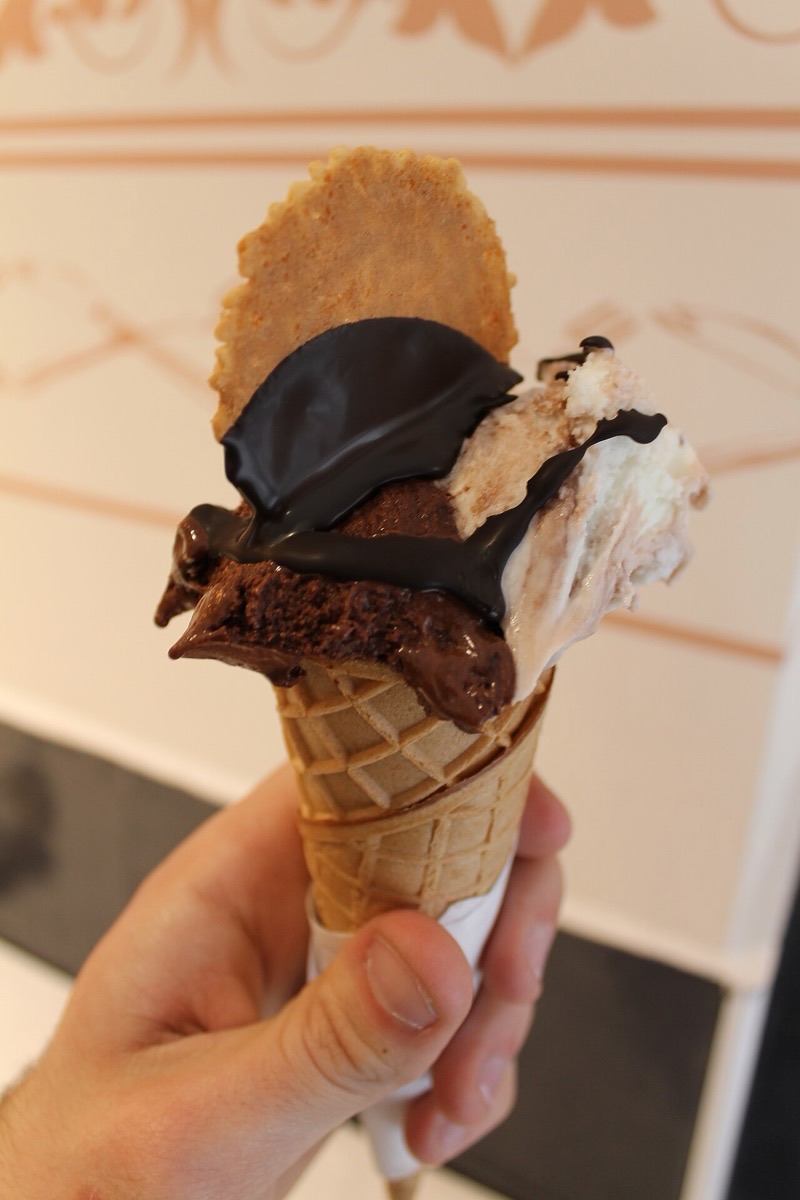
Allergies and gluten. Cones usually contain wheat, and the same spatula can touch many flavors. If you have a food allergy or celiac disease, tell the staff before they serve you. Some shops, such as Gelateria del Teatro, use separate colored spatulas for guests with intolerances. Our guide to Roman food explains how to find places in the network of the Italian Celiac Association.
Where can you find good gelato in central Rome?
These are well-known gelaterie in and near the historic center, listed by area, not ranked. We checked each address on the shop’s own website on November 10, 2026. Opening hours change with the seasons, so check the shop’s website or social media before you make a special trip.
- Giolitti, near the Pantheon. Via degli Uffici del Vicario 40, a few steps from the Pantheon. The Giolitti family opened a dairy in 1890 and has welcomed customers in this street since 1900, according to its website. Open every day of the year from 7:30 to midnight, later in summer.
- Gelateria del Teatro, near Piazza Navona. Via dei Coronari 65/66, with a window on the street where you can watch the gelato being made, and a second shop on the Tiber at Lungotevere dei Vallati 25. It rotates more than 200 recipes through the year. Its website does not list opening hours.
- Tre Scalini, Piazza Navona. Piazza Navona 28. A bar and restaurant rather than a gelateria, it is the home of the chocolate tartufo described above. Open every day from 9:00 to midnight. Read more about the square in our Piazza Navona post.
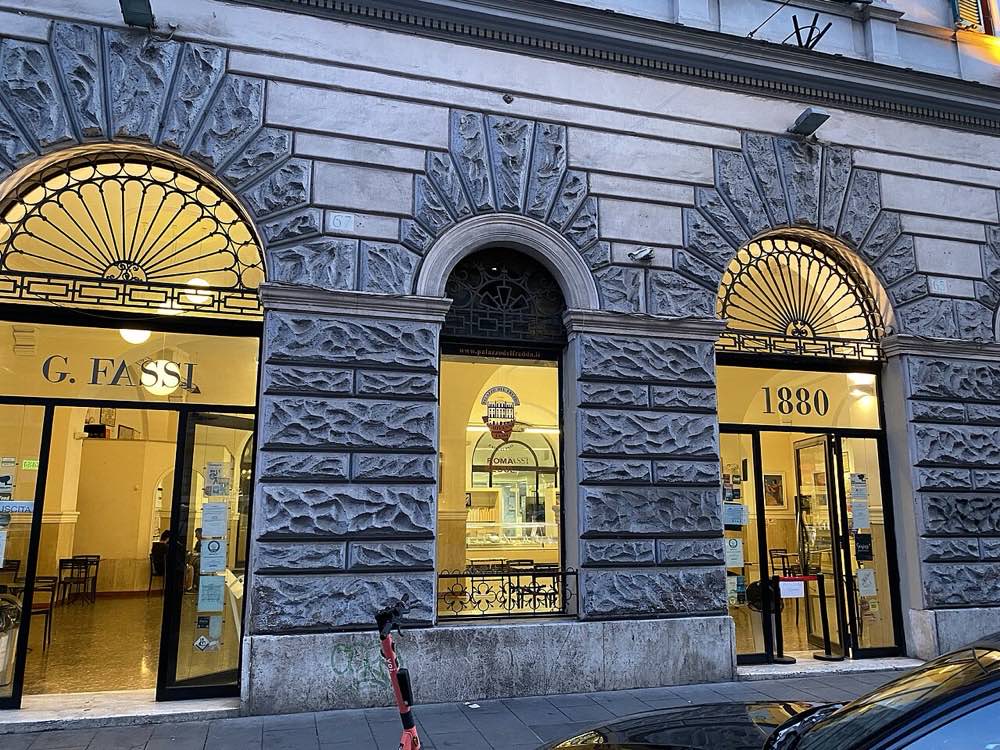
- Palazzo del Freddo Giovanni Fassi, Esquilino. Via Principe Eugenio 65/67, near Piazza Vittorio. The Fassi family business dates back to 1880, and Giovanni Fassi founded this large “palace of cold”, with a laboratory you can see, in 1928. Its website does not list opening hours.
- Come il Latte, Sallustiano. Via Silvio Spaventa 24/26, a short walk from Termini station. It keeps its gelato in a closed counter, makes only what it needs each day and changes its flavors daily. Its website does not list opening hours.
- Gelateria dei Gracchi, Prati. Via dei Gracchi 272, in the district next to the Vatican, open every day from 11:30 to midnight. A second shop at Via di Ripetta 261, near Piazza del Popolo, opens at 12:00 and closes at 20:00 on Monday and Tuesday, at 22:00 from Wednesday to Sunday. It says it uses natural ingredients, without preservatives or colorings.
- Old Bridge, near the Vatican Museums. Viale dei Bastioni di Michelangelo 5, open since 1987, a short walk from the Museums entrance, with a second shop in Trastevere at Via della Scala 70. Check the hours before you go.
- Otaleg, Trastevere. Via di San Cosimato 14a, open every day from 12:00 to midnight. The name is “gelato” spelled backwards, and the shop is known for creative flavors. Our Trastevere guide covers the rest of the neighborhood.
The famous names get long lines on summer evenings. If you see one, the gelateria in your own neighborhood, judged with the signs above, may serve you just as well.
Taste gelato in Rome with us
The easiest way to combine sightseeing and gelato is our private golf cart tour of Rome. Your driver picks you up at your hotel, Airbnb or restaurant in the historic center at 9:30, 10:00, 14:30, 18:00 or 18:30. The 3-hour tour passes the Colosseum, the Circus Maximus, Piazza Navona, the Pantheon, the Trevi Fountain and the Spanish Steps, seen from the outside, and includes the Trevi Fountain ticket and a culinary stop, such as gelato or coffee near the Pantheon.
- Prices: 3 hours €450 for 1–3 people, then €150 per person; 2 hours €350 for 1–3 people (November to mid-April); 5 hours €750 for 1–3 people.
- Driver: drivers are not licensed tour guides, but they know the city well and adapt the route to your requests.
- Weather and groups: golf carts run in the rain, with covers, and take up to 21 guests guaranteed, larger groups on request (on the 2-hour tour, the maximum depends on the start time).
- Children: welcome at any age. Child seats are available on private golf cart tours only.
- Cancellation: full refund up to 72 hours before the tour, 50% up to 48 hours before.
For more food along the way, the private golf cart tour with food tasting includes three tastings: a slice of Roman-style pizza with a glass of wine or water, fresh mozzarella, and a classic Italian gelato. It starts at 14:30 or 18:00 and costs €510 for 1–2 people, then €180 per person. See all our golf cart tours in Rome.
For more Roman food, see our food tours and tastings, or cook your own meal in our pasta making class or pizza making class. Planning the rest of your meals? Our guide to Roman food lists the dishes to try, and on a wet day what to do in Rome when it rains has more indoor ideas, a cooking class included.
Explore it with us
 Golf Cart Tour with Food Tasting3-hour private ride with Roman pizza, mozzarella and gelato · from €510 for 1–2 peopleBook now
 Pizza Making Class3-hour shared class: bake your own pizza, then eat it together · €79 per personBook now
 Private Golf Cart Tour of Rome2, 3 or 5 hours with hotel pickup and a gelato or coffee stop · from €350 for 1–3 peopleBook now
FAQ
What is the difference between gelato and ice cream?
Gelato is simply the Italian word for ice cream: the Treccani dictionary defines it as a sweet made from eggs, sugar, milk or cream, or from fruit juice and sugar, frozen while it is stirred. In the US, ice cream must by law contain at least 10% milkfat, while gelato has no federal definition, and recipes vary from shop to shop.
How can you tell if gelato is good?
Look for natural colors, such as a muted green-brown pistachio, fruit flavors in season, and gelato kept level in steel tubs or in covered wells called pozzetti. Towering mounds decorated with fruit and sauces are designed to catch the eye from the street.
Which are the most famous gelaterie in Rome?
Well-known names in the center include Giolitti near the Pantheon, in its street since 1900, Gelateria del Teatro near Piazza Navona, and the Palazzo del Freddo Giovanni Fassi in the Esquilino district, a family business since 1880. Tre Scalini in Piazza Navona is famous for its chocolate tartufo. We do not rank them: try a few.
How do you order gelato in Rome?
Choose a cup (coppetta) or a cone (cono) and the size, then two or three flavors: prices usually go by size. In some busy shops you pay first at the register and hand your receipt to the person at the counter. Ask for panna if you want whipped cream on top.
Can you eat gelato on the Spanish Steps?
Not sitting down. Since 2019, the City of Rome’s Urban Police Regulation has banned sitting on the Steps, also while eating or drinking, with a €250 fine. Enjoy your gelato in Piazza di Spagna, then walk up the Steps for the view.

Comment (0)