
The Saturnalia was ancient Rome’s festival of Saturn. It began on December 17 and, at its longest, lasted seven days, until December 23. Romans feasted, gambled, swapped candles and small figurines, greeted each other with “Io Saturnalia!” and turned social rules upside down. Its center was the Temple of Saturn, whose columns still stand in the Roman Forum.
Cover photo: Diana Ringo, CC BY-SA 3.0, via Wikimedia Commons
Every December, Rome fills with lights, markets and nativity scenes. Two thousand years ago, the same weeks belonged to another celebration: the Saturnalia, the most popular festival of the Roman year. We are a local tour operator in Rome, and three of our golf cart tours pass the Capitoline Hill, which overlooks the Roman Forum and the temple where the festival opened each year. This guide explains what the Saturnalia was, how Romans celebrated, what ancient writers said about it, how it relates to Christmas, and where you can still stand in front of Saturn’s temple. For the festive season in today’s Rome, read our guides to Christmas in Rome, New Year’s Eve in Rome and Christmas food in Rome.
What was the Saturnalia?
The Saturnalia was a festival in honor of Saturn (Saturnus), an old Roman god of seed and sowing, whom the Romans identified with the Greek god Kronos. Romans believed that Saturn had once ruled over a golden age of plenty, and for a few days each December they played at bringing it back: work stopped, rank mattered less and everyone celebrated.
The festival opened at the Temple of Saturn in the Roman Forum. According to the Colosseum Archaeological Park, which manages the Forum today, the temple had been dedicated on December 17, the first day of the festival. After a sacrifice at the temple came a public banquet. Inside stood an ivory statue of the god whose feet were bound with woolen bands; on the Saturnalia the bands were loosened, a sign of the god’s liberation, according to the University of Chicago’s Encyclopaedia Romana.
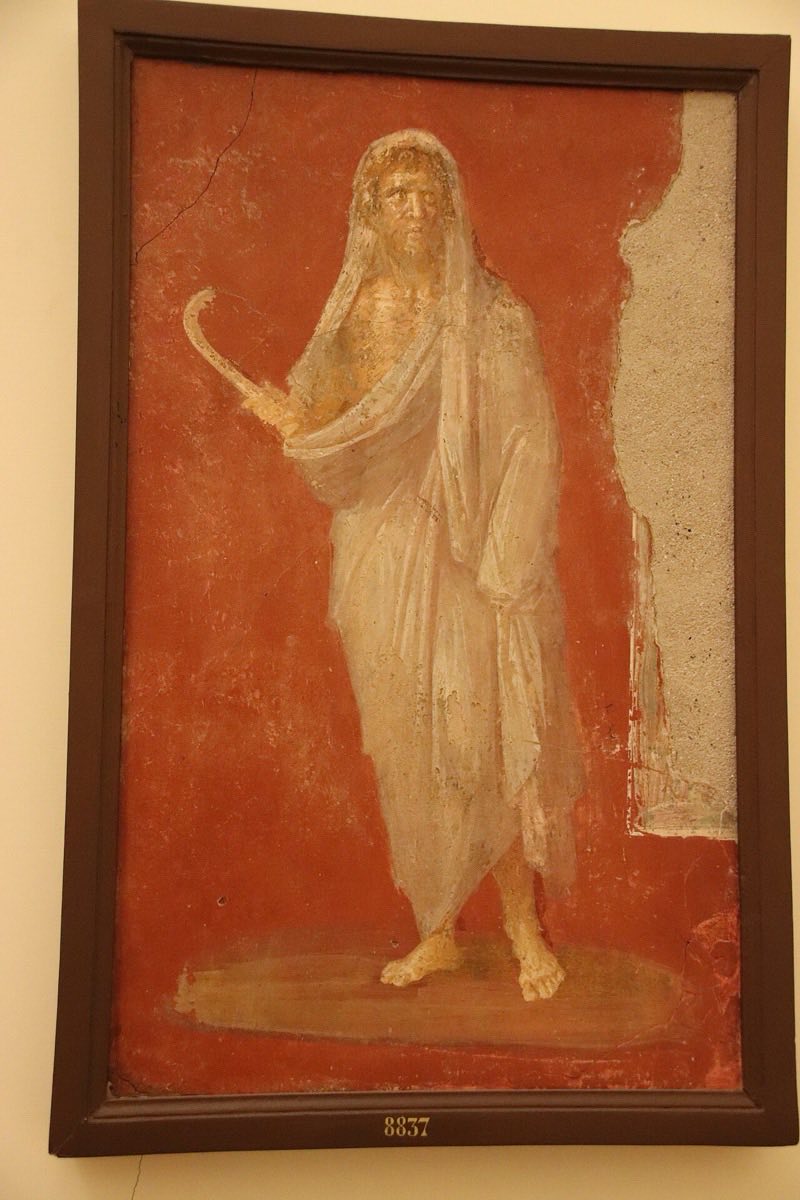
Romans pictured Saturn as a god with a veiled head and a sickle, a tool of the harvest. This fresco comes from the House of the Dioscuri in Pompeii and is now in the National Archaeological Museum of Naples.
When was the Saturnalia celebrated, and for how many days?
The official day was December 17. By the late Republic, in Cicero’s time, the celebrations already ran for seven days, from December 17 to 23. Then the emperors tried to set the length:
- Augustus limited the public holiday to three days, so that the law courts would not stay closed for too long.
- Caligula extended it to five days. Claudius later restored the fifth day after it had been dropped.
- In practice, Romans kept celebrating for the whole week. The last day became the Sigillaria, named after the small figurines sold and given as presents.
The writer Macrobius gave his own explanation of why one day became several: when Julius Caesar’s calendar reform added two days to December, people no longer agreed on the exact day, so some celebrated on one day and some on another. In 2026, the old Saturnalia week runs from Thursday, December 17, to Wednesday, December 23. For the weather and the crowds you can expect in those weeks, see our month-by-month guide to the best time to visit Rome.
How did the Romans celebrate the Saturnalia?
For a few days, Rome was a different city. According to the Getty Museum, businesses, schools and law courts closed, and families and friends gathered to eat and drink together.
- “Io Saturnalia!” This was the traditional greeting of the season, shouted in the streets. The Ashmolean Museum in Oxford compares it to “Merry Christmas”, only louder: Romans used it both to greet and to reply. “Io” was a cry of celebration and surprise, pronounced “ee-yo” or simply “yo”.
- No togas. Instead of the formal toga, Romans wore colorful dinner clothes called synthesis. Many men, whatever their status, wore the pileus, the felt cap of freed slaves, as a sign of the season’s freedom.
- Dice in public. Gambling, normally restricted, was allowed, and the traditional stakes were nuts.
- Masters and slaves. Enslaved people did not have to work and could play dice. Ancient writers say that masters sometimes served them at table; at the very least, the household ate together.
- A mock king. A household could pick a king of the feast, the Saturnalicius princeps (“leader of the Saturnalia”). Anyone in the household could get the role, even a slave, and everyone had to obey, even the head of the family. The historian Tacitus tells how the young Nero, given this role, ordered his stepbrother Britannicus to sing, to humiliate him.
It was a holiday from the rules, not the end of them. When the festival was over, slavery and rank went back to normal, and the Ashmolean’s team calls the equality of those days a fantasy.
What gifts did Romans give at the Saturnalia?
Presents were a big part of the festival. These are the gifts our sources mention most:
- Wax candles (cerei), perhaps a symbol of the light returning after the winter solstice, and oil lamps, which also lit the evening parties.
- Small figurines (sigillaria) of wax, terracotta or wood, bought in bulk from stalls set up for the season and given on the last day.
- Food and drink: wine, nuts and even fattened pigs, according to the Getty; a poem by Martial adds figs, prunes and olives.
- Rich gifts for those who could afford them, such as rings and silver drinking cups.
Choosing presents was already tricky. The poet Martial teased a friend who had passed on to him all the presents he had received for the festival: bulky, but cheap.
What did ancient writers say about the Saturnalia?
Much of what we know comes from Roman and Greek authors. Here is what they wrote, as summarized by the museum and university sources we read:
- Catullus (1st century BC) calls the Saturnalia “the best of days” in one of his poems.
- Seneca (1st century AD), the philosopher, complains in one of his letters that during the festival the whole crowd lets itself go in pleasure.
- Pliny the Younger (around AD 100) writes that he withdrew to his own rooms while the rest of his household celebrated.
- Martial (1st century AD) wrote two whole books of short poems, the Xenia and the Apophoreta, to go with the gifts of the season.
- Statius (1st century AD) describes a Saturnalia given by Emperor Domitian, with food showered on the crowd and bread and wine for everyone.
- Lucian (2nd century AD), writing in Greek, lets the god himself list the rules of his week: no serious business, but drinking, noise, games, dice, mock kings and feasts for slaves.
- Macrobius (early 5th century AD) set his long dialogue Saturnalia during the festival, in the house of the Roman aristocrat Vettius Agorius Praetextatus. His learned guests discuss, among many other things, why the festival lasted more than one day and what the little figurines meant.
How did the Saturnalia change over the centuries?
The festival lasted for more than nine centuries, from the early Republic to the Christian empire:
| When | What happened | Source we read |
|---|---|---|
| Early Republic (traditionally 497 BC) | The Temple of Saturn is dedicated on December 17, the day the festival begins | Colosseum Archaeological Park; World History Encyclopedia |
| 217 BC | After a public banquet, Romans are told to keep the day as a festival forever, according to the historian Livy | Encyclopaedia Romana |
| 1st century BC | In Cicero’s time the celebrations last seven days, December 17 to 23 | Encyclopaedia Romana |
| 45 BC | Julius Caesar’s new calendar adds two days to December; Macrobius links the longer festival to the confusion that followed | Encyclopaedia Romana |
| Reign of Augustus | The public holiday is limited to three days | Encyclopaedia Romana |
| Reign of Caligula | Five days; Claudius later restores the fifth day | Encyclopaedia Romana |
| 2nd century AD | Lucian writes his Saturnalia | Ashmolean Museum |
| AD 354 | The Calendar of 354 still marks December 17 as the Saturnalia, and is the earliest record of December 25 as the birth of Jesus | Encyclopaedia Romana |
| Early 5th century AD | Macrobius writes his Saturnalia | Ashmolean Museum; World History Encyclopedia |
| AD 448 | A Christian calendar lists December 17 only as a “holiday of the slaves” | Encyclopaedia Romana |
Is Christmas based on the Saturnalia?
Historians and museums see links in the customs, not in the date. Both festivals fall in the darkest weeks of the year, close to the winter solstice, and several traditions look alike:
- The Colosseum Archaeological Park writes that the Saturnalia shares several similarities with modern Christmas traditions, such as exchanging small gifts.
- The Getty Museum’s curators write that some Saturnalia traditions, like gift-giving, hanging garlands and lighting candles, were probably absorbed into the celebration of Christmas.
- The Ashmolean Museum notes that holly and ivy were already used in Saturnalia wreaths and garlands, and compares the mock king of the Saturnalia to the “king” of the medieval Feast of Fools.
- The Encyclopaedia Romana points to the Calendar of 354, the earliest record of December 25 as the birth of Jesus, which still lists the Saturnalia on December 17, and writes that by the middle of the 4th century the festival’s celebrations were becoming part of Christmas.
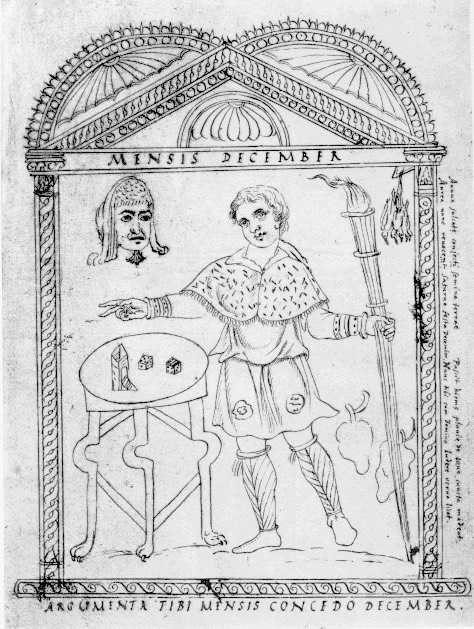
December in the Calendar of 354, in a 17th-century copy now in the Vatican Library. The dice on the table recall the gambling of the Saturnalia, still linked to this month in a Christian manuscript.
What the sources do not say is that Christmas was placed on December 25 because of the Saturnalia: none of the sources we read makes that claim, and the Saturnalia ended on December 23. Treat the resemblance as a shared winter mood, with some customs that probably passed from one festival to the other.
| Saturnalia in ancient Rome | Today’s December holidays | What our sources say |
|---|---|---|
| Gifts: candles, figurines, food | Christmas presents | Gift-giving probably passed into Christmas (Getty) |
| Wreaths and garlands of holly and ivy | Christmas wreaths and greenery | Already used at the Saturnalia (Ashmolean) |
| Candles and lamps for the evening parties | Christmas lights and candles | Probably absorbed into Christmas (Getty) |
| The mock king of the feast | The “king” of the medieval Feast of Fools | Compared by the Ashmolean |
| “Io Saturnalia!” | “Merry Christmas!” | Same use as a greeting (Ashmolean) |
Even a Roman Christmas cake has an ancient story: tradition links pangiallo to the winter solstice in ancient Rome, as our guide to Christmas food in Rome explains.
Where can you see the Saturnalia in Rome today?
At the Temple of Saturn, in the Roman Forum. According to the Colosseum Archaeological Park, it is one of the most ancient places of worship in the Forum: it was consecrated in the early years of the Republic and stands with its columns on the slopes of the Capitoline Hill, at the edge of the Forum.
- What you see: eight columns are still standing, under a stretch of the entablature. The inscription on the front reads Senatus Populusque Romanus incendio consumptum restituit: the Senate and People of Rome restored the temple after a fire. The Park dates this restoration to the imperial age.
- The treasury: the temple was the first seat of the aerarium, the state treasury of Rome, and the original place where public documents and laws were published, according to the Park’s Forum itinerary.
To walk up to the columns, you need a ticket for the Roman Forum, part of the Colosseum Archaeological Park:
- Tickets: every ticket of the Park includes the Roman Forum and the Palatine, and the Forum Pass SUPER covers them without the Colosseum. Tickets are in the visitor’s name, so carry an ID. Our Colosseum tickets guide explains the options and prices.
- Winter hours: from October 25, 2026 to February 28, 2027, the Roman Forum and the Palatine open at 9:00 and close at 16:30, with last admission at 15:30, according to the Park’s official page.
- Closed on December 25, 2026, and January 1, 2027. Entry is free on the first Sunday of the month, so on December 6, 2026.
You can also see the temple without a ticket, from above. The Park’s own photo of the temple was taken from the slopes of the Capitoline Hill, and the terraces behind the City Hall on the Capitoline look down on this end of the Forum.
Can you see the Temple of Saturn on a golf cart tour?
Not from inside the Forum: our golf carts stay on the streets, and the sights are seen from the outside. Three of our tours pass the Forum area, and this is what their booking pages say:
- Private golf cart tour: only your group, with pickup at your hotel or Airbnb in the historic center at 9:30, 10:00, 14:30, 18:00 or 18:30. The 3-hour route includes the Capitoline Hill, with views over the Roman Forum, whose Capitoline end is where the Temple of Saturn stands, plus the Colosseum, the Circus Maximus, the Pantheon and the Trevi Fountain. The Trevi Fountain ticket and a culinary stop, such as gelato or coffee, are included. The route adapts to your interests, so tell the driver if the Temple of Saturn matters to you. There is also a 2-hour version with fewer stops: €350 for 1–3 people (2 hours, November to mid-April).
- Semi-private golf cart tour: 3 hours on a fixed route, with no more than 6 guests in the cart and pickup at your hotel in the historic center between 9:30 and 10:00 or between 14:30 and 15:00. The route includes Piazza Venezia and the Roman Forum, Trajan’s Markets and the Capitoline Hill. €120 per person, up to 5 per booking.
- Shared golf cart tour: a fixed route from our office at Via del Colosseo 11A, at 9:30 or 14:30, in carts of up to 7 people shared with other travelers. The 2-hour tour passes the Capitoline Hill and ends at the Trevi Fountain (€59 per person); the 3-hour tour adds Trajan’s Markets and the Forum of Augustus, among other stops, and ends back at Via del Colosseo (€99).
All three routes also pass the Circus Maximus, the valley of Rome’s chariot races: read our guide to the Circus Maximus. If you plan to ride during the old Saturnalia week, December 17 to 23, or over Christmas and New Year, check the available dates when you book.
Good to know on these tours:
- Drivers: our drivers are not licensed tour guides, but they gladly help with your requests whenever possible.
- Groups: the private tour takes up to 21 guests guaranteed (on the 2-hour tour, the maximum depends on the start time), with larger groups on request. The shared tour takes up to 21 per booking.
- Children: golf carts take children of any age, and child seats are available on private golf cart tours only. A folded stroller fits on board; just tell us when you book.
- Wheelchairs: on the private golf cart tour, wheelchair users move onto a seat of the golf cart, and the folded wheelchair travels on board in place of the two back seats. Contact us before booking if the traveler cannot move from the wheelchair to a seat. The semi-private and shared tours are not suitable for wheelchair users.
- Weather: the golf carts have rain covers and run in the rain.
- Cancellation: full refund if you cancel at least 72 hours before the tour, 50% if you cancel at least 48 hours before; later cancellations and no-shows are not refunded.
If the temple itself is your goal, a Forum ticket is the better choice: only inside the Forum can you walk up to its columns. Our tours suit you if you want to see the Forum area together with the Colosseum, the Circus Maximus, the Pantheon and the Trevi Fountain in a few hours, without long walks. To compare the options, read our guide to the best tours in Rome for first-time visitors, and to fit the Forum into your stay, see our Rome itinerary. See all our golf cart tours in Rome.
In December, the Forum area is also on our evening tours, when the monuments are lit up. On Rome by night in a vintage Fiat 500, the typical route passes Piazza Venezia, the Roman Forum and the Capitoline Hill, seen from the outside, with starts at 20:00, 21:00, 22:00 or 23:00. On the private golf cart tour by night, at 20:00, 21:00 or 22:00, you choose the stops, such as the Colosseum and the Circus Maximus.
Explore it with us
 Private Golf Cart Tour of Rome2, 3 or 5 hours with pickup in the center; the 3-hour route includes the Capitoline Hill above the Forum · from €350 for 1–3 peopleBook now
 Semi-Private Golf Cart Tour3 hours with no more than 6 guests and hotel pickup, past the Roman Forum · €120 per personBook now
 Shared Golf Cart Tour of Rome2 or 3 hours from Via del Colosseo 11A, on a fixed route with the Capitoline Hill · €59 per personBook now
FAQ
When was the Saturnalia celebrated?
It began on December 17, the day the Temple of Saturn in the Roman Forum had been dedicated. By the late Republic it lasted seven days, until December 23. Augustus cut the official holiday to three days and Caligula raised it to five, but most Romans celebrated for the whole week.
What does “Io Saturnalia” mean?
It was the traditional greeting of the festival, shouted in the streets and used both to greet and to reply, much like “Merry Christmas” today, only louder. “Io” was a cry of celebration and surprise, pronounced “ee-yo” or simply “yo”.
Is Christmas based on the Saturnalia?
Not in its date: the Saturnalia ended on December 23, and none of the sources we read says that Christmas was placed on December 25 because of it. Museums such as the Getty and the Ashmolean do see links in the customs, such as gifts, candles and greenery, which probably passed into Christmas.
What gifts did Romans give at the Saturnalia?
Wax candles, oil lamps and small figurines of wax, terracotta or wood were the classic gifts, together with food and drink such as nuts, figs and wine. Wealthy Romans also gave rings and silver cups. The figurines gave their name to the Sigillaria, the last day of the festival.
Who was the king of the Saturnalia?
A household could choose a mock king, the Saturnalicius princeps or “leader of the Saturnalia”. Anyone in the household could get the role, even a slave, and everyone had to obey, even the head of the family. According to the historian Tacitus, the young Nero once had the role and used it to make his stepbrother Britannicus sing.
Where is the Temple of Saturn, and can you visit it?
It stands in the Roman Forum, at the foot of the Capitoline Hill, and you need a ticket of the Colosseum Archaeological Park to walk up to it. Until February 28, 2027, the Forum is open from 9:00 to 16:30, with last admission at 15:30, and it is closed on December 25 and January 1. You can also see the temple from above, from the Capitoline Hill.


Comment (0)